
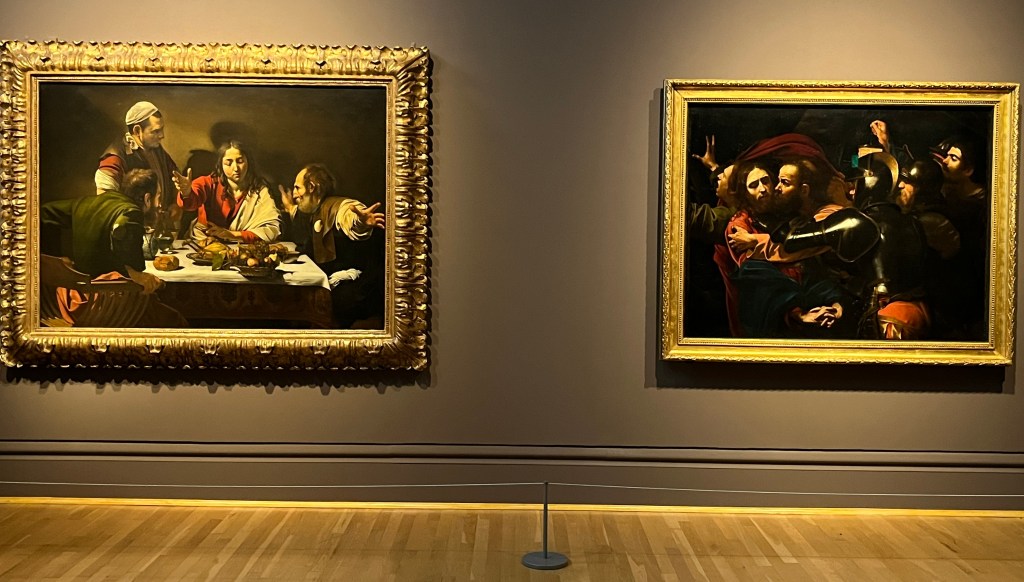
I was there this morning to see these. The two Caravaggios, We were first viewers to arrive at 10am, and for about five glorious minutes had the room to ourselves.
The attendant filled us in on the details that brought these two paintings together into the same physical space almost for the first time since they were painted in 1601 (for The Supper at Emmaus) and 1602 (for The Taking of Christ). I’ve seen both of them before in the National Galleries of Dublin & London, and of course I spent a huge amount of time studying The Taking of Christ when I wrote my poem inspired by that painting; but there was something magical about seeing the two together in the natural light with just a single line of lamps at ceiling level to softly highlight them. Over four hundred years and they still look so fresh and raw and muscular.
With the western cultural reflex of reading left to right, initially I wondered about the placing of the paintings from L-R in non-chronological order in terms of the Biblical scenes they represent. Of course, the resurrected Christ in Emmaus has been restored to the visage of a very young man. Nevertheless, in narrative terms, Christ’s seizing in Gethsemane precedes that of his resurrection. Perhaps it because we entered the room on the right? So one’s gaze would, arguably, first meet Taking. And then the gaze would follow on across the unseen crucifixion to the relief of recognising the risen Christ. The order couldn’t be that of chronology of their creation, because that’s reversed with respect to the Biblical scenes they represent. Furthermore, Caravaggio’s use of chiaroscuro is, to me, even more developed in Taking compared with his admittedly superb use of it in Emmaus.
The beauty of seeing these painting now however, compared with when I first saw each of them is that today I have an iPhone. And you’re allowed to take photos. As I kept taking various parts of each painting, my eye was drawn more and more to the characters. Obviously Caravaggio used the models that were available to him at the time, including, famously, himself as the young man lifting the lamp at the rear of the mob in Taking. I stared at the captain of the guard with the crest on his helmet in Taking. Was he Cleopas of the outspread arms in Emmaus? And is the guy serving the table in Emmaus an older version of Caravaggio? They aren’t exactly alike, but an artist who can portray a 15-year (at least) age difference in his main character (Jesus) could surely do it for himself: a receding hairline; the gaunter face. And there’s the bemused nonplussedness of this servant in Emmaus, his hands thumbed into his belt. He doesn’t have a clue, or is certainly not overly impressed, at the astonishing moment that Caravaggio has just captured: the recognition of Christ by Luke and Cleopas in the breaking of the bread.
What I love about Caravaggio’s take on that moment is the millisecond of a difference in that recognition by the two pilgrims (I also love the shell representing the Camino de Santiago; and the continuity from Jesus’ own day through Caravaggio’s right to the present, that that little symbol gathers to itself). Jesus’ right hand is raised suggesting the conventional blessing. However, it can also be interpreted as having just lifted from the piece of bread broken for Luke on Christ’s right, because Luke’s astonishment seems to be slightly behind that of Cleopas’ – Luke has had only time to grip the arms of his chair in reaction. Cleopas, however, having had the bread broken first for him, has had a millisecond longer to fling both his arms wide, thus embracing the whole of the moment. Yet again, using this gesture of Christ’s, what Caravaggio has done is embody the sacred in the ordinary and the quotidian. Literally in time. I found myself close to tears at the sight of it.
Because I was paying such close attention to the hands (oh, I could say more about Jesus’ tightly gripped and braced hands in Taking versus his relaxed and open hands moving gracefully through the air in Emmaus), I then noticed the trompe d’oeil of John’s stretched arms in the Taking and of Cleopas’ in Emmaus. I’ve always thought the portrayal of John’s terror magnificent, if a little ungainly – his left arm disappears out of the frame into the darkness, the flounce of his cloak forms a canopy for the treachery of Judas’ kiss as the pallid fists of the second soldier grip on the tail end of it – but it’s that upraised right arm with its splayed fingers that make a megaphone for John’s scream that has always gripped me. But now I wonder, is this the reason for the L-R order of the display? Is John’s left arm reaching not into but through the darkness where it has the possibility of gripping Cleopas’? The splayed hands of each of them seem to suggest the possibility. Those fingers look as if they could lock, not defensively and protectively as Jesus’s do in Taking, but to hold each other steady for the horror of the interval between. Or more precisely, for Cleopas’ to reach back for John’s to hold him steady.
Did the curator display these two works of art like this so that that Cleopas can reach back to help John across the chasm of death and darkness into the light of the resurrection?
Given that Caravaggio painted these two works for the same family in a relatively short space of time, could that have been, consciously or unconsciously, his own intention?
Whatever the reason for the order of the display, the fact that paintings from another age can speak so viscerally, both individually and together, is surely a sign of Caravaggio’s continued hold on the imagination. What an artist. These two works, and the possibilities of the conversation between them, are not to be missed. I will be back for more.

 mary-montague.com