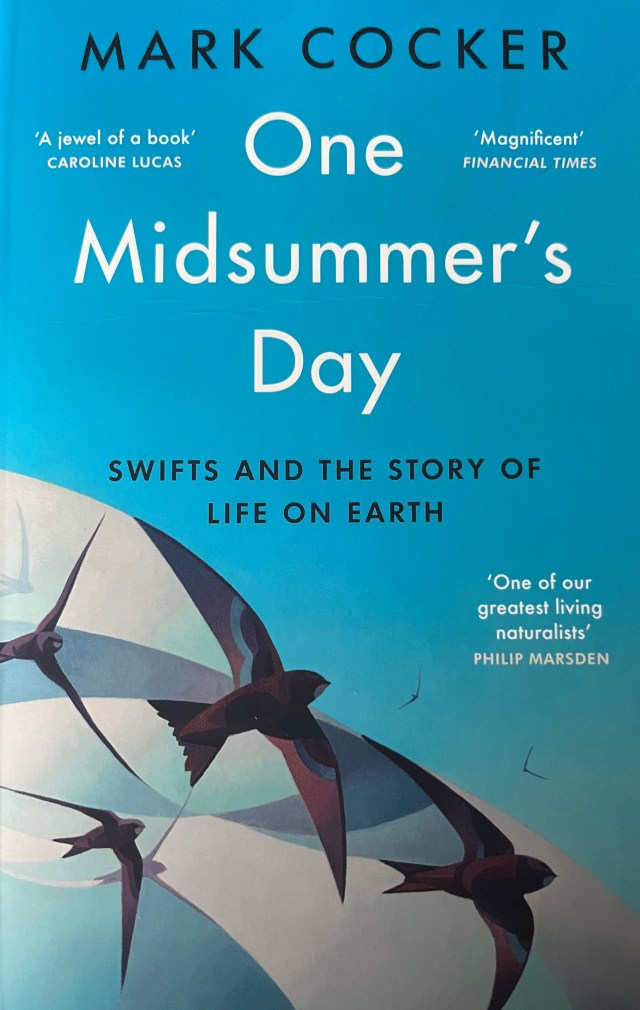
We are living through the Sixth Mass Extinction on our planetary home, and while those of us alive today won’t live to see the end of it, our so-called civilisation really needs to take a hard look at itself. This morning, ironically given that I’m in conversation with Mark Cocker re his 2023 book One Midsummer’s Day, on June 7th (see below), which while not “about” swifts, as Mark himself is keen to emphasise, uses the swift as chart and compass to take us through the wondrous story of life’s evolution and our own interconnectedness with all of nature.
Unfortunately as we live through the end of capitalism (infinite growth is simply not possible on a finite planet! – I wish the so-called pragmatism and realism that passes for decontextualised economics would actually get real) and the demise of the delusions of the Age of Enlightenment, that message has still to reach those in power. Or maybe they are just so full of cynicism and resentment that they just can’t take it in. Maybe it’s too hard. Maybe they are too greedy. But when I read in today’s Guardian about the wanton destruction of a swift colony during the breeding season, when the birds had already travelled 8000 miles to come “home”, and committed to building their nests and laying their eggs – of course it’s illegal to do so, but I’m sure any fine is derisory – I found myself, yet again, crying. It is just so ridiculous that as ecosystems collapse on a planetary scale and global temperatures soar, that this kind of cruelty and destructiveness can take place.
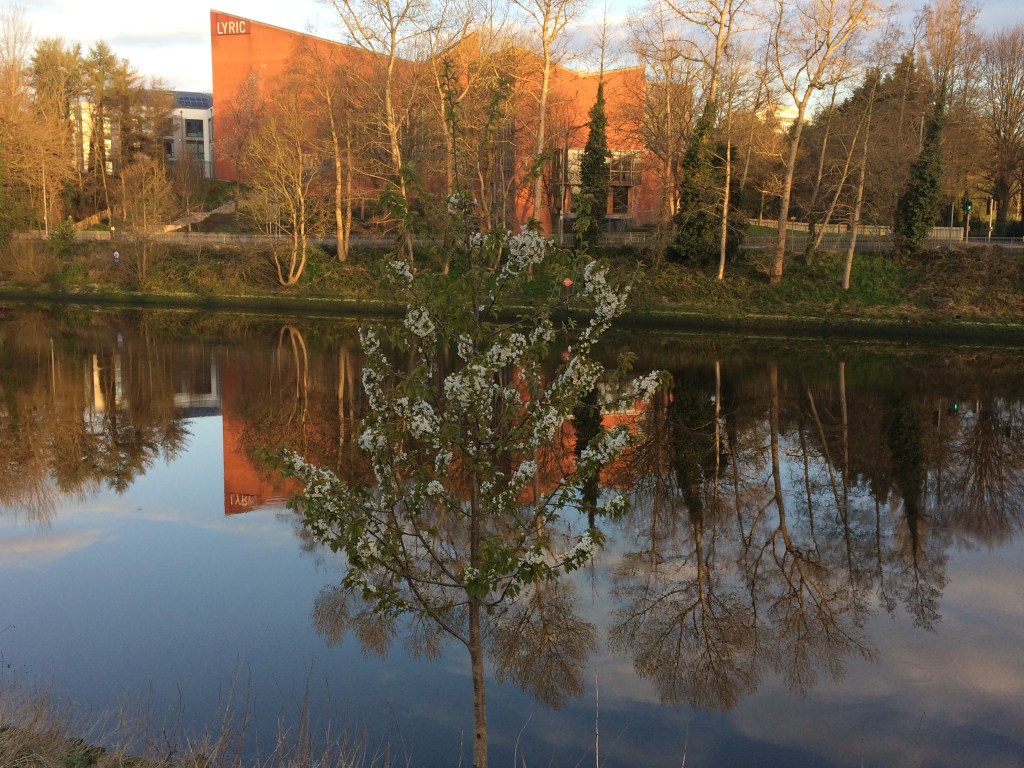
It reminded me of some years back, when local swift expert Peter Cush of NI Swift Group told me of his story about trying to get the Lyric Theatre to incorporate swift bricks into the new building. I live quite close to the Lyric and its cliff of a building would be the perfect facade for swifts to nest in. Alas whoever was then in charge dismissed the idea. The swifts would be “dirty”.
The Lyric Cliffs: an opportunity lost for swifts
Swift bricks are now a legal obligation in new builds in Scotland. Would that they were here.
Anyway, I’m taking to opportunity to plug this Sunday’s conversation with Mark when we will in the Crescent Arts Centre, which, unlike the Lyric, has a far more enlightened attitude to its native swifts. We will converse as these emissaries of the early Palaeocene dart across the sky above us. Please join us. We need to make our conversation as large as possible on this upcoming midsummer day.
Well it won’t be quite midsummer, but near enough. I have the honour of conversing with the brilliant Mark Cocker as part of the Belfast Book Festival on 7th June. Mark is over to talk about his latest book on swifts, and of course, where the Crescent Arts Centre is not only home to the Belfast Book Festival, it’s also home to a large swift colony.
Mark’s latest book – perfect for June in the Crescent Arts Centre
I am really looking forward to this event and having the chance to converse with Mark at length. He is one of Britain’s greatest-ever nature writers, and the erudition and poetry of his writing pervades every sentence of his work. I also have the great honour of being his colleague as a fellow contributor to The Guardian’s Country Diary (famously, the oldest newspaper column in the world).
If you haven’t already booked your ticket, get cracking. And if you want to read a bit more about Mark check this wonderful article by Irish News contributor and author, Ruby Free.
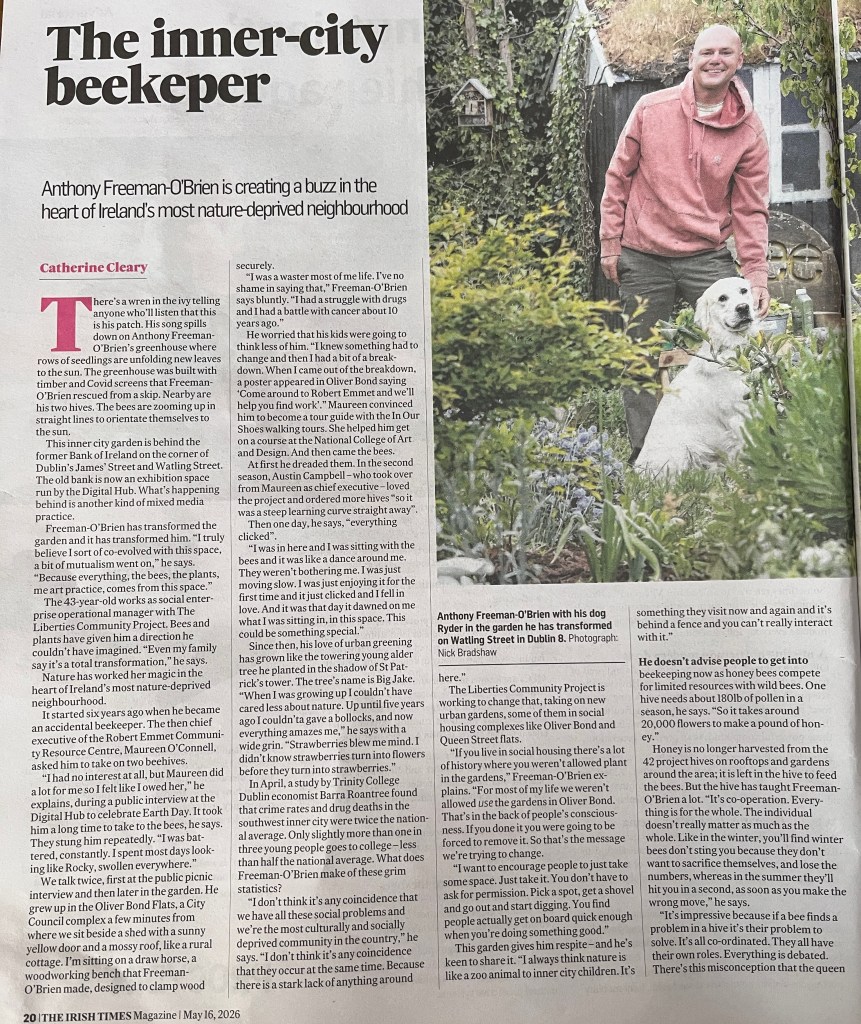
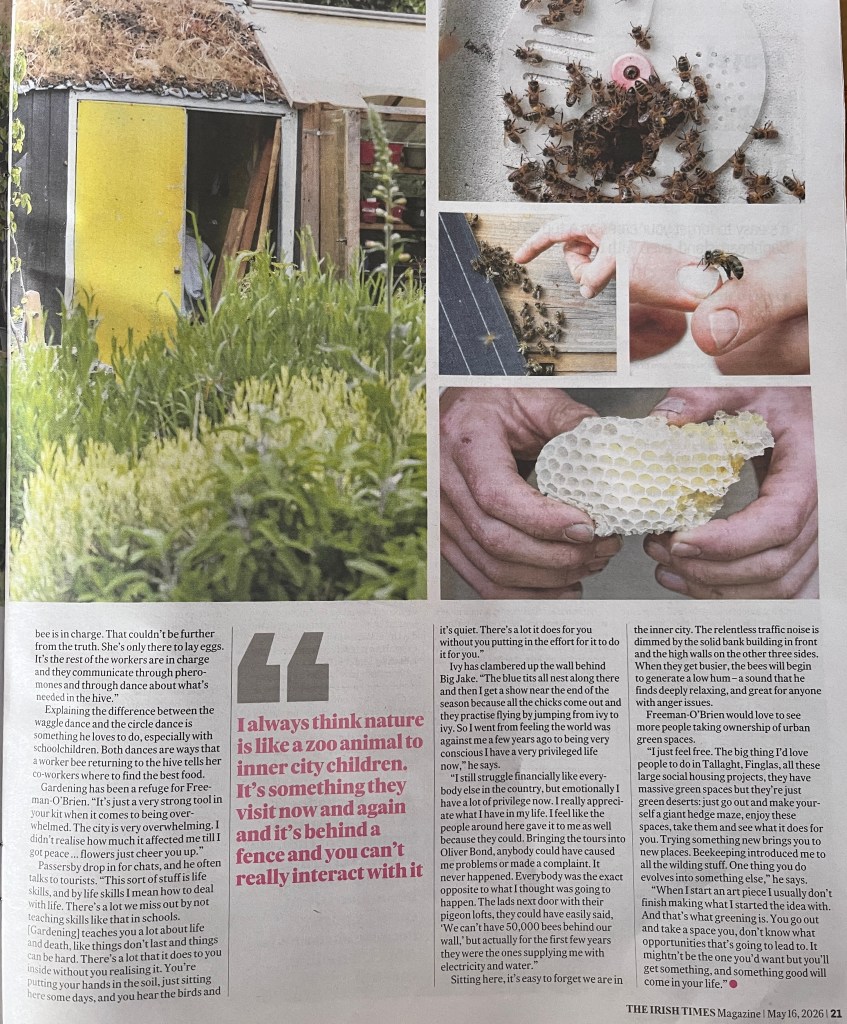
I only got to this wonderful article by Catherine Cleary in Saturday’s Irish Times this morning. It was such a joy to read:
It reminded me of how nature makes city living so much richer for everyone. It also took me back to my April Country Diary about the Botanic Meadow in Lower Botanic Gardens. This wildflower meadow, research garden, and community garden is currently under threat of being turned into an all-weather sports pitch, thanks to a “restricted business” decision by Belfast City Council (BCC) made without any consultation with local people. As my short piece and the above article make clear, the restorative power of nature is especially significant for city dwellers, which makes the peremptoriness and short-sightedness of BCC all the more galling.
A delightful outcome of my own piece was that I was contacted from Canada by a man who was born in 1956 on the Botanic Meadow, when it then was home to families living in the Botanic Bungalows. It was also joy to hear from Bill, and to get confirmation that our meadow does indeed “grow people” past and present. I can only hope that the momentum towards preserving our meadow will grow as well.
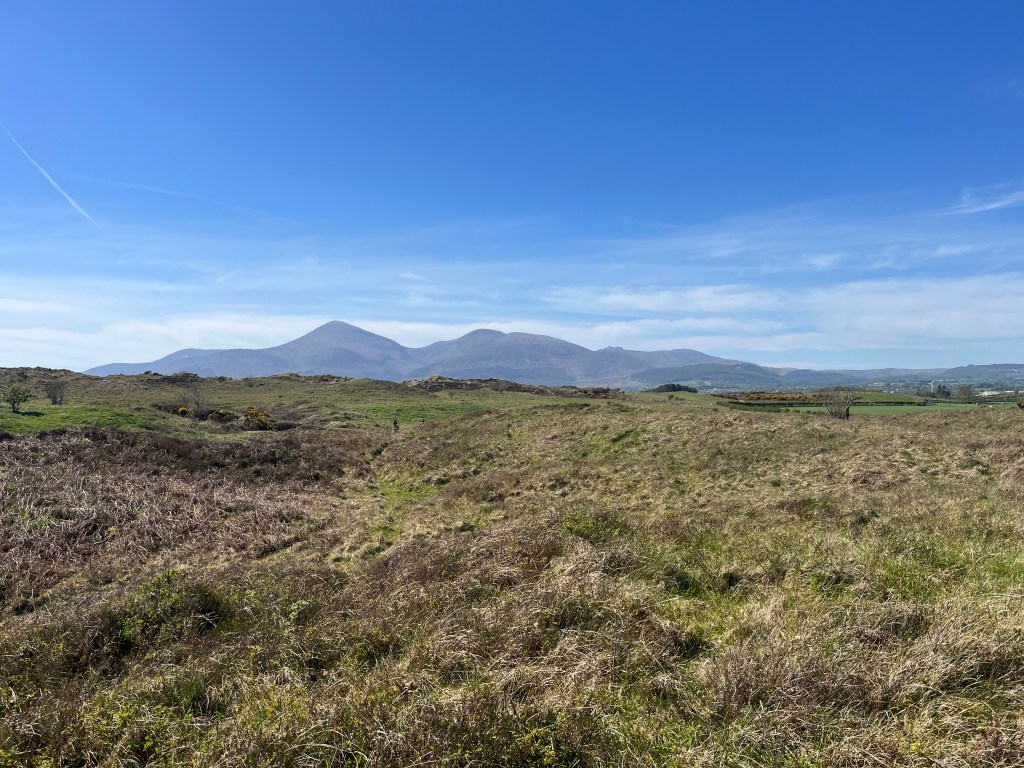
I was fortunate to have several encounters with the common cuckoo, at Murlough’s nature reserve recently. It’s a place that holds a lot of resonance for me having spent a summer working there in 1987 as a temporary warden. That summer was an important hiatus at an uncertain period of my life. I had been bitterly disappointed by getting a 2ii in my degree (many years later I found out that I missed the doors-opening 2i by a single mark); and I felt entirely disorientated in terms of what the future held for me. My late mother, god bless her, having spent much of my childhood trying to distract me away from my love of the natural world, responded to my “failure”, with the then-devastating remark that “animals ruined Mary”. It seemed the larger world agreed with her, and all I wanted to do was flee my original passion. Murlough didn’t let me. I don’t remember much about that summer except walking the dunes, and watching the badger sett. But it was enough to keep me at least tentatively in touch with my deepest self.
Murlough and the Mournes
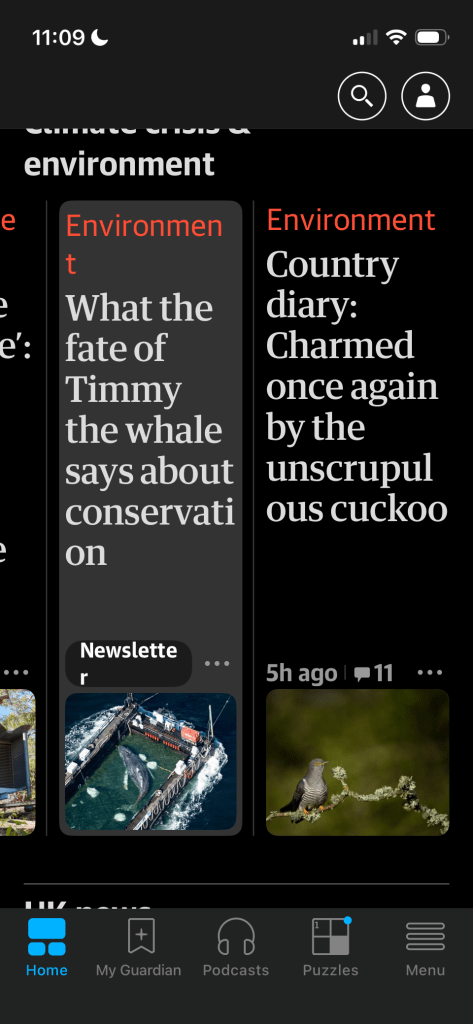
In those long-ago days, I could never have imagined that I would end up with a PhD in ornithology; nor that I would become a contributor to The Guardian’s Country Diary. But my latest contribution on the cuckoo made the Guardian!s Home Page – a first for me!
Success! – on the Homepage!
Also, and as ever vital, was the guidance of editor Paul Fleckney, who reads the room of the Guardian’s readership far better than I do. When my original draft rather too gleefully celebrated the cuckoo’s brood parasitism, Paul gently but firmly guided me to a more acceptable way of putting it. Indeed, as many of the comments show, there’s a lot of people still uncomfortable with that evolved strategy – although the cuckoo can no more help how natural selection has shaped its reproductive strategy than can any other species. And that this has led to a process of such chance and complexity is still a wonder to me. Besides, the cuckoo is a beautiful bird, with an utterly captivating voice; and it was wonderful not only to hear it, but also to get some great sightings – many more than I could fit into the column. One that will live in my mind is the sight of that self-same cuckoo taking off and flying over the high dunes, still calling, with a retinue of suspicious passerines, mainly meadow pipits, in tow.
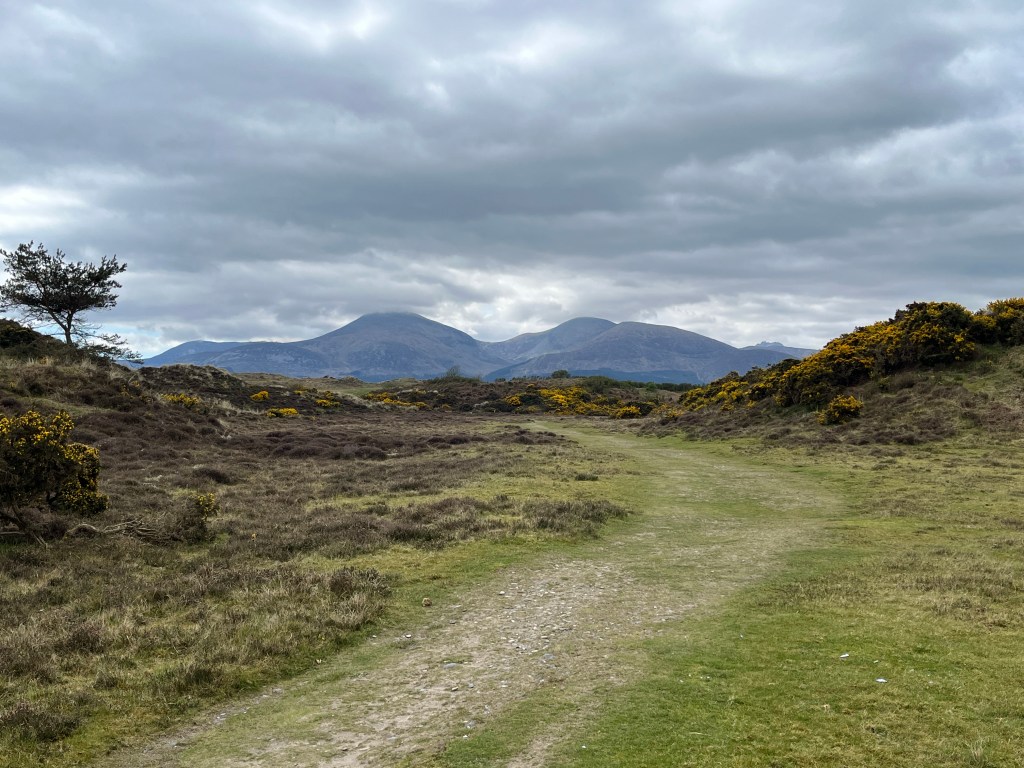
Path through Murlough’s dune heathland
Anyway, as I was drafting the piece I couldn’t help but think of Stephen Colton, who on the 6th of May last year sent me a short recording of a cuckoo calling near Drumquin in Co Tyrone. It was his last message to me. Stephen was the nature contributor to The Irish News, and I had read him for years before I got to know him personally for an all-too brief period of time. Had I known in those long-ago days when I was wandering the Murlough dune heathland – still reeling from what I perceived to be the end of all my dreams – that he was my cousin’s cousin, that we were, essentially, related, I wonder what a difference that might have made to me? He was 10 years older than me, but he was a connection that might have helped me know that I wasn’t the only person in my wider family who was interested in birds. Alas, it was only in the last year of his life that I found out about that; and got to know him, all too briefly. It’s funny to grieve someone you scarcely knew, but I do grieve Stephen hard. I feel the loss of what never was; what never had the chance to be. I feel the loss that I will never walk with him to see hen harriers as he promised me. And all the knowledge, particularly of the Irish language and birds that is now gone with him.
Image of the location of Stephen’s cuckoo
But there is something apt that moves in the universe all the same. When Paul commissioned the piece on the cuckoo, of course I thought of Stephen. I remembered his cuckoo calling. I remembered his kindness and his generosity, and I hope that somewhere he might have been with me, as I watched and listened to the Murlough cuckoo.
My Country Diary on the cuckoo was published yesterday, the day after Stephen’s first anniversary on the 14th May. It is dedicated to him.
The 1926 Census returns of the Irish Free State were released on line as of yesterday. The first census after independence. What a treasure trove they are.
Born on the 18th February, my late mother only just made it onto the record, but here she is at 0 years and exactly 2 months old.
On the household record, my grandparents’ ages are recorded: 28 for him, and 23 for her. I had never thought of my grandmother being so young. And this was not even her first child. Little Catherine, who preceded my mother, had already been born and died, hence my mother’s birth in a nursing home in Waterford rather than in her own home in Carrick Beg, Co Tipperary.
And finally, my grandfather’s signature, as head of the household, on the original form. And I just love the underlining (on the form’s heading) of the word “carefully”.
Honestly, I could cry looking at these (in fact I have …)
Well, that set me off. I knew my grandfather, Kieran Bennett came from the townland of Cuddagh in Co Laois, and I knew he had an elder brother, Michael, who had inherited the farm, so off I went to find that family. And here is Michael’s record that links to that whole family. And there is my great-grandfather (William) who passed his name to my mother’s brother Liam. And there is my great-grandmother Kate, who must have been Catherine, hence my mother’s elder sister’s name. And Kate’s daughter, also Kate. But my other great-aunt, Maggie Bennett, I don’t think I ever heard of her. Three adult children living at home. I know that Michael never married, but what became of those young women? I have no idea.
As always, the women are more difficult. I know from my mother that her parents met while my grandmother, Mary Lawlor, was working in the post-office in Borris, Co Carlow. But I assumed that meant she was from Borris. Apparently not. I think this is her, in the 1911 census when she was 9 years of age living in Raheendoran in Co Carlow. Her age is a little out; she was 23 on the 18th April 1926; and here she is at 9 years of age on the 2 April 1911. So she was born in either 1902 or 1903. But no other record of a Mary Lawlor comes close to her in age, and when the head of the household is a 35-year old quarry labourer, with six children ranging in age from ten to one, I guess it’s easy enough to forget the precise age of your eldest daughter. That was my great-grandfather, James Lawlor. Again, I never heard of him. (But I guess the underlining of “carefully” in 1926 was borne of hard experience). But what confirms that this is the right record is the name of the youngest child: Anastatia (don’t you just love the spelling?). My mother mentioned an aunt Anastasia, and it’s such an unusual name, it thankfully lodged in my memory. This has to be the right family.
Anyway, that’s about all I can spare the energy for. There’s a lot to contemplate in the 15 years between 1911 and 1926, and how the lives of my grandparents were impacted. And how I wish I could trace the same details for my father’s people, but alas, in the North the records were lost or burned or dropped or some such. So in this format, I have only my mother’s people. But what a joy to find them.
Over the past few months, my Country Diaries have either been written out of experiences that came to me under my own steam, as it were; or, if others were part the process, they got a mention in the diary itself. Hence, my February Country Diary was written through connecting Belfast Hills Partnership, and especially with Geoff and Patricia.
March’s Diary had a long gestation. On the 11th March 2024, I saw a heron near Micky Taylor’s Lock on the Lagan towpath. It was standing in a marshy pool, and it prompted to write the following:
“There’s a scattering of mallards, and a single moorhen attracts my gaze with its jerky head. That reflex movement is suddenly writ large a little further into the tangle of trees. I lift my binoculars for a closer look and meet a yellow glare. For breath the heron’s eye stares fixedly back at me. Then it clearly decides I am harmless and continues about its business.
Herons are common enough along this stretch of water, but this individual looks ridiculous as it struggles through the reedy understory, while looking up into the gnarly branches of the small trees. All the sinuous lengths of its extremities – legs, neck, bill – seem ill-matched for its purpose. It sways and hunches and bends as it probes through the reeds, and then, hunkering back on its hocks to make a steadier platform of its body it pokes the spear of its bill up into the branches. It seizes a narrow branch and pulls at it. Then it suddenly flaps up, struggling into the lower branches, twisting its neck as it gains a perch. Pokes and seizes again. A thin flex of branch bends under the heron’s torc. Then the bird gives up and crashes back down into the reeds.
I take a breath and focus on its beauty. The gorgeous layered scalloping of its dorsal feathers. The long outer plumes of its throat and the delicate pattern of the black markings that draw attention to the sinuous neck. The bird embodies such awkward grace, that is somehow enhanced in this cluttered enclosure. For the heron has just got busier. It is trampling around the reeds, lifting up the stems, flipping them and dragging them, at times seemingly stepping on them deliberately as it to test them. None of them apparently meet its requirements. Now, as it brandishes a small twisted branch with an air of triumph, the bird’s mission is confirmed by a ghostly figure deeper into the reeds. Another heron. It – she? – is watching studiously. The nearer heron is likely a male, and his assiduous search is probably as much as an effort to impress the empress of the reeds as it is to collect nesting material. I suddenly feel like I’m intruding on an intimate and delicate encounter.”
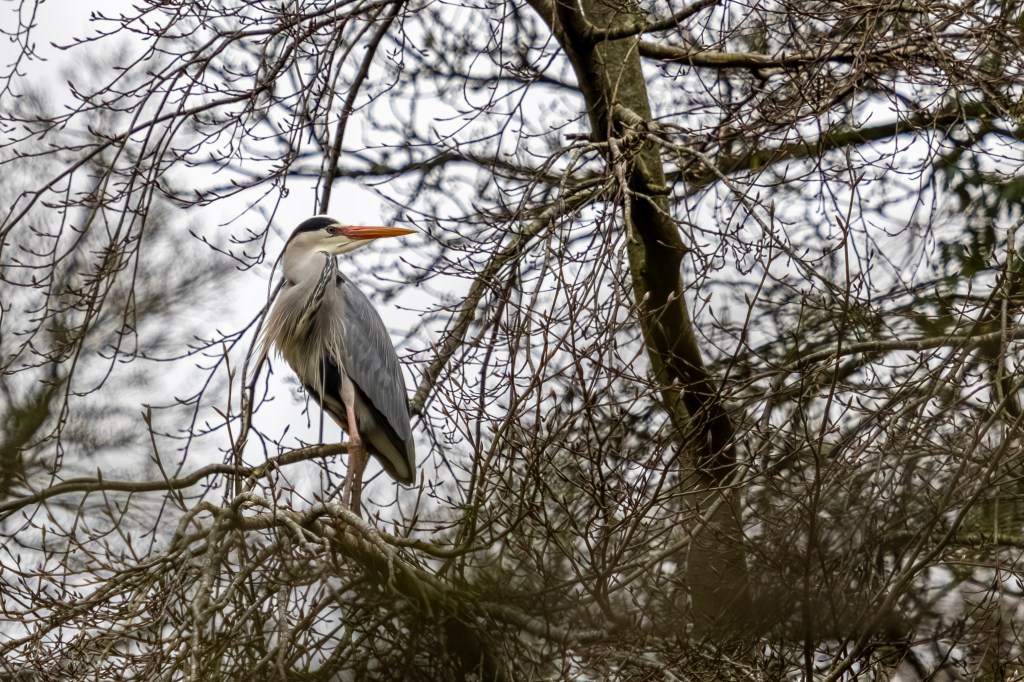
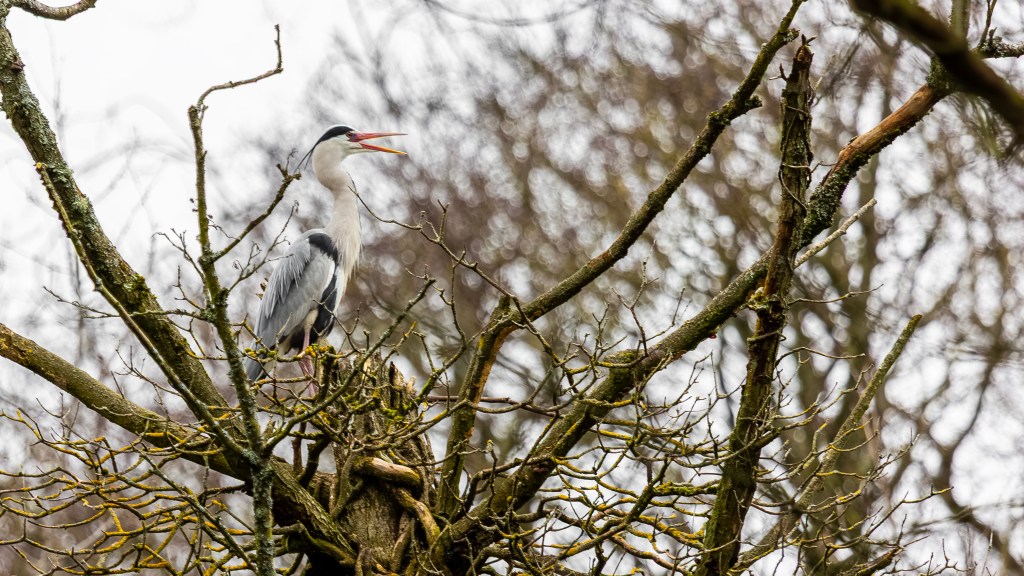
That sighting set me off on a mission to find a local heronry. With the help of Ian Endlander, Northern Ireland’s Heronry Census organiser for the BTO, I was directed to Greg McCready, who monitors the heronry in the woodland of the grounds of Stranmillis University College. This is the heronry nearest to the 2024 sighting that grabbed my attention.
Photo: Greg McCready
Stranmillis College’s woodland is a partial remnant of the original Cromac Woods, which predates the Plantation of Ulster. So it’s entirely possible that a heronry has existed on this spot for centuries and that Belfast’s urban environment has simply grown up around it. I was delighted when Greg took me on a history tour of the grounds, and showed me some of the best places to view the herons’ activities. He’s a really talented photographer, as these photos demonstrate. Greg’s Guardian-published photo has the advantage of communicating that the Stranmillis heronry is an urban one, and I love the matching greys of the bird’s plumage and the building in the background. However, the ones here (thanks for the gift of them Greg!) better convey the utter wildness of herons. Even in the heart of the city, I had the privilege of directly encountering that wildness – and all the emotion that trembles through those stately-looking birds. So I’m very grateful to have got the opportunity, through Greg, to become better acquainted with my local heronry.
I’d also like to thank Paul, of Stranmillis Estates Management, and the Stranmillis Security staff for out-of-hours access. I could not have written the piece without all their help. And I also had vital help from the staff of QUB’s Riddel Hall campus, who also facilitated out-of-hours access, which gave me great sightings along the boundary fence between the grounds of Riddel and Stranmillis. Especial thanks to Thomas, Steve, and Gary.
And of course, I’d like to thank The Guardian’s Country Diary editor, Paul Fleckney, for commissioning the piece and for his guidance towards its publication.
All in all, what my experience of writing this Diary (apart from the joy of getting the chance to get close up to the herons at what is indeed an “intimate and delicate”– and utterly vital – part of their lives) has impressed upon me, is that nothing is created alone. All of our vital connections feed into the ecology of witness and celebration. So final thanks go to the herons. May they flourish.
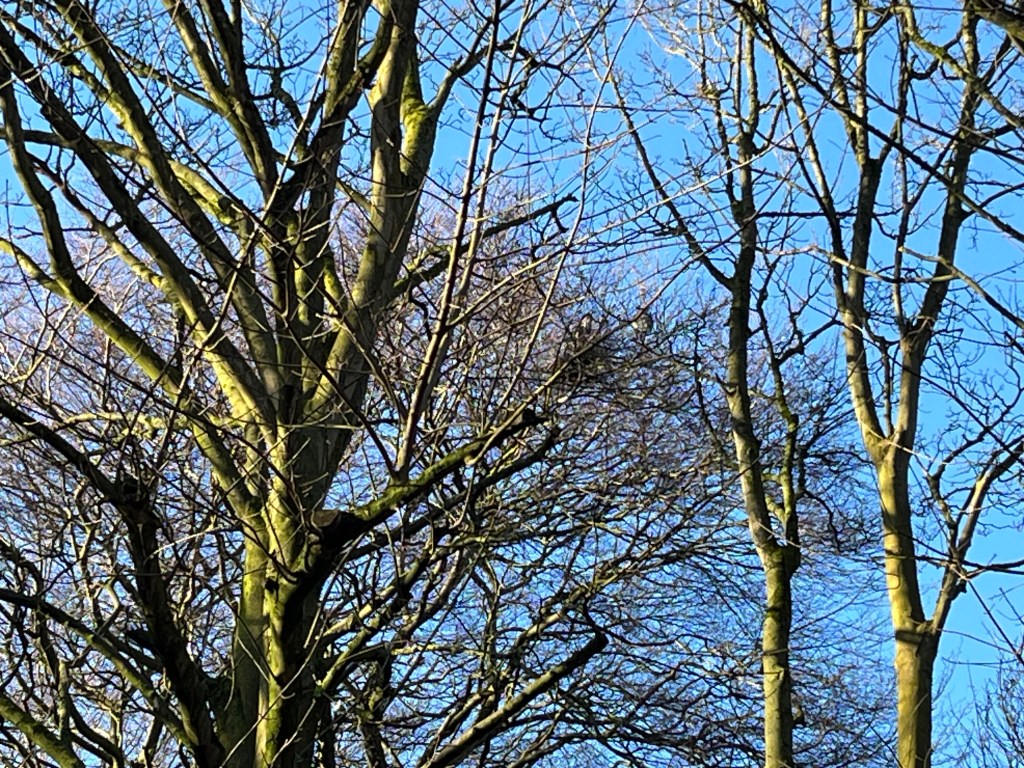
The beech tree pair – briefly together (photo by yours truly)
I’ve been thinking a lot about relationships recently. How the most intimate can also be the most fragile. How we don’t realise what we have until it’s gone.
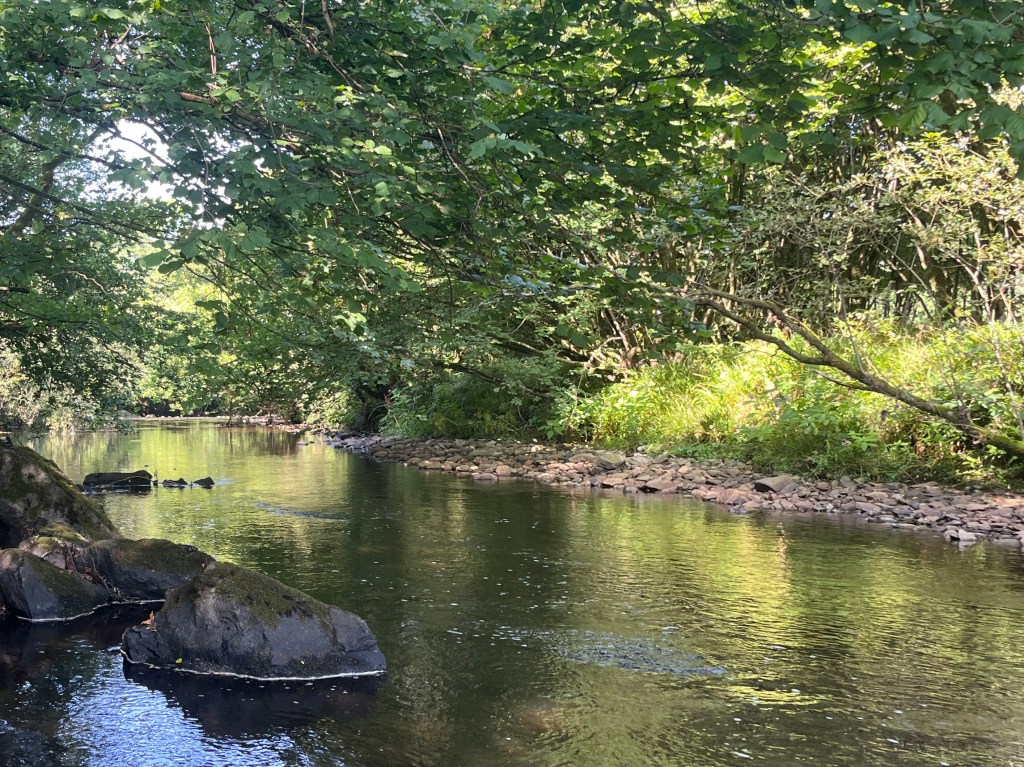
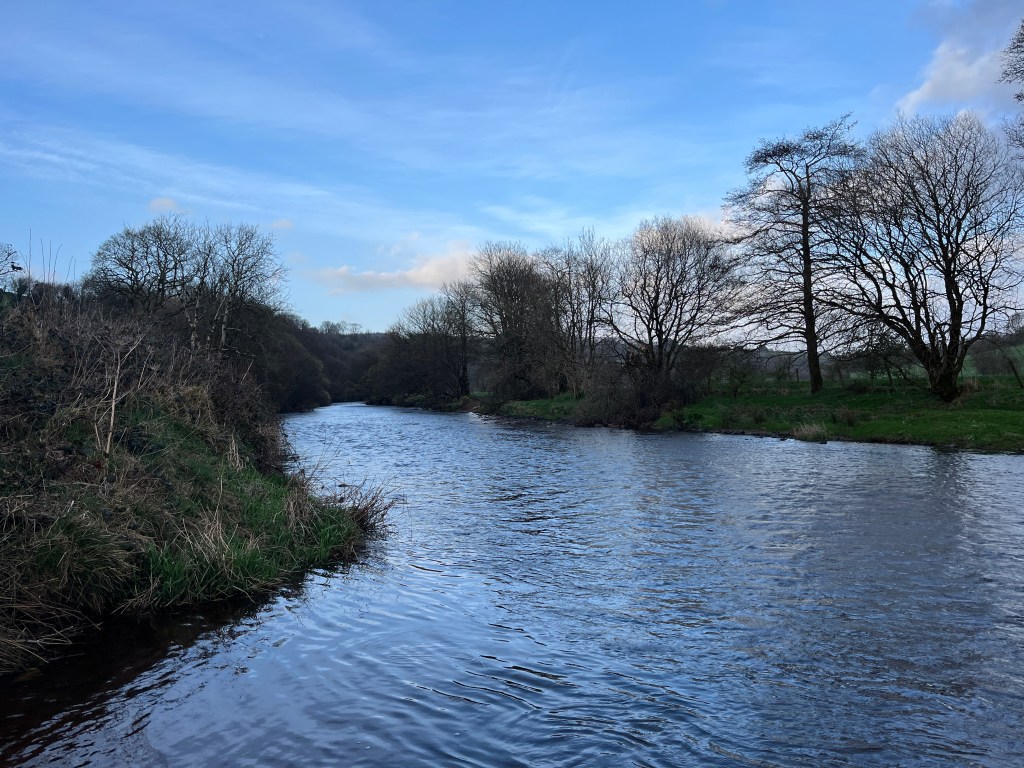
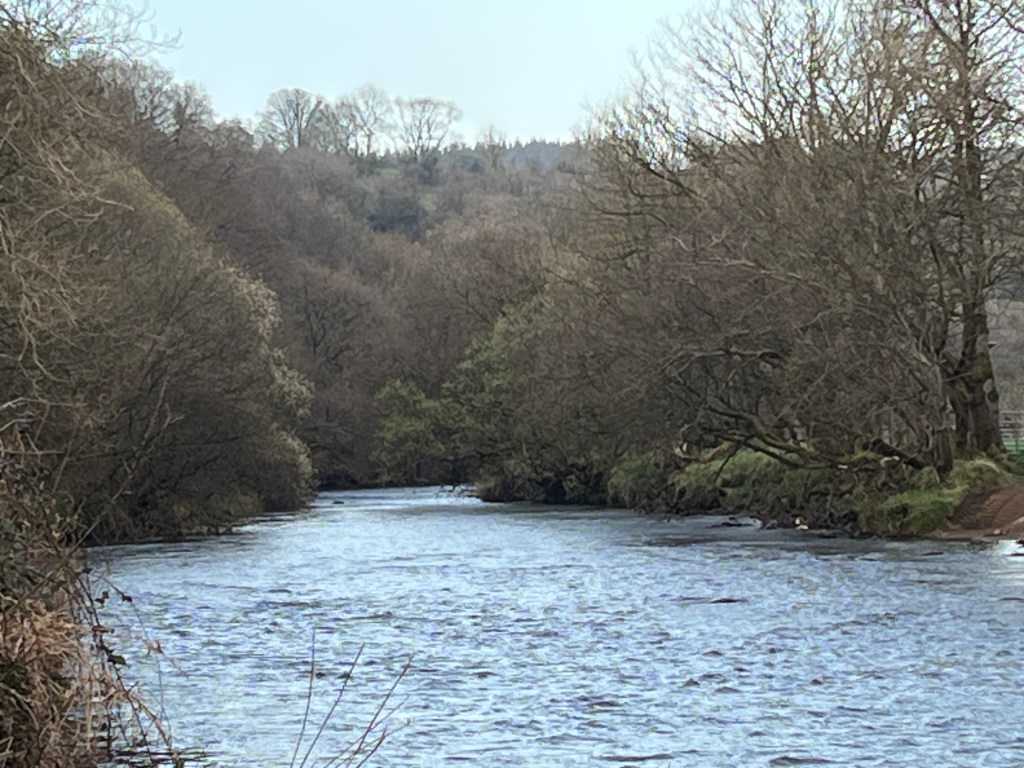
The Owenkillew River, Sperrins, Co Tyrone
The world is feeling an increasingly fragile place. Trusted relationships are distorted and severed. Old stories no longer serve. To speak is to be exposed and endangered. Sometimes we don’t even know the treasures we possess until, like me, you find yourself considering whether to drink the water from your own tap because you know it comes from Lough Neagh and you know that the water is being poisoned. You filter the water. You still worry. You research the impact of phosphates on human health and find yourself confused and unsure. You – consistency being your strong point – feel happy enough to drink the water when the taste of it is masked in coffee or tea, but when you drink it as plain water, your tongue lingers over the flavour, mentally comparing it with the water you drank as a child in Fermanagh. Which came from Lough Erne? You try to remember – no, it was Lough Bradan. You check it out, yes, it was Lough Bradan, which the website cautions, is a public water supply, and care must be taken, apparently, to avoid polluting it. But every day now the lough that supplies your water is polluted. Every single day. And you remember the taste of your childhood Lough Bradan water, remember how every time you went home after being away working in London, Dublin, Derry, Belfast, you ran the tap and took a drink of that water. Because it was the taste of home. And because you trusted implicitly that it was clean.
Lough Neagh at Joyce’s pier near Rea’s Wood, 27th July 2025.
I’ve blogged about Lough Neagh before. Despite appearances in the above photo, nothing much has changed. It’s likely that, because my visit to Joyce’s pier in July 2025 was a little earlier in the season that my 2023 visit to the same location, there was no bad smell. But the reality is that Lough Neagh is in an awful state. And local people are being forced to drink its water. Which is not even to speak about the effect on wildlife and the ecosystem generally.
In our culture, and its predominant thesis of the short term “value” of superficial and exploitative economic “realism”, the intrinsic evolved value of ecological relationships are hard to defend against greed and the desire to make a quick buck. I was grateful to have the opportunity to do that to a small degree in my most recent Country Diary, which was about the freshwater pearl mussel (FPM). This is a species that I was unfamiliar with until Fidelma O’Kane mentioned that it was found in the Owenreagh and Owenkillew rivers in County Tyrone. I wrote about Fidelma in a previous Country Diary. She is an amazing woman who, with other activists, set up the campaign group Save Our Sperrins, which opposes the proposed operations of a gold mining company. As filter feeders of particulate matter, mussels are especially vulnerable to toxic waste. They are also vulnerable due to their dependence on salmon, so if the salmon disappears, they disappear with it.
The brevity of the Country Diary constrained what I could say, about the complexity of the relationship between the mussel and its salmon “host”. It is truly a wonder that this relationship has evolved, which it’s far too simplistic to call “parasitism” – the mussels depend on the salmon, but also, through their filtering activities, help provide the conditions – ie, clean water – for the salmon to survive in. The intimacy and tenuousness of the connection between the two species is a source of joy to me. So, esoteric as it may seem to some, there is an ironic rightness in the fact that a species that depends entirely for its existence on its tenuous and fragile relationship with an entirely different species, is something of a poster child to illustrate the importance of ecological relationships. And stay with me, because the story of the Owenkillew ties in with the story of Lough Neagh.
Freshwater pearl mussel shell, briefly returned to its native waters
It’s hard to write about ecological relationships and their diversity and complexity. They can be reduced to a version of mutualism, which is what I was trying to get across when I described the relationship between the larval FPM and the juvenile salmon as payback rather than parasitism (parasitism seems far too limiting a term; one derived from functional terms like “direct benefit” and “ecosystem service”; the likes of which narrow relationship down to a single function of exchange). The you tube video that I linked to in the piece showing the industriousness of mussels in obtaining food by filtering the water clearly (!) illustrates this point.
With regard to the specific intertwining of the life cycles of the FPM and the salmon, perhaps the best expression of the “payback” is found in this paper by Castrillo et al (2022). It opens with a beautiful take on the naiads, those mythological Greek spirits or nymphs … “least of the lesser goddesses” as Circe described them – her maternal forebears – in Madeline Miller’s novel. As they introduce Margaritifera margaritifera, the freshwater pearl mussel, the scientists invoke these “mythological female nature deities which preside over bodies of fresh water and protect the water quality and the freshwater ecosystem” . That’s how I will forever now think of the FPM: a modest goddess, scarcely seen, sequestering the pearl of great price – which is not located in the nacreous globules that it makes to protect itself from the rub of irritant particles – and for which it was plundered almost to extinction – but for the “ecosystem service” that it generously provides. (For the record, I hate that anthropocentric term “ecosystem service“, but I can just about swallow it when “service” is applied to all parts of the ecosystem, and not just us). So, rather than a single pearl that might be hidden in the folds of the mollusc’s flesh, the “pearl of great price” is the clean water that its species’ evolved feeding activity gives freely to other riverine inhabitants and dependants, including the salmon.
Of course it’s a fair point that, for the individual salmon that are parasitised by the infant freshwater pearl mussel, there may indeed be a cost. Castrillo et al provides a detailed description of the growth and development of the mussel while it is part and parcel of the salmon’s flesh, but make no comment on the effect on the fish. However, this paper, by Taeubert and Geist (2017) provides a comprehensive assessment. It makes the point the relationship between the FPM and its host is unique because it is “very different from any other common host–parasite system. Although the fate of the larvae is directly linked to the survival of the host, the parasite does not reproduce on the host and successful reproduction of M. margaritifera (FPM) is — to some extent (at least for the post-parasitic stage)—decoupled from the host. This is supported by the fact that the mussel needs up to 15 years to reach sexual maturity after leaving the host (in contrast to 3–4 years in most of its hosts), and by the substantially smaller distribution area (ie, geographical range) of M. margaritifera compared to its hosts.”
Taeubert and Geist go on to say: “Taken together, M. margaritifera reveals a clear parasitic character during its host dependent phase at high infection rates, although moderate infection intensities do not seem to have significant detrimental effects on the hosts (Taeubert and Geist, 2013). This is also supported by Treasurer et al. (2006), who found that (moderate) infection … had no significant effect on salmon survival and only a small effect on host growth.”
So, while it’s not quite the same, I can’t help thinking of the “parasitic” mussel larva (a nymph? a tutelary spirit?– OED) as commensals, living in “fragile harmony” (as Country Diary editor Paul Fleckney put it) with their hosts, like various species of bacteria do with us. And it prompts in me a sense of gratitude towards both the salmon and the mussel and all the other complex ecological relationships that we scarcely understand but into which we are built and networked; because like all other forms of life, we are made from this Earth and we cannot be separated from it. So no more that I can reject (or eject) the bacteria living on and in my body, given the larger picture, the clean water, the other forms of life including its prey that that clean water sustains, if it had the power, would the salmon choose to get rid of the mussel?
Personally, I would bet not. We can’t so simply compartmentalise the relationships between species.
These species – salmon and mussel – co-evolved, and while the connection between them may be more tenuous than that between flower and pollinator, it’s the same kind of relationship. Both parties ultimately benefit. And naiad that it is, like a protective spirit, the FPM also contributes to making a clean home for other species as well.
Older knowledge, embedded in our language, tapping down into the deepest reaches of the psyche, teaches us this. Freshwater pearl mussels belong to the taxonomic group Unionida, and an old meaning of the word “union” is “pearl of large size, good quality, and great value” (from the Latin unio, “a single large pearl”, Cassell’s Latin Dictionary). Back to the pearl of great price. The “tutelary spirit” of the naiad, is burrowed deep into the word. A kind of etymological ecology? – etymo-ecology? – reminding us of the union of ecology, its interrelationships and interdependence. There is no separation.
I am so very grateful to have had the opportunity to write about the freshwater pearl mussel. Thank you Fidelma O’Kane & Cormac McAleer of SOS. Thank you to the local farmer whose land the Owenkillew runs through and who was the source of the shell I held in my hand, as well as many stories. Thank you Bryan Ward of Ulster Wildlife, for talking me through the details of the mussel’s life cycle and many of the issues surrounding the protection of this species. Thanks as always to Paul Fleckney. And thank you, Sperrins. Thank you, salmon. And special thanks to the naiad of the Owenkillew and Owenreagh rivers – the freshwater pearl mussel.
I finished Monday’s Country Diary with a prayer for all the river’s spawn. I will extend it now, paraphrasing Castrillo et al‘s words, to all the rivers and loughs and all the life that depends on them, which are threatened by pollution, from whatever source:
May the ancient naiads of the living waters preside over and protect us all.
It’s been a while. First there’s the matter of my most recent contribution to The Guardian‘s Country Diary. As the more long-memoried of you will recall, I wrote about Newgrange for December. And I went back to Brú na Bóinne for the start of May, which gave me the opportunity to spend more time at Knowth, an equally fascinating if somewhat less famous place
The Great Mound & some of its satellites at Knowth, Co Meath
So (thanks again to Paul Fleckney for the commission and his editorial support), I was delighted to have the chance to write about Knowth here.
Neolithic carvings on a Knowth kerbstone
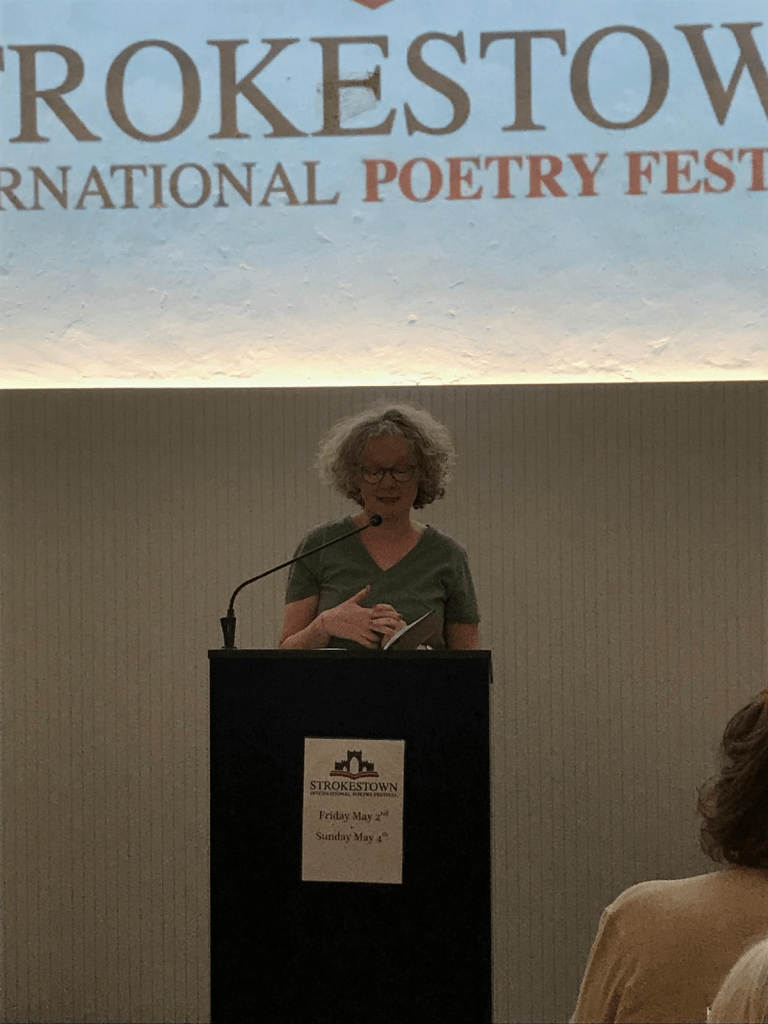
We spent time in the Boyne Valley and then went on to Strokestown in Co Roscommon to attend the Strokestown International Poetry Festival. I have been meaning to attend that festival for many years, but it always coincides with International Dawn Chorus Day. Which has meant that, heretofore, I was usually involved in some birdsong event or other. However, I have stepping back a little from my teaching and facilitating work (including my sciency work) to focus on my own writing. So this year I was able to attend!
It was a wonderful festival with some fabulous readings from Sam Furlong and Eilish Martin who have recently published collections with the wonderful Macha Press; as well as Kate Newmann, Noel Monahan, and many others, including the esteemed Eiléan Ní Chuilleanáin. It was great to have the chance to catch up with old friends also.
Not only did I attend, I also read from my now-published excerpt of my work-in-progress novel, A Wolf’s Breath (WIP, but coming along nicely, thank you). I was very honoured to read as part of the launch of Cyphers Magazine (99). And what great company to be in!
That’s me – reading with nervous hands! – Thanks to Kate Newmann for the photoFiction – published!
Many thanks to everyone at the festival for all the organising; and especially to Eiléan, Natasha Cuddington, Léan Ní Chuilleanáin, Joe Woods & Áinin Ní Bhroin at Cyphers Magazine.
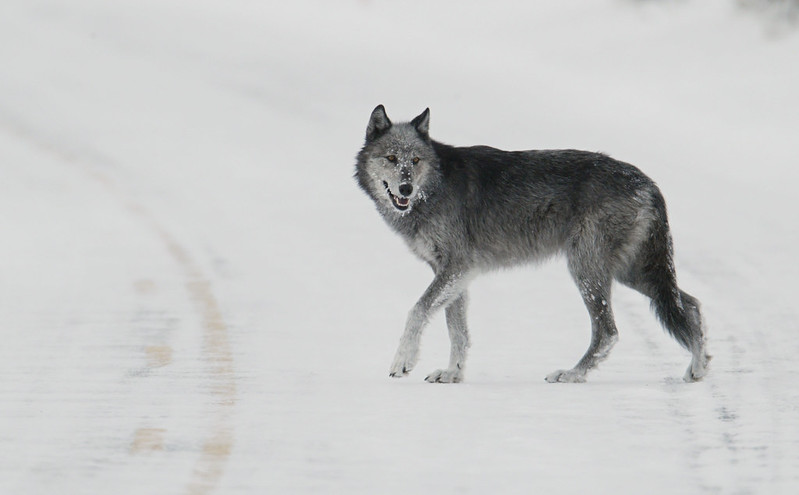
Half-Black: daughter of 42F & 21M, by Jim Peaco, 31 December 2003, Lamar Valley, Yellowstone
I love this photo. I especially love it because just a few weeks after it was taken, I visited Yellowstone in January 2004 and saw this very wolf. I was also introduced to her natal pack, the Druids (named for Druid Peak, in the Lamar Valley). Half-Black was one of the then-famous Druid Daughters who was restive during the breeding season, always sneaking away from her birth-family as she tried to establish her own. Her father was none too happy about the strange males she and her sisters kept flirting with. It didn’t stop their rendezvous. Here she is crossing that same road that I, along with the group I was travelling with, were taken up and down to try and keep track of the wolves. The whole trip was one of the most inspiring and compelling experiences of my life.
All this is by way of preamble to say that an excerpt from my unpublished novel “A Wolf’s Breath” has been accepted for publication. It is forthcoming in Cyphers Magazine. Cyphers 99 will be launched at the Strokestown International Poetry Festival on the 4th May. I am very grateful to all on the publishing team, but especially to editor, Eiléan Ní Chuilleanáin.
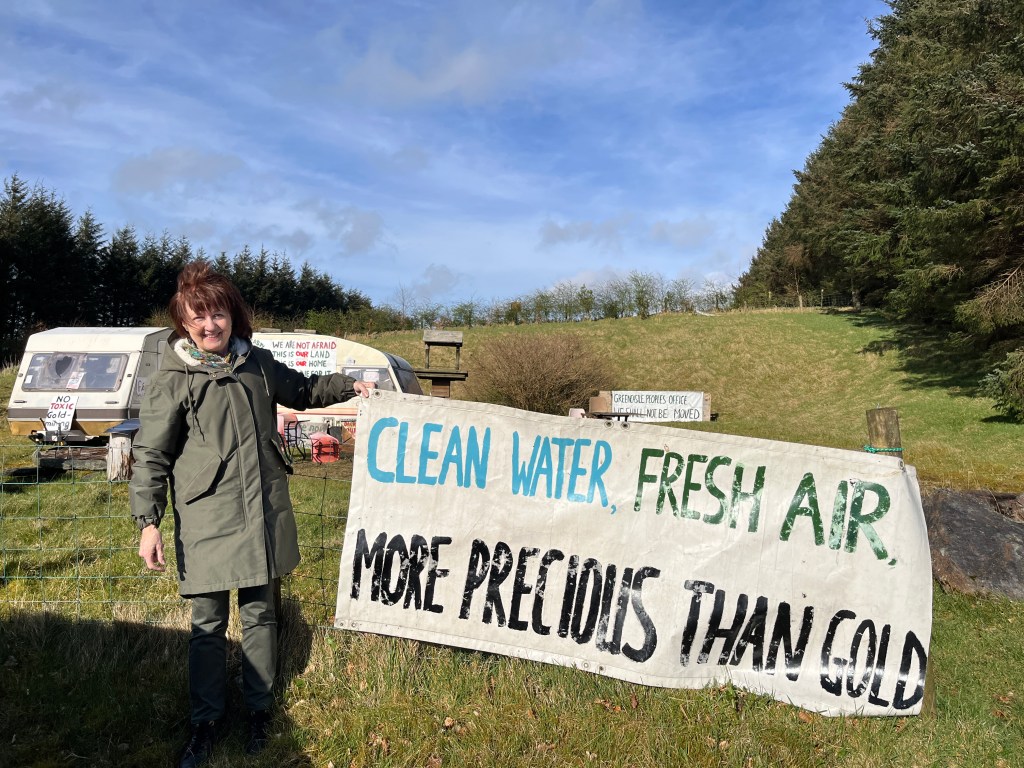
Where is your treasure? I was delighted to have this chance to write about the Sperrins, and meeting Fidelma O’Kane and other members of the Save Our Sperrins campaign was a truly inspirational experience.
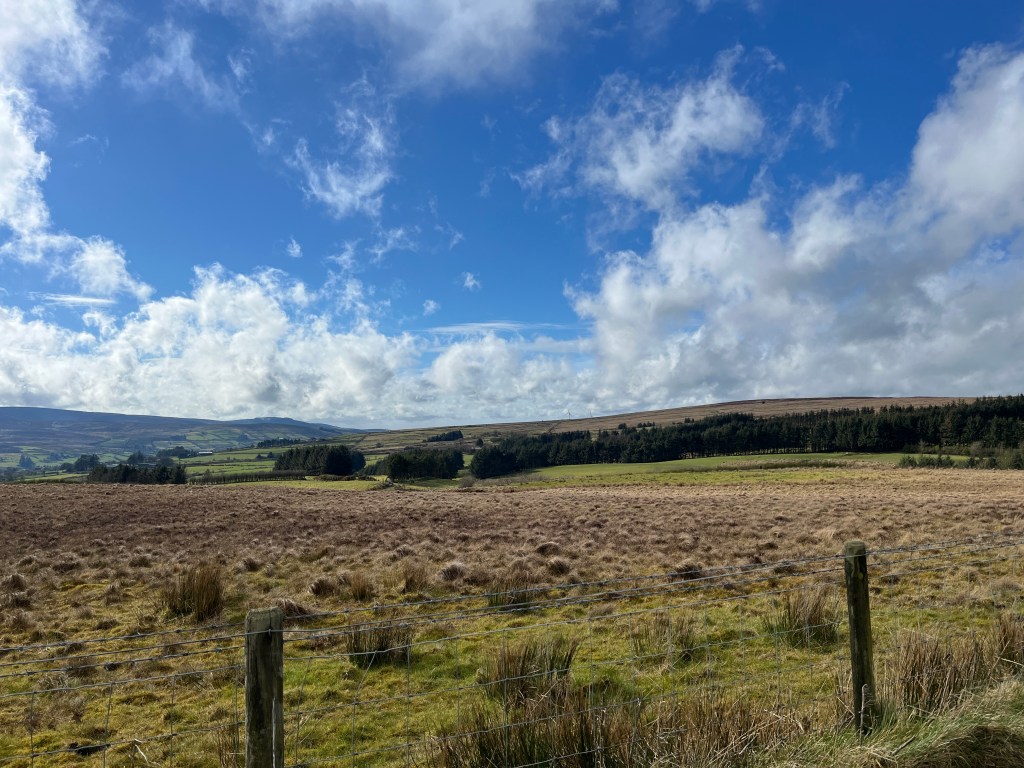
View from Crockenboy Hill (where the proposed mine would be situated)
It was prompted by an invitation from Cherry Smyth to the poetry-music performance of her poem One Mountain: Sold. The poem is brilliant on the page, but the live performance at An Creagán, on 29th March, was something else. Interwoven and in conversation with the vocal and musical compositions of of Lauren Kinsella and Dan Nicholls, it was an ethereal, resonant and haunting evocation of the voice of the land itself. Through the magic of electronics and instrumentation, Lauren’s voice morphed from the tinkling of birdsong and mountain streams to the disturbing thuds of drilling and the groans of the earth. The voices of local children were braided through the performance, as they chanted the townland names like a song. It was a wonderful evening.
I’d already spent much of the afternoon in the company of Fidelma O’Kane, who took me on a whistle-stop tour of the area. Having myself lived in the north Sperrins for over a decade, I could appreciate in a visceral way the dissonance local people must feel at the thought of a mine so close to their homes. And as commenter Wormwood20 drew prompt attention to in their comment on my piece, this a really current issue, not just in the Sperrins, but all over the world.
However, people like Fidelma, and others in SOS, many of whom I met that evening in An Creagán, are a testament to the human spirit and to its ability to persist against all odds. It was an honour to meet them all, and to have the chance to put that into a very small number of words, which hardly do justice to their commitment and sacrifice.
Fidelma O’Kane says it like it is…
I spent a little time by myself towards evening at the Owenkillew River and had a few words with some shy sheep.
Owenkillew RiverSome local inhabitants
Speaking of words, every one of those is precious too. I took the notion to buy the hard-copy of The Guardian today, because I wanted to see what lovely wood-cut effect image might accompany the piece, (as often the case in the print version). Well, there wasn’t one – maybe this was to allow for more space for my words. And indeed there is no difference between the print and the on-line version that I have identified (sometimes the latter is a smidgeon longer – the column as a physical thing means there’s more pressure on the word-count). Anyway, here’s the hard copy:
The column – sans woodcut.
I am grateful to Cherry Smyth for connecting me directly to this issue and to the SOS campaign, as well as for her wonderful poem, One Mountain: Sold. To Fidelma O’Kane for all the time she gave me, all she showed me, and for all the stories of commitment and creativity. To Lauren and Dan, as well as Cherry, for making such a stunning work of art, which completely illustrated, as I think Dan said, how art is political ‘even when it pretends not to be’ – and that it’s vital not to play it down as simply ‘entertainment’. Their collective work was mesmerising in its beauty and its bravery. To everyone I met at An Creagán, especially Mairead, Emmet, Cormac, Fergus and Barney. You are all so inspiring. I’d also like to thank Kerry McCrory and Gordon Dunn for generously providing the gorgeous photos that accompanied the published piece.
And finally, I especially want to thank the editor of the Country Diary, Paul Fleckney, for all his encouragement and guidance.








 mary-montague.com