
If I’d been able to add my tuppence worth as a comment to this article, I wouldn’t be writing this blog. But a couple of weeks ago, I read it and was dying to add this book to the list that article celebrates. I’ve read a fair few on that list, I was pleased to note, but was even more pleased to see that I haven’t read the majority – which means MORE JOY awaits me. Because, in these dark times, as Francesca Segal puts it, we need, not escapism, but solace.
However. That barrier to me adding my contribution got me thinking about the books I’ve read on repeat. Not the books I’ve read several times. Because, when I like a book, I am a several-times reader. But those re-readings can take place over years or decades. And that’s different. I’m talking about the books that, the minute I’ve come to the final page, I literally go back to the start. I’m talking about reading on a loop. Of those, I think there’s only been these two:

I’m on my third time for Romantic Comedy, and I’m not done with it yet. It is pure joy. It’s funny and contemporary, the dialogue zings, and the story is both realistic and reassuring. I love the way, Sally, our unreliable narrator is so insecure and only through the arc of the novel do we come to realise how highly competent and talented she is. It’s a tale that captures the exhilaration of work, and the pleasures of belonging to a small group of people similarly engaged. I saw an interview with Curtis Sittenfeld where she compared it to being a post-grad student, and that is spot-on; but I’m sure it also applies to any specialist high-status but semi-reclusive workplace, where those that are part of it are envied by outsiders, and create their own utterly self-involved world. And it is also, fundamentally, a book about writing, and the perils and rewards of creativity.
I’ve a way to go until Romantic Comedy achieves the repeats of read that Black Beauty was thought worthy of by my seven-year old self. I read BB at least twenty times as a child (21 is the figure in my head and, while I can’t be sure, I think it’s probably a conservative estimate). I read it on repeat, and I also read it, as best I could at that young age, in a single go. Which meant starting it on a Friday afternoon when I came home from school, reading it until I fell asleep that night, and finishing it when I woke up on Saturday morning. Week after week after week. I used to know passages of it off by heart, which sadly (take that qualifier as you wish) is no longer the case. But actually (!), it has some other things in common with Romantic Comedy, other than being repeatedly read by me. It’s a quest story, and the quest of both books is for love; and for the connection that provides a haven against a harsh world.
So these are both solace stories.
Before I leave the subject, I just want to add a mention of the two other books I have that came along with Black Beauty, as a box set gift from my father when I was seven. There were four, and one is gone the way of the lost and left behind – My Family and Other Animals by Gerald Durrell. It’s probably not a coincidence that that one did not survive in my long-term care, because while I read it, somewhat later, and enjoyed it, it’s the only one that does not have an animal protagonist.
So here’s the other two:

The Custer Wolf is the story of what we would now call ecocide – exemplified by the slaughter of apex predators in the American West that focussed on “trophy wolves” – of which the (historical) Custer Wolf was one. It was this book – which I read often rather than on repeat because it was so upsetting – that it’s probably no exaggeration to say set the course of my life.
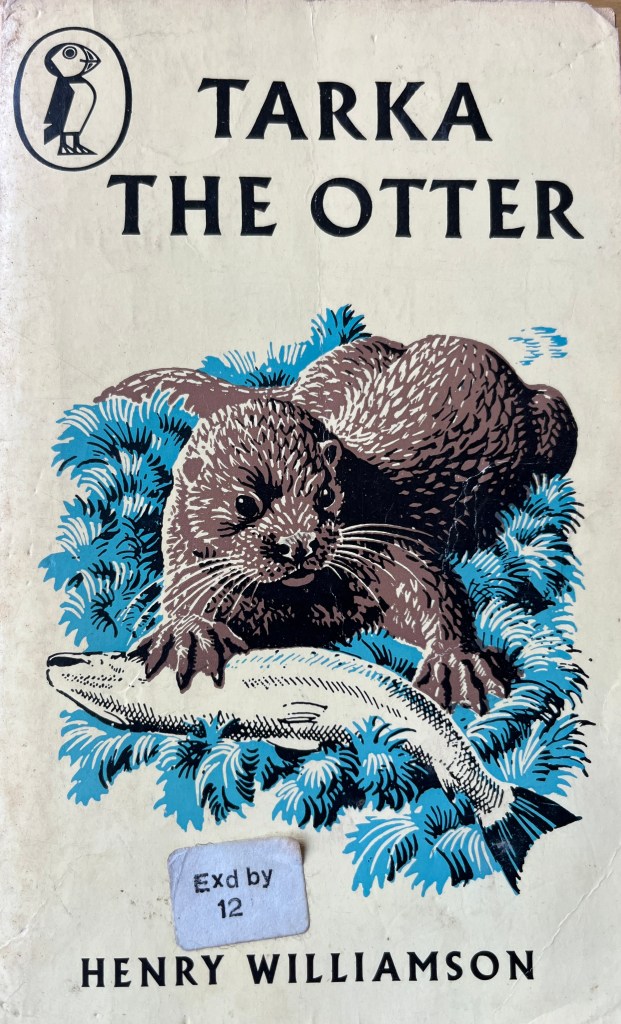
The other book is Tarka the Otter, by Henry Williamson. I’m not sure how it ended up “backed”, as we used to say when we were strengthening the covers of our school books, in 1970s Christmas paper. And until today, I’d never unwrapped. But here is the slow reveal:

Against the advice of the above blurb, I definitely read Tarka too young, which is probably why it hasn’t nestled in my heart in quite the same way as BB & CW. But it could be time to give it another go, especially given this striking cover, hidden for decades:
I do remember enough of Tarka to know it is another ecocide story, albeit on a smaller scale than that of the Custer Wolf. So that brings me back to Francesca Segal’s premise. We need solace stories to strengthen the muscle of our heart to confront the terrible ones. Read all of them. On repeat, or often, or only the once to grasp their truth. But read them.

 mary-montague.com