
I’ve been thinking a lot about relationships recently. How the most intimate can also be the most fragile. How we don’t realise what we have until it’s gone.
The world is feeling an increasingly fragile place. Trusted relationships are distorted and severed. Old stories no longer serve. To speak is to be exposed and endangered. Sometimes we don’t even know the treasures we possess until, like me, you find yourself considering whether to drink the water from your own tap because you know it comes from Lough Neagh and you know that the water is being poisoned. You filter the water. You still worry. You research the impact of phosphates on human health and find yourself confused and unsure. You – consistency being your strong point – feel happy enough to drink the water when the taste of it is masked in coffee or tea, but when you drink it as plain water, your tongue lingers over the flavour, mentally comparing it with the water you drank as a child in Fermanagh. Which came from Lough Erne? You try to remember – no, it was Lough Bradan. You check it out, yes, it was Lough Bradan, which the website cautions, is a public water supply, and care must be taken, apparently, to avoid polluting it. But every day now the lough that supplies your water is polluted. Every single day. And you remember the taste of your childhood Lough Bradan water, remember how every time you went home after being away working in London, Dublin, Derry, Belfast, you ran the tap and took a drink of that water. Because it was the taste of home. And because you trusted implicitly that it was clean.

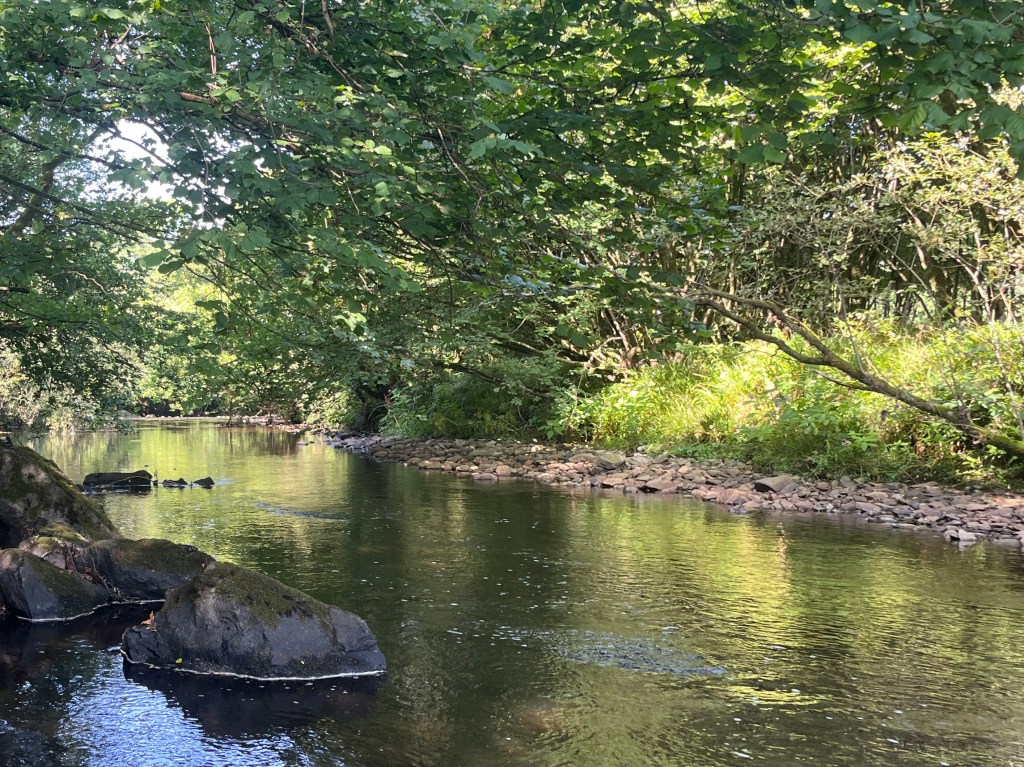
I’ve blogged about Lough Neagh before. Despite appearances in the above photo, nothing much has changed. It’s likely that, because my visit to Joyce’s pier in July 2025 was a little earlier in the season that my 2023 visit to the same location, there was no bad smell. But the reality is that Lough Neagh is in an awful state. And local people are being forced to drink its water. Which is not even to speak about the effect on wildlife and the ecosystem generally.
In our culture, and its predominant thesis of the short term “value” of superficial and exploitative economic “realism”, the intrinsic evolved value of ecological relationships are hard to defend against greed and the desire to make a quick buck. I was grateful to have the opportunity to do that to a small degree in my most recent Country Diary, which was about the freshwater pearl mussel (FPM). This is a species that I was unfamiliar with until Fidelma O’Kane mentioned that it was found in the Owenreagh and Owenkillew rivers in County Tyrone. I wrote about Fidelma in a previous Country Diary. She is an amazing woman who, with other activists, set up the campaign group Save Our Sperrins, which opposes the proposed operations of a gold mining company. As filter feeders of particulate matter, mussels are especially vulnerable to toxic waste. They are also vulnerable due to their dependence on salmon, so if the salmon disappears, they disappear with it.
The brevity of the Country Diary constrained what I could say, about the complexity of the relationship between the mussel and its salmon “host”. It is truly a wonder that this relationship has evolved, which it’s far too simplistic to call “parasitism” – the mussels depend on the salmon, but also, through their filtering activities, help provide the conditions – ie, clean water – for the salmon to survive in. The intimacy and tenuousness of the connection between the two species is a source of joy to me. So, esoteric as it may seem to some, there is an ironic rightness in the fact that a species that depends entirely for its existence on its tenuous and fragile relationship with an entirely different species, is something of a poster child to illustrate the importance of ecological relationships. And stay with me, because the story of the Owenkillew ties in with the story of Lough Neagh.

It’s hard to write about ecological relationships and their diversity and complexity. They can be reduced to a version of mutualism, which is what I was trying to get across when I described the relationship between the larval FPM and the juvenile salmon as payback rather than parasitism (parasitism seems far too limiting a term; one derived from functional terms like “direct benefit” and “ecosystem service”; the likes of which narrow relationship down to a single function of exchange). The you tube video that I linked to in the piece showing the industriousness of mussels in obtaining food by filtering the water clearly (!) illustrates this point.
With regard to the specific intertwining of the life cycles of the FPM and the salmon, perhaps the best expression of the “payback” is found in this paper by Castrillo et al (2022). It opens with a beautiful take on the naiads, those mythological Greek spirits or nymphs … “least of the lesser goddesses” as Circe described them – her maternal forebears – in Madeline Miller’s novel. As they introduce Margaritifera margaritifera, the freshwater pearl mussel, the scientists invoke these “mythological female nature deities which preside over bodies of fresh water and protect the water quality and the freshwater ecosystem” . That’s how I will forever now think of the FPM: a modest goddess, scarcely seen, sequestering the pearl of great price – which is not located in the nacreous globules that it makes to protect itself from the rub of irritant particles – and for which it was plundered almost to extinction – but for the “ecosystem service” that it generously provides. (For the record, I hate that anthropocentric term “ecosystem service“, but I can just about swallow it when “service” is applied to all parts of the ecosystem, and not just us). So, rather than a single pearl that might be hidden in the folds of the mollusc’s flesh, the “pearl of great price” is the clean water that its species’ evolved feeding activity gives freely to other riverine inhabitants and dependants, including the salmon.
Of course it’s a fair point that, for the individual salmon that are parasitised by the infant freshwater pearl mussel, there may indeed be a cost. Castrillo et al provides a detailed description of the growth and development of the mussel while it is part and parcel of the salmon’s flesh, but make no comment on the effect on the fish. However, this paper, by Taeubert and Geist (2017) provides a comprehensive assessment. It makes the point the relationship between the FPM and its host is unique because it is “very different from any other common host–parasite system. Although the fate of the larvae is directly linked to the survival of the host, the parasite does not reproduce on the host and successful reproduction of M. margaritifera (FPM) is — to some extent (at least for the post-parasitic stage)—decoupled from the host. This is supported by the fact that the mussel needs up to 15 years to reach sexual maturity after leaving the host (in contrast to 3–4 years in most of its hosts), and by the substantially smaller distribution area (ie, geographical range) of M. margaritifera compared to its hosts.”
Taeubert and Geist go on to say: “Taken together, M. margaritifera reveals a clear parasitic character during its host dependent phase at high infection rates, although moderate infection intensities do not seem to have significant detrimental effects on the hosts (Taeubert and Geist, 2013). This is also supported by Treasurer et al. (2006), who found that (moderate) infection … had no significant effect on salmon survival and only a small effect on host growth.”
So, while it’s not quite the same, I can’t help thinking of the “parasitic” mussel larva (a nymph? a tutelary spirit?– OED) as commensals, living in “fragile harmony” (as Country Diary editor Paul Fleckney put it) with their hosts, like various species of bacteria do with us. And it prompts in me a sense of gratitude towards both the salmon and the mussel and all the other complex ecological relationships that we scarcely understand but into which we are built and networked; because like all other forms of life, we are made from this Earth and we cannot be separated from it. So no more that I can reject (or eject) the bacteria living on and in my body, given the larger picture, the clean water, the other forms of life including its prey that that clean water sustains, if it had the power, would the salmon choose to get rid of the mussel?
Personally, I would bet not. We can’t so simply compartmentalise the relationships between species.
These species – salmon and mussel – co-evolved, and while the connection between them may be more tenuous than that between flower and pollinator, it’s the same kind of relationship. Both parties ultimately benefit. And naiad that it is, like a protective spirit, the FPM also contributes to making a clean home for other species as well.
Older knowledge, embedded in our language, tapping down into the deepest reaches of the psyche, teaches us this. Freshwater pearl mussels belong to the taxonomic group Unionida, and an old meaning of the word “union” is “pearl of large size, good quality, and great value” (from the Latin unio, “a single large pearl”, Cassell’s Latin Dictionary). Back to the pearl of great price. The “tutelary spirit” of the naiad, is burrowed deep into the word. A kind of etymological ecology? – etymo-ecology? – reminding us of the union of ecology, its interrelationships and interdependence. There is no separation.
I am so very grateful to have had the opportunity to write about the freshwater pearl mussel. Thank you Fidelma O’Kane & Cormac McAleer of SOS. Thank you to the local farmer whose land the Owenkillew runs through and who was the source of the shell I held in my hand, as well as many stories. Thank you Bryan Ward of Ulster Wildlife, for talking me through the details of the mussel’s life cycle and many of the issues surrounding the protection of this species. Thanks as always to Paul Fleckney. And thank you, Sperrins. Thank you, salmon. And special thanks to the naiad of the Owenkillew and Owenreagh rivers – the freshwater pearl mussel.
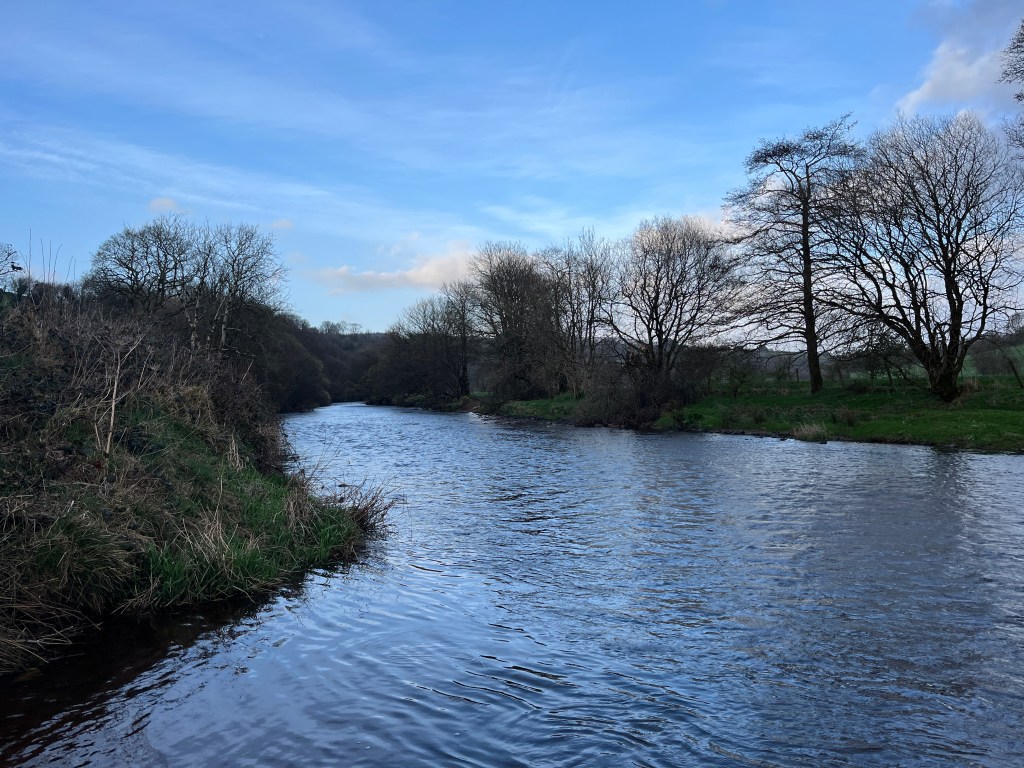
I finished Monday’s Country Diary with a prayer for all the river’s spawn. I will extend it now, paraphrasing Castrillo et al‘s words, to all the rivers and loughs and all the life that depends on them, which are threatened by pollution, from whatever source:
May the ancient naiads of the living waters preside over and protect us all.

 mary-montague.com