
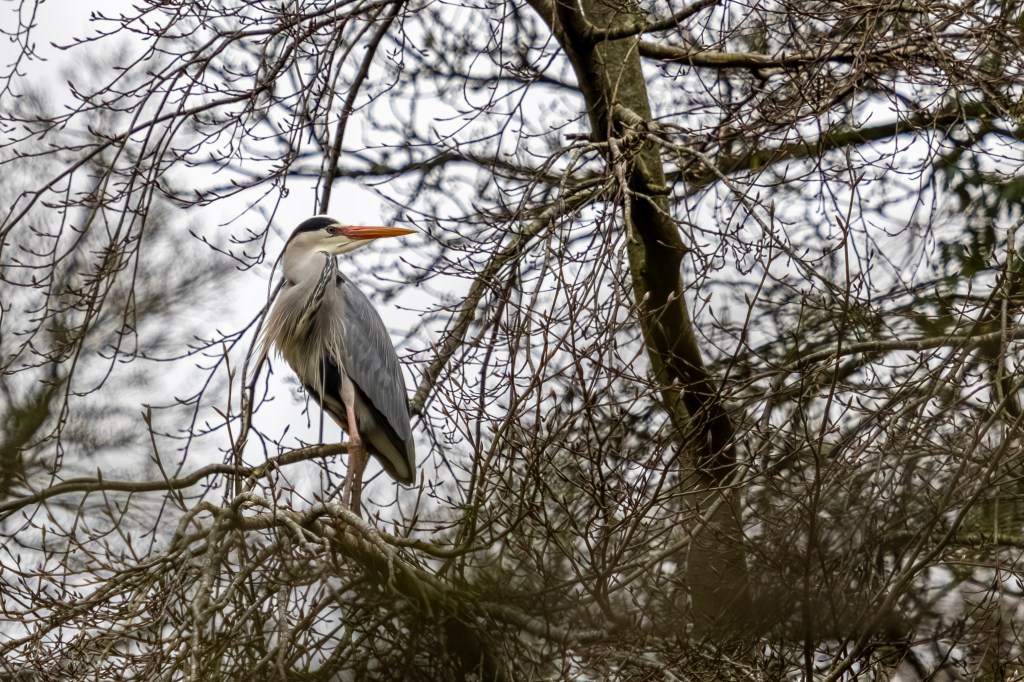
Over the past few months, my Country Diaries have either been written out of experiences that came to me under my own steam, as it were; or, if others were part the process, they got a mention in the diary itself. Hence, my February Country Diary was written through connecting Belfast Hills Partnership, and especially with Geoff and Patricia.
March’s Diary had a long gestation. On the 11th March 2024, I saw a heron near Micky Taylor’s Lock on the Lagan towpath. It was standing in a marshy pool, and it prompted to write the following:
“There’s a scattering of mallards, and a single moorhen attracts my gaze with its jerky head. That reflex movement is suddenly writ large a little further into the tangle of trees. I lift my binoculars for a closer look and meet a yellow glare. For breath the heron’s eye stares fixedly back at me. Then it clearly decides I am harmless and continues about its business.
Herons are common enough along this stretch of water, but this individual looks ridiculous as it struggles through the reedy understory, while looking up into the gnarly branches of the small trees. All the sinuous lengths of its extremities – legs, neck, bill – seem ill-matched for its purpose. It sways and hunches and bends as it probes through the reeds, and then, hunkering back on its hocks to make a steadier platform of its body it pokes the spear of its bill up into the branches. It seizes a narrow branch and pulls at it. Then it suddenly flaps up, struggling into the lower branches, twisting its neck as it gains a perch. Pokes and seizes again. A thin flex of branch bends under the heron’s torc. Then the bird gives up and crashes back down into the reeds.
I take a breath and focus on its beauty. The gorgeous layered scalloping of its dorsal feathers. The long outer plumes of its throat and the delicate pattern of the black markings that draw attention to the sinuous neck. The bird embodies such awkward grace, that is somehow enhanced in this cluttered enclosure. For the heron has just got busier. It is trampling around the reeds, lifting up the stems, flipping them and dragging them, at times seemingly stepping on them deliberately as it to test them. None of them apparently meet its requirements. Now, as it brandishes a small twisted branch with an air of triumph, the bird’s mission is confirmed by a ghostly figure deeper into the reeds. Another heron. It – she? – is watching studiously. The nearer heron is likely a male, and his assiduous search is probably as much as an effort to impress the empress of the reeds as it is to collect nesting material. I suddenly feel like I’m intruding on an intimate and delicate encounter.”
That sighting set me off on a mission to find a local heronry. With the help of Ian Endlander, Northern Ireland’s Heronry Census organiser for the BTO, I was directed to Greg McCready, who monitors the heronry in the woodland of the grounds of Stranmillis University College. This is the heronry nearest to the 2024 sighting that grabbed my attention.
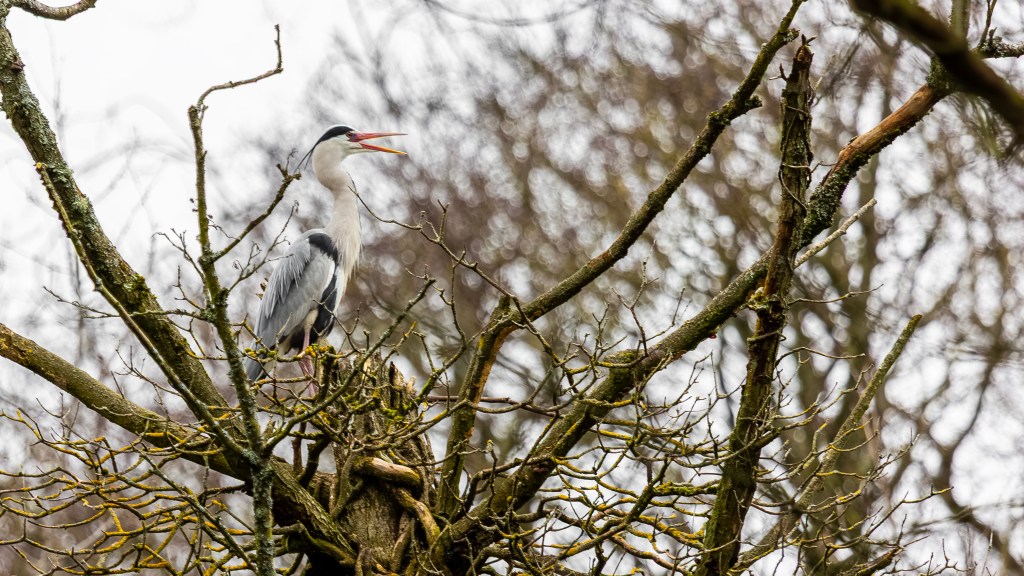
Stranmillis College’s woodland is a partial remnant of the original Cromac Woods, which predates the Plantation of Ulster. So it’s entirely possible that a heronry has existed on this spot for centuries and that Belfast’s urban environment has simply grown up around it. I was delighted when Greg took me on a history tour of the grounds, and showed me some of the best places to view the herons’ activities. He’s a really talented photographer, as these photos demonstrate. Greg’s Guardian-published photo has the advantage of communicating that the Stranmillis heronry is an urban one, and I love the matching greys of the bird’s plumage and the building in the background. However, the ones here (thanks for the gift of them Greg!) better convey the utter wildness of herons. Even in the heart of the city, I had the privilege of directly encountering that wildness – and all the emotion that trembles through those stately-looking birds. So I’m very grateful to have got the opportunity, through Greg, to become better acquainted with my local heronry.
I’d also like to thank Paul, of Stranmillis Estates Management, and the Stranmillis Security staff for out-of-hours access. I could not have written the piece without all their help. And I also had vital help from the staff of Riddell Hall, who also facilitated out-of-hours access, which gave me great sightings along the boundary fence between the grounds of Riddell and Stranmillis. Especial thanks to Thomas, Steve, and Gary.
And of course, I’d like to thank The Guardian’s Country Diary editor, Paul Fleckney, for commissioning the piece and for his guidance towards its publication.
All in all, what my experience of writing this Diary (apart from the joy of getting the chance to get close up to the herons at what is indeed an “intimate and delicate”– and utterly vital – part of their lives) has impressed upon me, is that nothing is created alone. All of our vital connections feed into the ecology of witness and celebration. So final thanks go to the herons. May they flourish.

 mary-montague.com