Over the past few months, my Country Diaries have either been written out of experiences that came to me under my own steam, as it were; or, if others were part the process, they got a mention in the diary itself. Hence, my February Country Diary was written through connecting Belfast Hills Partnership, and especially with Geoff and Patricia.
March’s Diary had a long gestation. On the 11th March 2024, I saw a heron near Micky Taylor’s Lock on the Lagan towpath. It was standing in a marshy pool, and it prompted to write the following:
“There’s a scattering of mallards, and a single moorhen attracts my gaze with its jerky head. That reflex movement is suddenly writ large a little further into the tangle of trees. I lift my binoculars for a closer look and meet a yellow glare. For breath the heron’s eye stares fixedly back at me. Then it clearly decides I am harmless and continues about its business.
Herons are common enough along this stretch of water, but this individual looks ridiculous as it struggles through the reedy understory, while looking up into the gnarly branches of the small trees. All the sinuous lengths of its extremities – legs, neck, bill – seem ill-matched for its purpose. It sways and hunches and bends as it probes through the reeds, and then, hunkering back on its hocks to make a steadier platform of its body it pokes the spear of its bill up into the branches. It seizes a narrow branch and pulls at it. Then it suddenly flaps up, struggling into the lower branches, twisting its neck as it gains a perch. Pokes and seizes again. A thin flex of branch bends under the heron’s torc. Then the bird gives up and crashes back down into the reeds.
I take a breath and focus on its beauty. The gorgeous layered scalloping of its dorsal feathers. The long outer plumes of its throat and the delicate pattern of the black markings that draw attention to the sinuous neck. The bird embodies such awkward grace, that is somehow enhanced in this cluttered enclosure. For the heron has just got busier. It is trampling around the reeds, lifting up the stems, flipping them and dragging them, at times seemingly stepping on them deliberately as it to test them. None of them apparently meet its requirements. Now, as it brandishes a small twisted branch with an air of triumph, the bird’s mission is confirmed by a ghostly figure deeper into the reeds. Another heron. It – she? – is watching studiously. The nearer heron is likely a male, and his assiduous search is probably as much as an effort to impress the empress of the reeds as it is to collect nesting material. I suddenly feel like I’m intruding on an intimate and delicate encounter.”
That sighting set me off on a mission to find a local heronry. With the help of Ian Endlander, Northern Ireland’s Heronry Census organiser for the BTO, I was directed to Greg McCready, who monitors the heronry in the woodland of the grounds of Stranmillis University College. This is the heronry nearest to the 2024 sighting that grabbed my attention.
Photo: Greg McCready
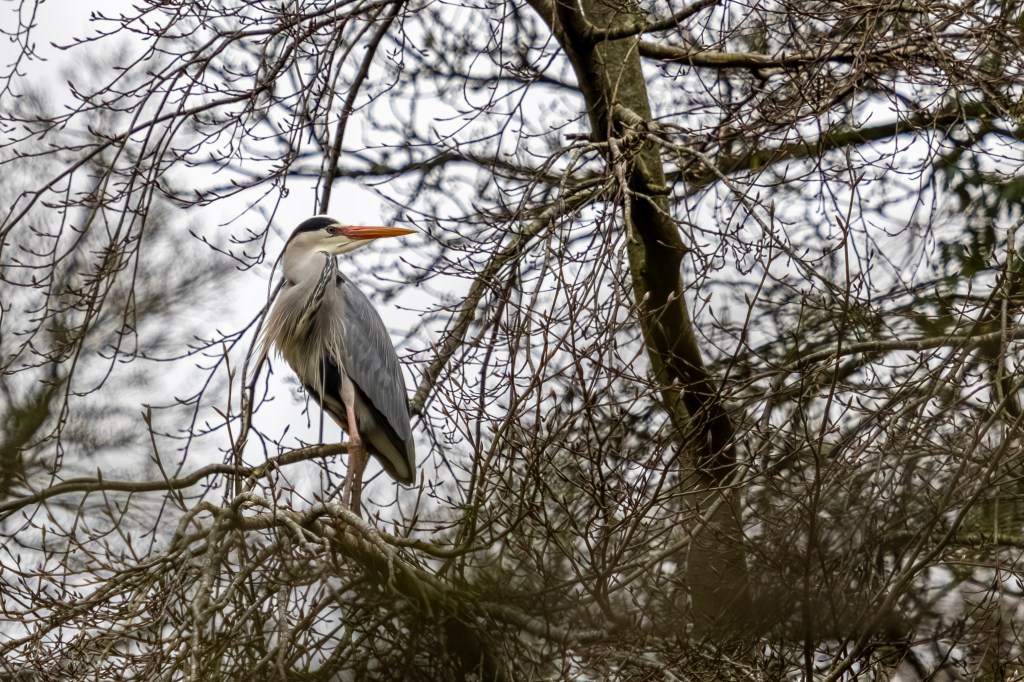
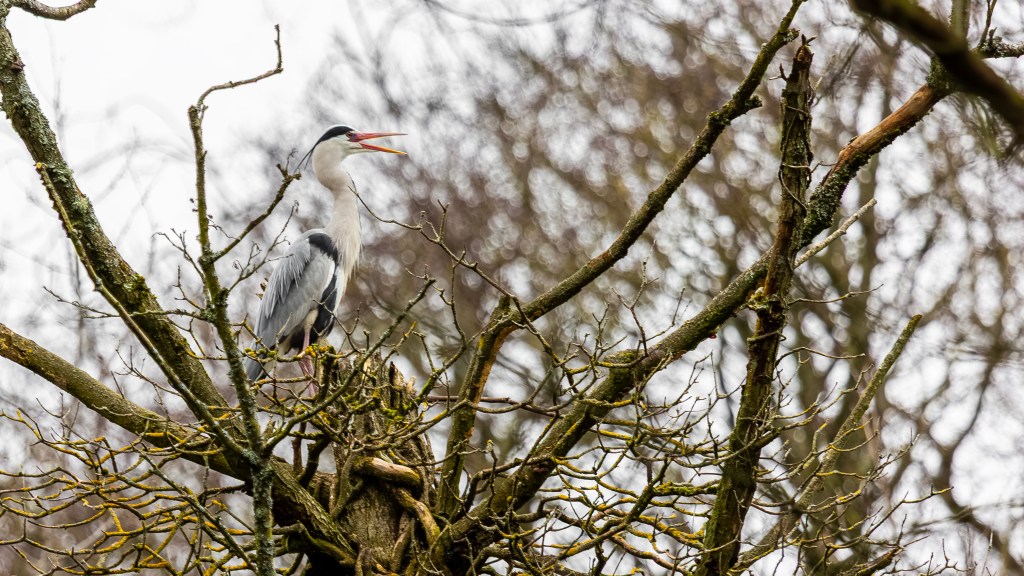
Stranmillis College’s woodland is a partial remnant of the original Cromac Woods, which predates the Plantation of Ulster. So it’s entirely possible that a heronry has existed on this spot for centuries and that Belfast’s urban environment has simply grown up around it. I was delighted when Greg took me on a history tour of the grounds, and showed me some of the best places to view the herons’ activities. He’s a really talented photographer, as these photos demonstrate. Greg’s Guardian-published photo has the advantage of communicating that the Stranmillis heronry is an urban one, and I love the matching greys of the bird’s plumage and the building in the background. However, the ones here (thanks for the gift of them Greg!) better convey the utter wildness of herons. Even in the heart of the city, I had the privilege of directly encountering that wildness – and all the emotion that trembles through those stately-looking birds. So I’m very grateful to have got the opportunity, through Greg, to become better acquainted with my local heronry.
I’d also like to thank Paul, of Stranmillis Estates Management, and the Stranmillis Security staff for out-of-hours access. I could not have written the piece without all their help. And I also had vital help from the staff of QUB’s Riddel Hall campus, who also facilitated out-of-hours access, which gave me great sightings along the boundary fence between the grounds of Riddel and Stranmillis. Especial thanks to Thomas, Steve, and Gary.
And of course, I’d like to thank The Guardian’s Country Diary editor, Paul Fleckney, for commissioning the piece and for his guidance towards its publication.
All in all, what my experience of writing this Diary (apart from the joy of getting the chance to get close up to the herons at what is indeed an “intimate and delicate”– and utterly vital – part of their lives) has impressed upon me, is that nothing is created alone. All of our vital connections feed into the ecology of witness and celebration. So final thanks go to the herons. May they flourish.
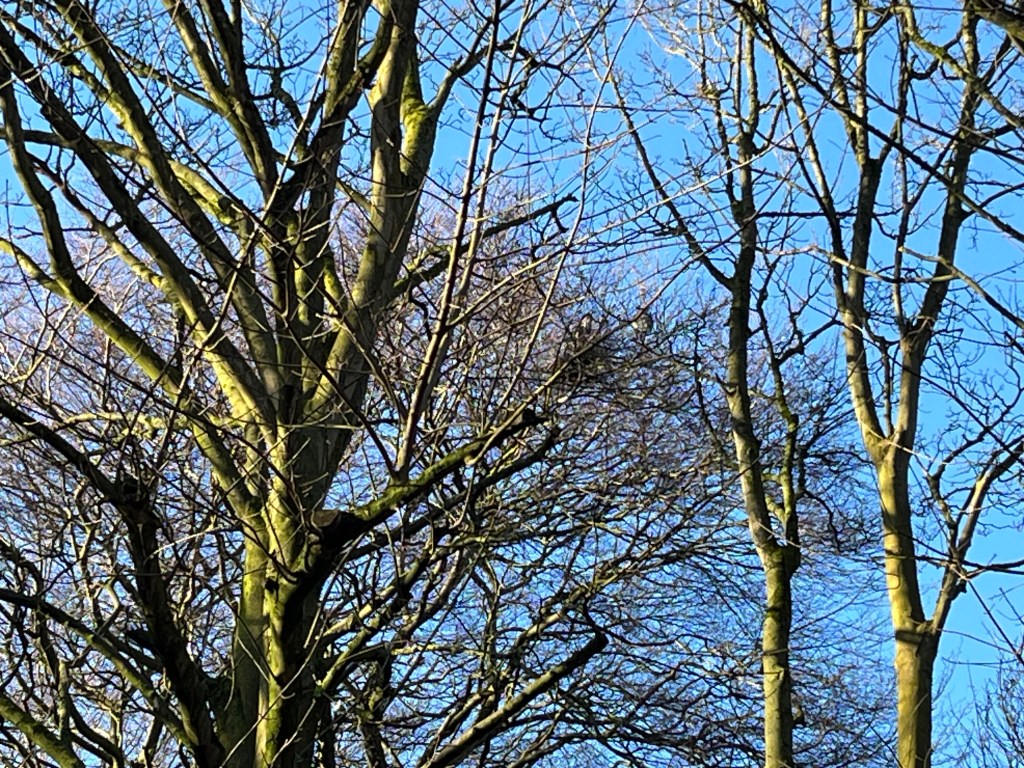
The beech tree pair – briefly together (photo by yours truly)
I’ve been thinking a lot about relationships recently. How the most intimate can also be the most fragile. How we don’t realise what we have until it’s gone.
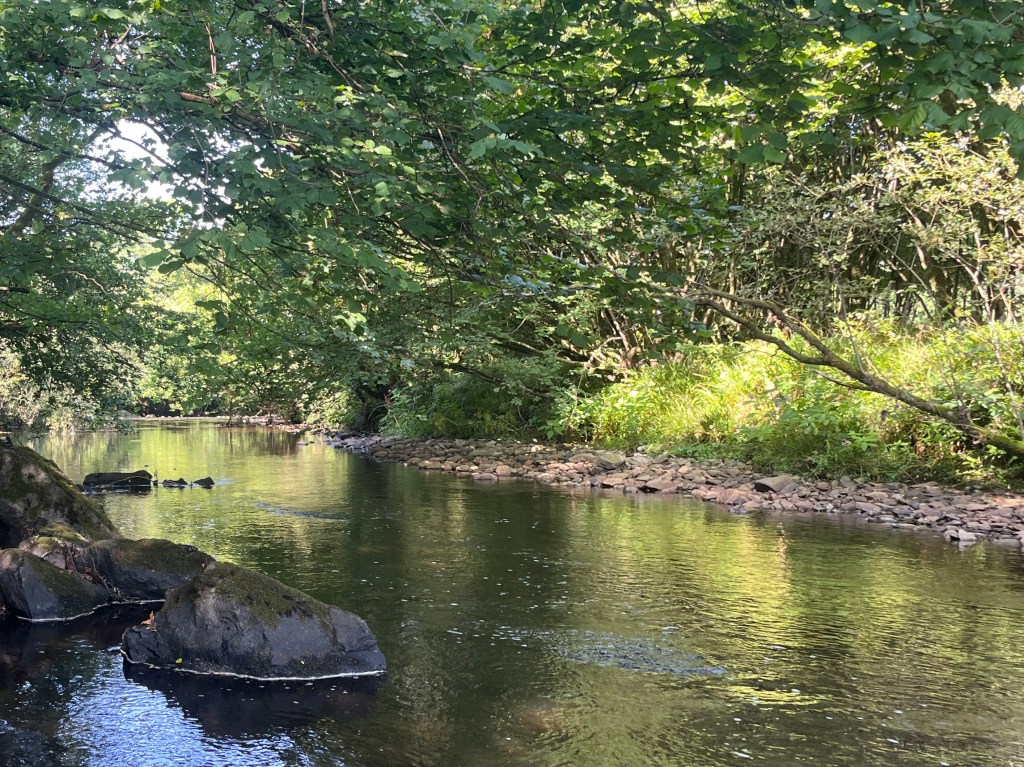
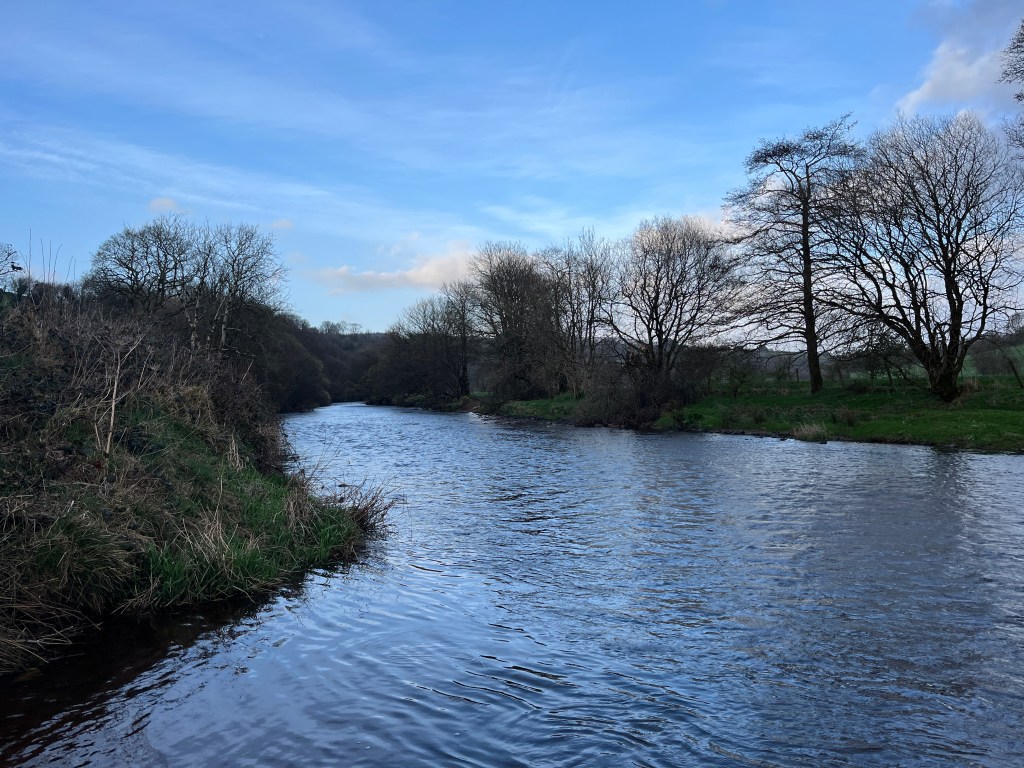
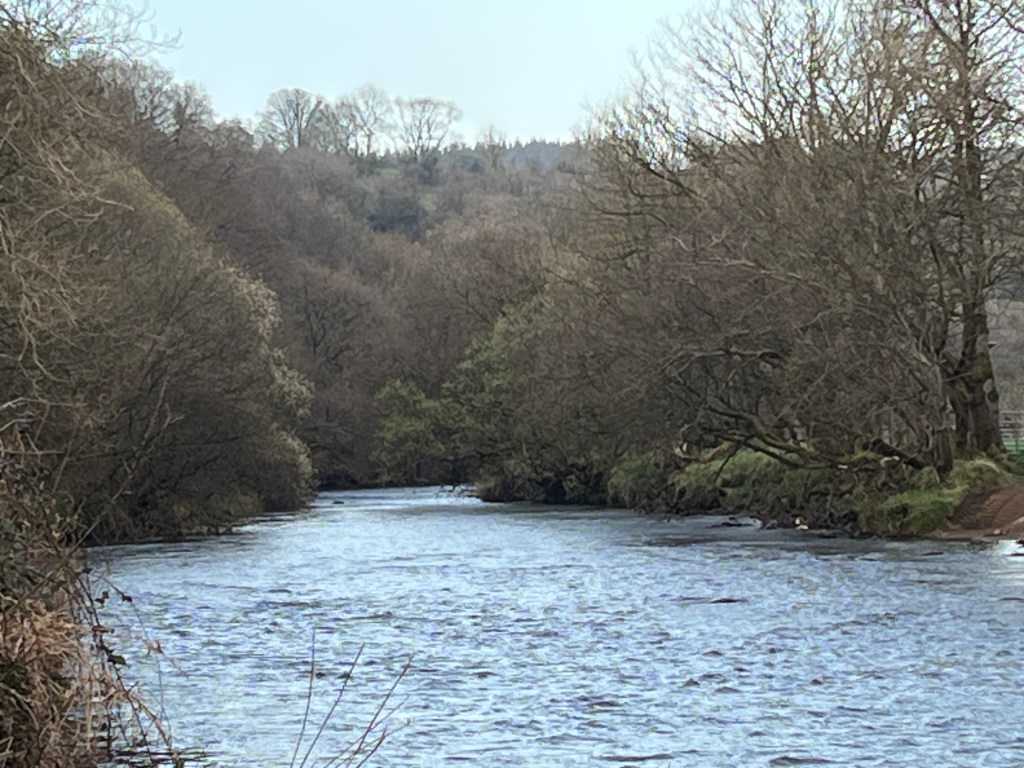
The Owenkillew River, Sperrins, Co Tyrone
The world is feeling an increasingly fragile place. Trusted relationships are distorted and severed. Old stories no longer serve. To speak is to be exposed and endangered. Sometimes we don’t even know the treasures we possess until, like me, you find yourself considering whether to drink the water from your own tap because you know it comes from Lough Neagh and you know that the water is being poisoned. You filter the water. You still worry. You research the impact of phosphates on human health and find yourself confused and unsure. You – consistency being your strong point – feel happy enough to drink the water when the taste of it is masked in coffee or tea, but when you drink it as plain water, your tongue lingers over the flavour, mentally comparing it with the water you drank as a child in Fermanagh. Which came from Lough Erne? You try to remember – no, it was Lough Bradan. You check it out, yes, it was Lough Bradan, which the website cautions, is a public water supply, and care must be taken, apparently, to avoid polluting it. But every day now the lough that supplies your water is polluted. Every single day. And you remember the taste of your childhood Lough Bradan water, remember how every time you went home after being away working in London, Dublin, Derry, Belfast, you ran the tap and took a drink of that water. Because it was the taste of home. And because you trusted implicitly that it was clean.
Lough Neagh at Joyce’s pier near Rea’s Wood, 27th July 2025.
I’ve blogged about Lough Neagh before. Despite appearances in the above photo, nothing much has changed. It’s likely that, because my visit to Joyce’s pier in July 2025 was a little earlier in the season that my 2023 visit to the same location, there was no bad smell. But the reality is that Lough Neagh is in an awful state. And local people are being forced to drink its water. Which is not even to speak about the effect on wildlife and the ecosystem generally.
In our culture, and its predominant thesis of the short term “value” of superficial and exploitative economic “realism”, the intrinsic evolved value of ecological relationships are hard to defend against greed and the desire to make a quick buck. I was grateful to have the opportunity to do that to a small degree in my most recent Country Diary, which was about the freshwater pearl mussel (FPM). This is a species that I was unfamiliar with until Fidelma O’Kane mentioned that it was found in the Owenreagh and Owenkillew rivers in County Tyrone. I wrote about Fidelma in a previous Country Diary. She is an amazing woman who, with other activists, set up the campaign group Save Our Sperrins, which opposes the proposed operations of a gold mining company. As filter feeders of particulate matter, mussels are especially vulnerable to toxic waste. They are also vulnerable due to their dependence on salmon, so if the salmon disappears, they disappear with it.
The brevity of the Country Diary constrained what I could say, about the complexity of the relationship between the mussel and its salmon “host”. It is truly a wonder that this relationship has evolved, which it’s far too simplistic to call “parasitism” – the mussels depend on the salmon, but also, through their filtering activities, help provide the conditions – ie, clean water – for the salmon to survive in. The intimacy and tenuousness of the connection between the two species is a source of joy to me. So, esoteric as it may seem to some, there is an ironic rightness in the fact that a species that depends entirely for its existence on its tenuous and fragile relationship with an entirely different species, is something of a poster child to illustrate the importance of ecological relationships. And stay with me, because the story of the Owenkillew ties in with the story of Lough Neagh.
Freshwater pearl mussel shell, briefly returned to its native waters
It’s hard to write about ecological relationships and their diversity and complexity. They can be reduced to a version of mutualism, which is what I was trying to get across when I described the relationship between the larval FPM and the juvenile salmon as payback rather than parasitism (parasitism seems far too limiting a term; one derived from functional terms like “direct benefit” and “ecosystem service”; the likes of which narrow relationship down to a single function of exchange). The you tube video that I linked to in the piece showing the industriousness of mussels in obtaining food by filtering the water clearly (!) illustrates this point.
With regard to the specific intertwining of the life cycles of the FPM and the salmon, perhaps the best expression of the “payback” is found in this paper by Castrillo et al (2022). It opens with a beautiful take on the naiads, those mythological Greek spirits or nymphs … “least of the lesser goddesses” as Circe described them – her maternal forebears – in Madeline Miller’s novel. As they introduce Margaritifera margaritifera, the freshwater pearl mussel, the scientists invoke these “mythological female nature deities which preside over bodies of fresh water and protect the water quality and the freshwater ecosystem” . That’s how I will forever now think of the FPM: a modest goddess, scarcely seen, sequestering the pearl of great price – which is not located in the nacreous globules that it makes to protect itself from the rub of irritant particles – and for which it was plundered almost to extinction – but for the “ecosystem service” that it generously provides. (For the record, I hate that anthropocentric term “ecosystem service“, but I can just about swallow it when “service” is applied to all parts of the ecosystem, and not just us). So, rather than a single pearl that might be hidden in the folds of the mollusc’s flesh, the “pearl of great price” is the clean water that its species’ evolved feeding activity gives freely to other riverine inhabitants and dependants, including the salmon.
Of course it’s a fair point that, for the individual salmon that are parasitised by the infant freshwater pearl mussel, there may indeed be a cost. Castrillo et al provides a detailed description of the growth and development of the mussel while it is part and parcel of the salmon’s flesh, but make no comment on the effect on the fish. However, this paper, by Taeubert and Geist (2017) provides a comprehensive assessment. It makes the point the relationship between the FPM and its host is unique because it is “very different from any other common host–parasite system. Although the fate of the larvae is directly linked to the survival of the host, the parasite does not reproduce on the host and successful reproduction of M. margaritifera (FPM) is — to some extent (at least for the post-parasitic stage)—decoupled from the host. This is supported by the fact that the mussel needs up to 15 years to reach sexual maturity after leaving the host (in contrast to 3–4 years in most of its hosts), and by the substantially smaller distribution area (ie, geographical range) of M. margaritifera compared to its hosts.”
Taeubert and Geist go on to say: “Taken together, M. margaritifera reveals a clear parasitic character during its host dependent phase at high infection rates, although moderate infection intensities do not seem to have significant detrimental effects on the hosts (Taeubert and Geist, 2013). This is also supported by Treasurer et al. (2006), who found that (moderate) infection … had no significant effect on salmon survival and only a small effect on host growth.”
So, while it’s not quite the same, I can’t help thinking of the “parasitic” mussel larva (a nymph? a tutelary spirit?– OED) as commensals, living in “fragile harmony” (as Country Diary editor Paul Fleckney put it) with their hosts, like various species of bacteria do with us. And it prompts in me a sense of gratitude towards both the salmon and the mussel and all the other complex ecological relationships that we scarcely understand but into which we are built and networked; because like all other forms of life, we are made from this Earth and we cannot be separated from it. So no more that I can reject (or eject) the bacteria living on and in my body, given the larger picture, the clean water, the other forms of life including its prey that that clean water sustains, if it had the power, would the salmon choose to get rid of the mussel?
Personally, I would bet not. We can’t so simply compartmentalise the relationships between species.
These species – salmon and mussel – co-evolved, and while the connection between them may be more tenuous than that between flower and pollinator, it’s the same kind of relationship. Both parties ultimately benefit. And naiad that it is, like a protective spirit, the FPM also contributes to making a clean home for other species as well.
Older knowledge, embedded in our language, tapping down into the deepest reaches of the psyche, teaches us this. Freshwater pearl mussels belong to the taxonomic group Unionida, and an old meaning of the word “union” is “pearl of large size, good quality, and great value” (from the Latin unio, “a single large pearl”, Cassell’s Latin Dictionary). Back to the pearl of great price. The “tutelary spirit” of the naiad, is burrowed deep into the word. A kind of etymological ecology? – etymo-ecology? – reminding us of the union of ecology, its interrelationships and interdependence. There is no separation.
I am so very grateful to have had the opportunity to write about the freshwater pearl mussel. Thank you Fidelma O’Kane & Cormac McAleer of SOS. Thank you to the local farmer whose land the Owenkillew runs through and who was the source of the shell I held in my hand, as well as many stories. Thank you Bryan Ward of Ulster Wildlife, for talking me through the details of the mussel’s life cycle and many of the issues surrounding the protection of this species. Thanks as always to Paul Fleckney. And thank you, Sperrins. Thank you, salmon. And special thanks to the naiad of the Owenkillew and Owenreagh rivers – the freshwater pearl mussel.
I finished Monday’s Country Diary with a prayer for all the river’s spawn. I will extend it now, paraphrasing Castrillo et al‘s words, to all the rivers and loughs and all the life that depends on them, which are threatened by pollution, from whatever source:
May the ancient naiads of the living waters preside over and protect us all.
It’s been a while. First there’s the matter of my most recent contribution to The Guardian‘s Country Diary. As the more long-memoried of you will recall, I wrote about Newgrange for December. And I went back to Brú na Bóinne for the start of May, which gave me the opportunity to spend more time at Knowth, an equally fascinating if somewhat less famous place
The Great Mound & some of its satellites at Knowth, Co Meath
So (thanks again to Paul Fleckney for the commission and his editorial support), I was delighted to have the chance to write about Knowth here.
Neolithic carvings on a Knowth kerbstone
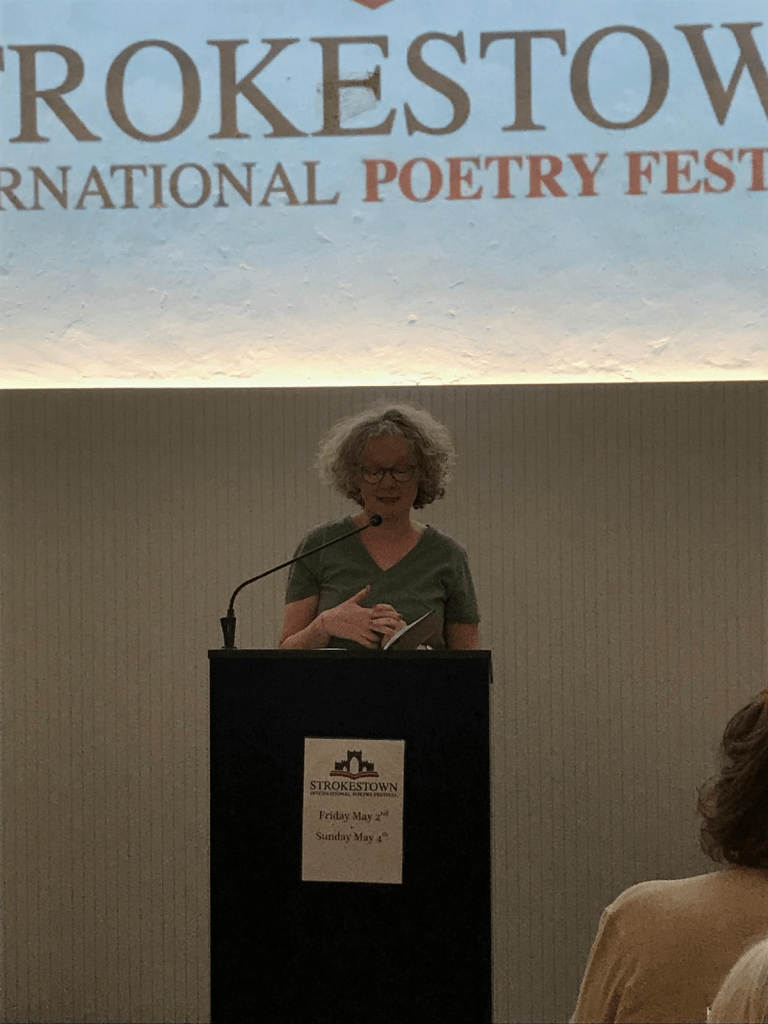
We spent time in the Boyne Valley and then went on to Strokestown in Co Roscommon to attend the Strokestown International Poetry Festival. I have been meaning to attend that festival for many years, but it always coincides with International Dawn Chorus Day. Which has meant that, heretofore, I was usually involved in some birdsong event or other. However, I have stepping back a little from my teaching and facilitating work (including my sciency work) to focus on my own writing. So this year I was able to attend!
It was a wonderful festival with some fabulous readings from Sam Furlong and Eilish Martin who have recently published collections with the wonderful Macha Press; as well as Kate Newmann, Noel Monahan, and many others, including the esteemed Eiléan Ní Chuilleanáin. It was great to have the chance to catch up with old friends also.
Not only did I attend, I also read from my now-published excerpt of my work-in-progress novel, A Wolf’s Breath (WIP, but coming along nicely, thank you). I was very honoured to read as part of the launch of Cyphers Magazine (99). And what great company to be in!
That’s me – reading with nervous hands! – Thanks to Kate Newmann for the photoFiction – published!
Many thanks to everyone at the festival for all the organising; and especially to Eiléan, Natasha Cuddington, Léan Ní Chuilleanáin, Joe Woods & Áinin Ní Bhroin at Cyphers Magazine.
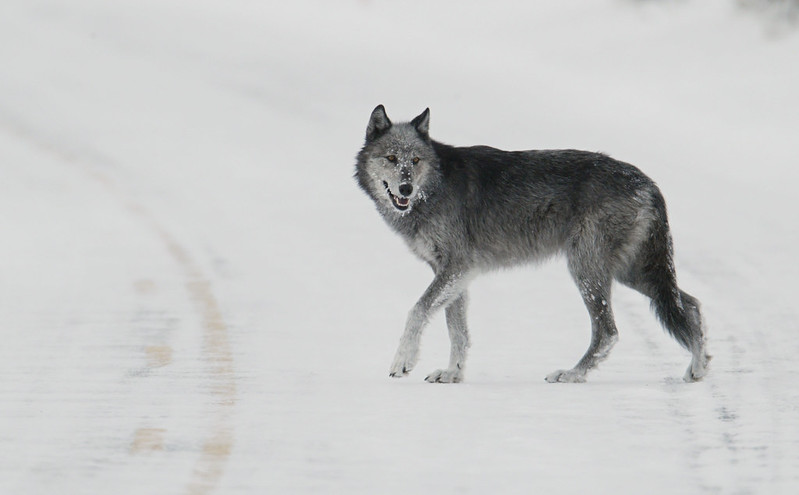
Half-Black: daughter of 42F & 21M, by Jim Peaco, 31 December 2003, Lamar Valley, Yellowstone
I love this photo. I especially love it because just a few weeks after it was taken, I visited Yellowstone in January 2004 and saw this very wolf. I was also introduced to her natal pack, the Druids (named for Druid Peak, in the Lamar Valley). Half-Black was one of the then-famous Druid Daughters who was restive during the breeding season, always sneaking away from her birth-family as she tried to establish her own. Her father was none too happy about the strange males she and her sisters kept flirting with. It didn’t stop their rendezvous. Here she is crossing that same road that I, along with the group I was travelling with, were taken up and down to try and keep track of the wolves. The whole trip was one of the most inspiring and compelling experiences of my life.
All this is by way of preamble to say that an excerpt from my unpublished novel “A Wolf’s Breath” has been accepted for publication. It is forthcoming in Cyphers Magazine. Cyphers 99 will be launched at the Strokestown International Poetry Festival on the 4th May. I am very grateful to all on the publishing team, but especially to editor, Eiléan Ní Chuilleanáin.
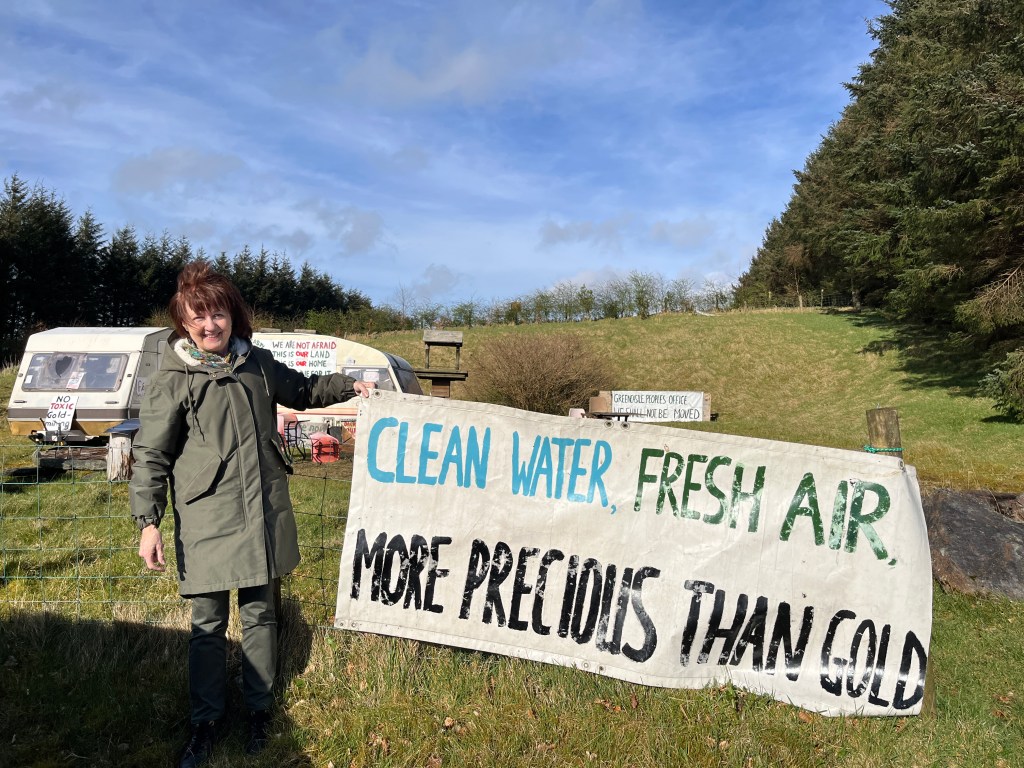
Where is your treasure? I was delighted to have this chance to write about the Sperrins, and meeting Fidelma O’Kane and other members of the Save Our Sperrins campaign was a truly inspirational experience.
View from Crockenboy Hill (where the proposed mine would be situated)
It was prompted by an invitation from Cherry Smyth to the poetry-music performance of her poem One Mountain: Sold. The poem is brilliant on the page, but the live performance at An Creagán, on 29th March, was something else. Interwoven and in conversation with the vocal and musical compositions of of Lauren Kinsella and Dan Nicholls, it was an ethereal, resonant and haunting evocation of the voice of the land itself. Through the magic of electronics and instrumentation, Lauren’s voice morphed from the tinkling of birdsong and mountain streams to the disturbing thuds of drilling and the groans of the earth. The voices of local children were braided through the performance, as they chanted the townland names like a song. It was a wonderful evening.
I’d already spent much of the afternoon in the company of Fidelma O’Kane, who took me on a whistle-stop tour of the area. Having myself lived in the north Sperrins for over a decade, I could appreciate in a visceral way the dissonance local people must feel at the thought of a mine so close to their homes. And as commenter Wormwood20 drew prompt attention to in their comment on my piece, this a really current issue, not just in the Sperrins, but all over the world.
However, people like Fidelma, and others in SOS, many of whom I met that evening in An Creagán, are a testament to the human spirit and to its ability to persist against all odds. It was an honour to meet them all, and to have the chance to put that into a very small number of words, which hardly do justice to their commitment and sacrifice.
Fidelma O’Kane says it like it is…
I spent a little time by myself towards evening at the Owenkillew River and had a few words with some shy sheep.
Owenkillew RiverSome local inhabitants
Speaking of words, every one of those is precious too. I took the notion to buy the hard-copy of The Guardian today, because I wanted to see what lovely wood-cut effect image might accompany the piece, (as often the case in the print version). Well, there wasn’t one – maybe this was to allow for more space for my words. And indeed there is no difference between the print and the on-line version that I have identified (sometimes the latter is a smidgeon longer – the column as a physical thing means there’s more pressure on the word-count). Anyway, here’s the hard copy:
The column – sans woodcut.
I am grateful to Cherry Smyth for connecting me directly to this issue and to the SOS campaign, as well as for her wonderful poem, One Mountain: Sold. To Fidelma O’Kane for all the time she gave me, all she showed me, and for all the stories of commitment and creativity. To Lauren and Dan, as well as Cherry, for making such a stunning work of art, which completely illustrated, as I think Dan said, how art is political ‘even when it pretends not to be’ – and that it’s vital not to play it down as simply ‘entertainment’. Their collective work was mesmerising in its beauty and its bravery. To everyone I met at An Creagán, especially Mairead, Emmet, Cormac, Fergus and Barney. You are all so inspiring. I’d also like to thank Kerry McCrory and Gordon Dunn for generously providing the gorgeous photos that accompanied the published piece.
And finally, I especially want to thank the editor of the Country Diary, Paul Fleckney, for all his encouragement and guidance.
I’ve have been meaning to write about this since I saw this article in the Guardian a few weeks ago, on response of Galapagos warblers to traffic noise. Having done a PhD on the impact of anthropogenic noise on birdsong, I do still take an interest in how noise affects birds generally. And, intuitively, it’s surely not surprising that birds are more aggressive in the presence of traffic noise – they are probably stressed by high levels of background noise in a similar way that humans are.
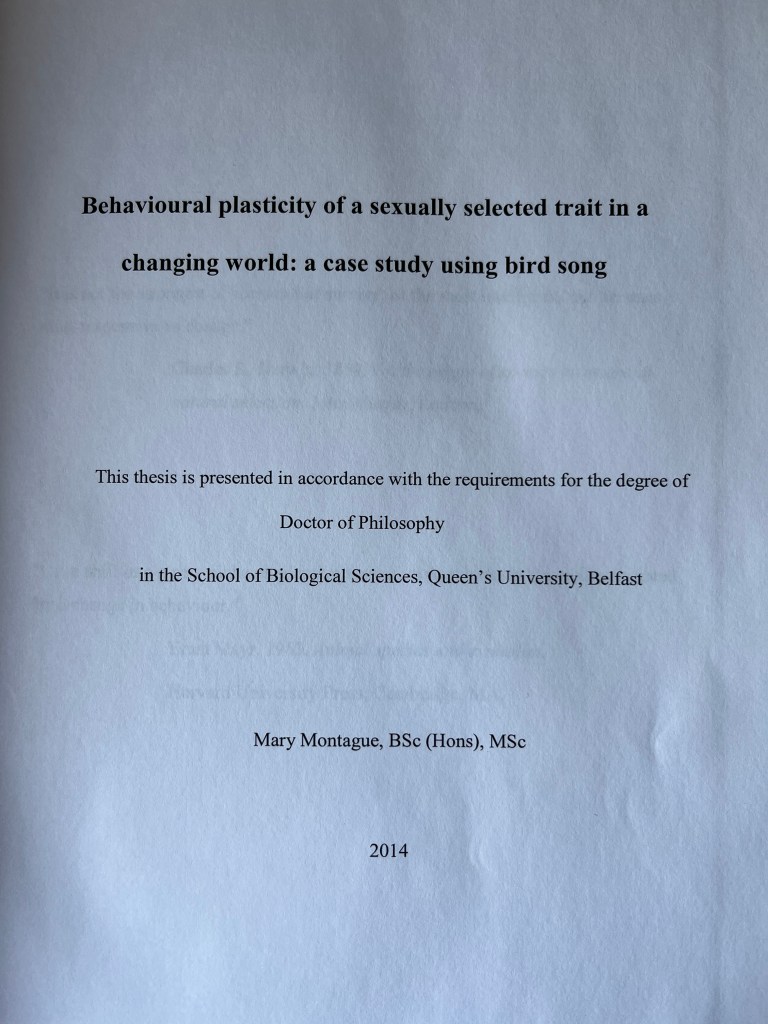
Frontispiece of my lovely PhD thesis
However, what tickled me what this finding:
“across the board, males slightly increased the minimum frequencies of their songs when traffic sounds were played – possibly to make it easier for others to hear them. And, while an increase in peak frequency was only seen in males that lived away from traffic, the team suggests that could be because the birds that lived near roads were already singing at the optimum peak frequency.”
Now, I don’t imagine most readers will be too struck by that kind of minute detail, but this was a central – and agonising – issue of my PhD. Do birds genuinely increase the frequency of their songs in the presence of (low-frequency) anthropogenic noise to evade its masking effect, in a similar way to how the shrill of car alarm can be clearly heard against the low frequency throb of traffic noise)??; or is the apparent increase in song frequency a result of singing louder, and thereby singing more shrilly??
In other words, is the increase in song frequency a first consequence, and therefore, implicitly, a chosen response by the singer; or is it an involuntary effect of the birds simply singing more loudly.
Believe me, that was some argument. A lot of it centred around the technical difficulties of measuring increased song amplitude in the field. As a result, in the one camp, there was Slabbekoorn & den Boer Visser (2006) providing compelling evidence for the higher minimum frequency of songs in urban areas, compared with rural areas. On the other hand, there were folks like Nemeth and Brumm et al arguing that said frequency changes were a by-product of other changes in singing response to noise (ie, singing more loudly), rather than a primary response in and of themselves. The argument got testy at times: ” … for crying out loud: singing higher may also matter!” ended the last line of this paper by Slabbekoorn, Yang and Halfwerk.
Little wonder that, in the middle of all this, I felt like the whole premise of my PhD was on quicksand.
There was also the difficulty with the experimental treatment that I subjected my wild birds to, namely, exposing them to pre-recorded traffic noise and measuring any behavioural changes to their song. Because the noise treatment showed up on the recording, it was difficult to effectively adjust was called the “power spectrum automatic parameter tool” (Glory be, all the lingo is coming back to me!) of the software to measure things without human input. So essentially, I had to use the tool manually, in other words, subjectively. The image below illustrates the problem:
Image of Chiffchaff song in (L), absence of noise; and (R) presence of noise.
You can see how close the lower parts of the song is to the background noise level on the image on the right. The software couldn’t always cope and had to be constantly reset in an extremely time-consuming way. But arguably – and I do – my human vision could.
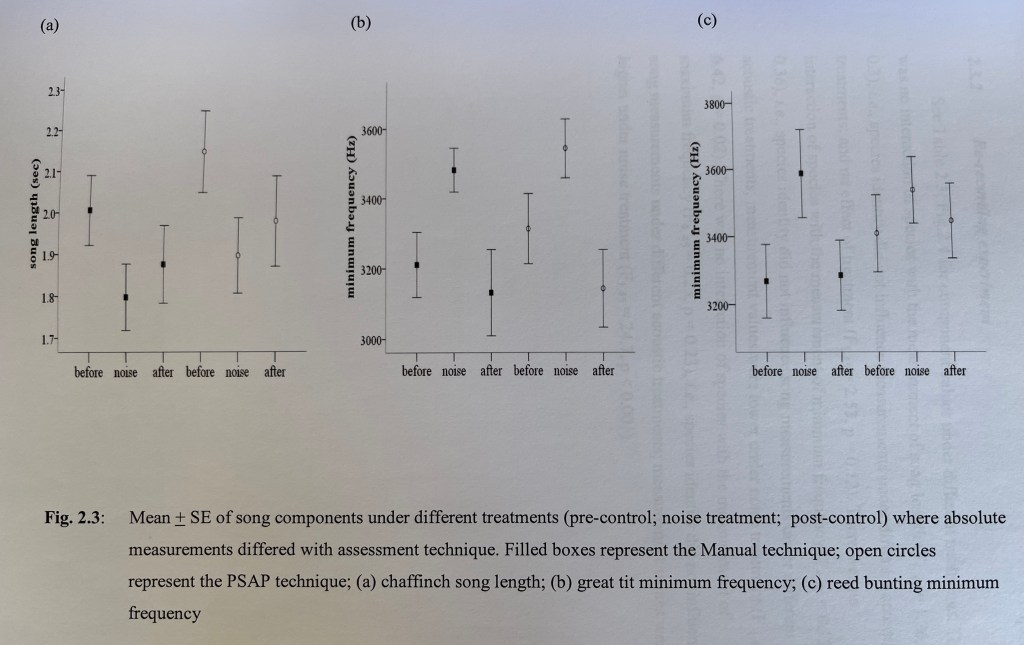
The reason I argue this is that, using a similar validation experiment to this paper by Verzijden et al (2010), I carried out a re-recording experiment on a number of species song-recordings with different singing styles (chaffinch; great tit; reed bunting), to verify that the background noise did not significantly affect the accuracy of manual measurements compared with the software.
Graphs showing that there was no significant difference in the automatic (PSAP) method using specialist software; and the human gaze (ie, my assessment was sufficiently objective for my study).
However, there’s no doubt, as you can see in the chiffchaff image above, that the minimum frequency, ie, the absolute lowest part of each note of the song, comes dangerously close to overlapping with the lower frequency background noise (that long dark smudge at the bottom of the graph; the white bit underneath is where I filtered out the lowest frequency noise of all to help the software to work a little better, and to make the whole thing easier for me to listen to). So, I also used an eraser tool to wipe out some of the background noise where it was interfering with the software’s measurement of song length. Again, I had precedent. I was guided by this paper, by Kamtaeja et al (2012), who did exactly the same thing. And if my vision could measure accurately along a vertical plane (ie, the song frequency), surely it could also accurately assess along the longitudinal plane as well? I also took precautions …
I took care to get it right … (APT = automatic parameter tool)
On top of all that, and this is finally bringing me back to those Galapagos warblers, that set me off on this trip, I also measured the peak frequency of the lowest song syllable. At that time (and forgive me, I’ve been a bit out of touch in the decade since) peak frequency was not always measured when checking for the impact on the song frequency, at least not in most of the literature that I scoured. Researchers tended to stick with the lowest frequency. However, the advantage of peak frequency was that it was entirely measured by the software, there was no potentially contaminating effect of my human gaze. I included the peak frequency measurement to back up whatever findings might emerge for the impact of the traffic noise on the lowest frequency part of the song.
Ok, I know, to the unfamiliar reader, what’s the big deal? Well, lowest frequency is the absolute lowest part of the song; peak frequency is the dominant frequency of the particular sound, ie the loudest part. They aren’t quite the same thing, although they both give an assessment of what might be shifting frequency-wise in the low frequency part of the song in response to low frequency noise.
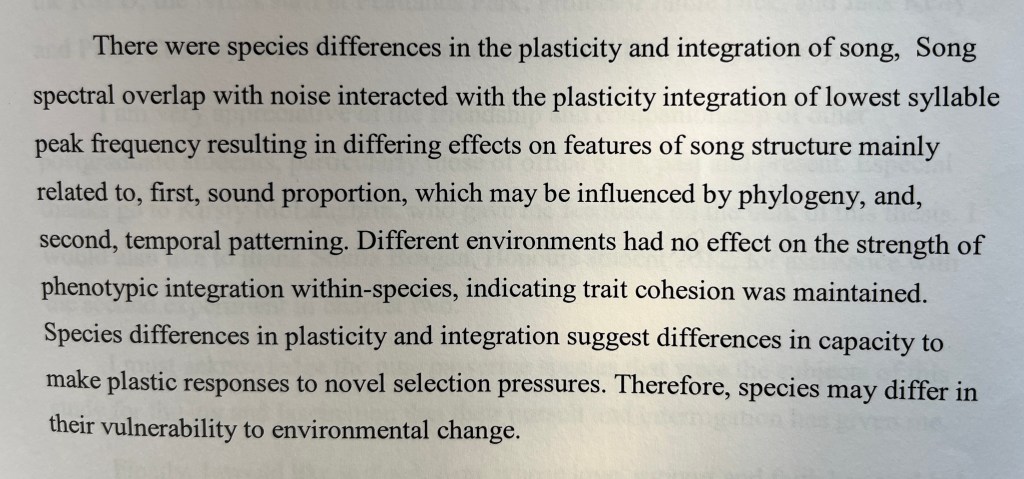
I’m so glad I did measure peak frequency. It turned out to be very important, and the wider implications were among the most important findings of my PhD. I essentially found that singing birds were happy enough to sacrifice the absolute lowest frequency part of their song; but peak frequency was more important. I linked this to what’s called plasticity integration – because the song changed in response to the noise, the birds integrated these changes in a way that maintained the cohesion of the song as a whole. But the foundation of that integration was its reliance on the peak frequency. Birds were probably unwilling to sacrifice the peak frequency too much, because across the animal kingdom, low frequency elements to a voice, particularly a male voice, are a sign of maturity. This was consistent across nine different species (chaffinch; wren; robin; blackbird; song thrush; great tit; reed bunting; chiffchaff; willow warbler).
How I summarised my entire PhD in the concluding paragraph of my thesis abstract
So imagine my pleasure at reading that the research described in the Guardian article found that the birds living away from roads shifted their minimum frequency when experimentally exposed to it – corroborating the idea that the shift in frequency is a primary response (rather than merely a consequence of singing more loudly). The birds already living next to roads, on the other hand, did not change their peak frequency, probably because they “were already singing at optimum peak frequency.”
Maybe they had were already performing at maximum integration of their song in relation to that peak frequency difference as well?
These Galapagos findings feel like a confirmation that I was on the right track all along. Which is nice, because the immediate aftermath of my PhD was a bit of a rollercoaster. I wrote a paper, but unfortunately, I think I fell foul of the polarised argument that I’ve described above. Without belabouring the details this far on, that paper was sent out ultimately to five different reviewers for the one publication (2-3 is the norm, as I recall), before it was rejected. There were some scathing comments from one reviewer about my methodology. I’m guessing he was on the “other side”.
It was upsetting at the time. I had gone to so much trouble to validate my methodology (to the extent that it must have cost me about 4-6 months of my PhD). But I had already decided that the PhD was enough for me, I wasn’t going to pursue an academic research career at that stage of my life. I’d done pretty well to get the PhD as it was. And inevitably, as I then pursued other things instead, the possibility of scientific publications faded further out of reach. I simply had neither the time nor the inclination.
Ah well.
However, it is nice to see that the Galapagos warbler findings bear out some of my own. I guess now I’ll be on the look-out for anybody interested in seeing how peak frequency changes influence the overall integration of birdsong. But you’ve read it here folks, I got there first!
Lá fhéile Pádraig sona dhaoibh! (Happy St Patrick’s Day everyone!).
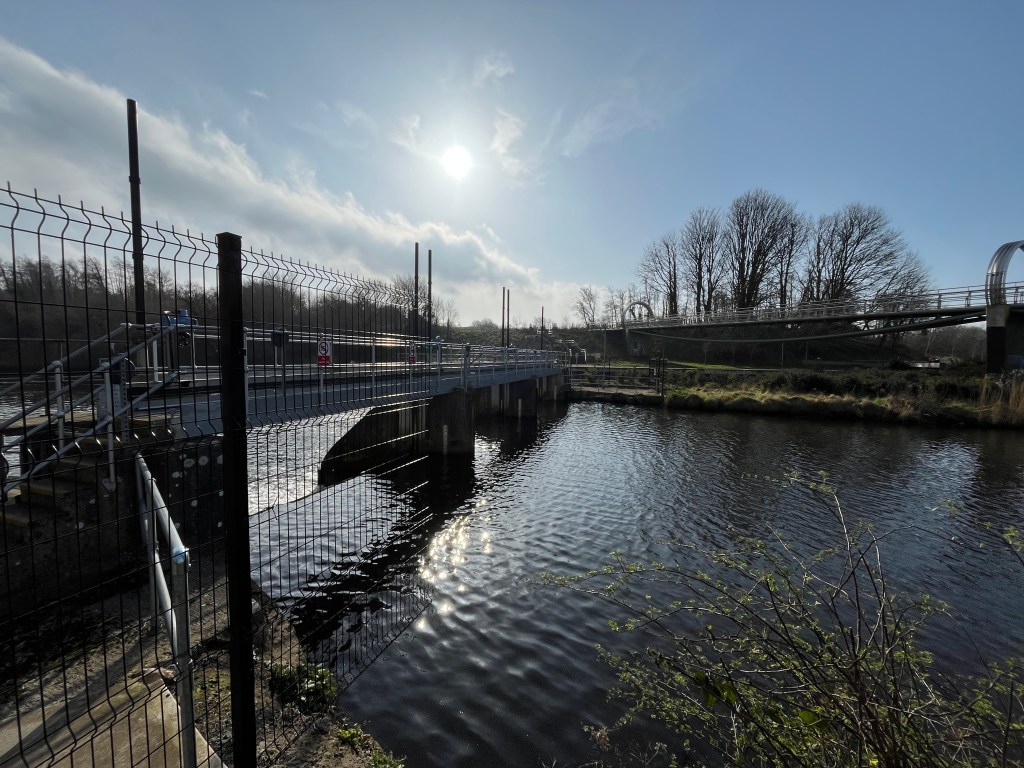
It’s a wee bit of an occasion for me today – my 40th contribution to The Guardian‘s Country Diary was published this morning. So in all the celebrations today, I’m glad to add that one into the mix.
The piece is about black-headed gulls, which like all birds that have defined and predictable breeding seasons, are currently undergoing massive change.
The sluice gates at Stranmillis – close to where “my” black-headed gulls were perched.
One of the many things I love about birds is how similar they are to us in some ways, and then, how mind-glowingly different.
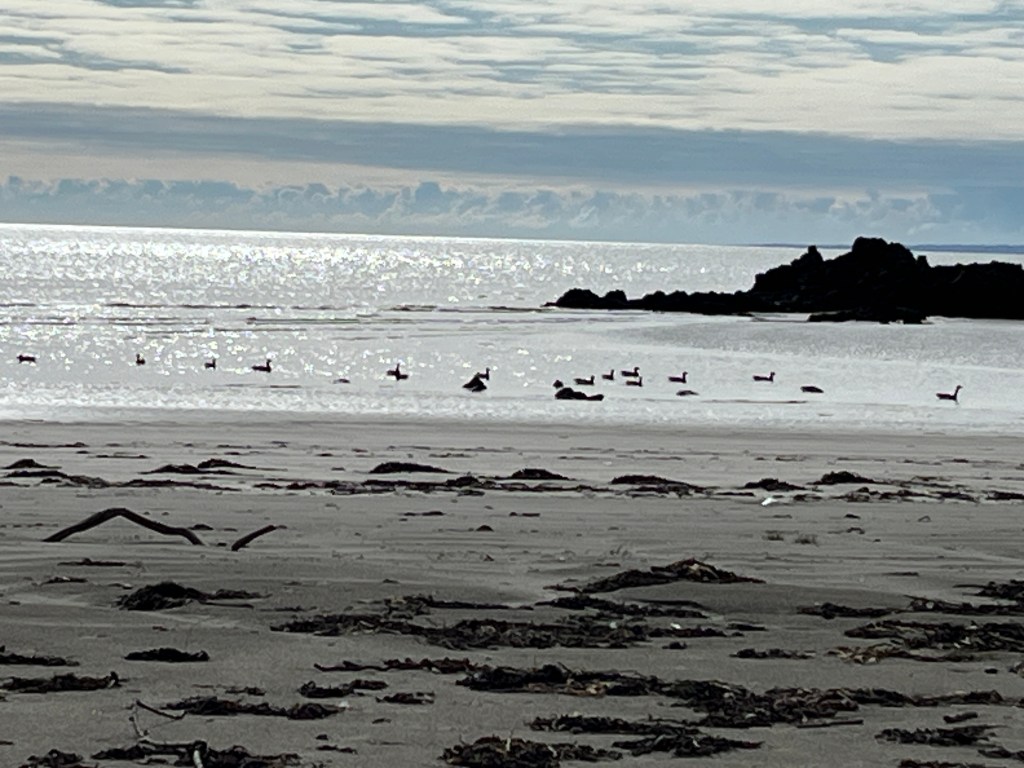
And just to add in another little celebration. Yesterday I was at Tyrella Beach for my final monthly survey of wetland birds for the BTO. This regular winter season survey by folks all over the UK & Ireland (the Republic’s sister organisation, Birdwatch Ireland, does theirs in parallel). I haven’t been brilliant this year – I missed 3 months (between holidays, illness and bad weather) but I did cover four. February’s was a desperate day, with appalling weather but yesterday was glorious. After I finished the survey part (designed to be within two hours either side of high tide – while I may not meet them, it’s always nice to think of the thousands of other volunteers who are doing this work at a similar time all over these islands), I just sat down on rock with my scope. It was such a different day. I saw no sanderlings or dunlins, which are so prevalent the winter months. They must be gone north to breed. However, there were a few Brent geese still around. But because I was anticipating today’s diary, I found myself paying far more attention to all the gulls. The different plumages that mark their species, age and stage. As the afternoon drifted on, I had the greatest compliment a wild creature can give you. Most of them relaxed enough under my gaze to doze.
Once again, this question (no idea if Henry is a relative, but I’d say not). In the days I mixed in “academic” poetry circles, I found myself, as I’ve blogged before, astonished at the sneery attitude to MO. And as I’ve also said before, this from people who had never actually read her. Or who had read her only from a couple of lines from some of her most loved poems. Who never “got” her.
For the record, I love Mary Oliver. I loved her enough to travel across the Atlantic twenty years ago for the express purpose of hearing her read. She is grossly underestimated. She has never drawn the critical attention she deserves.
Thanks to the ever-wonderful Dynamic Ecology to linking me to the question.
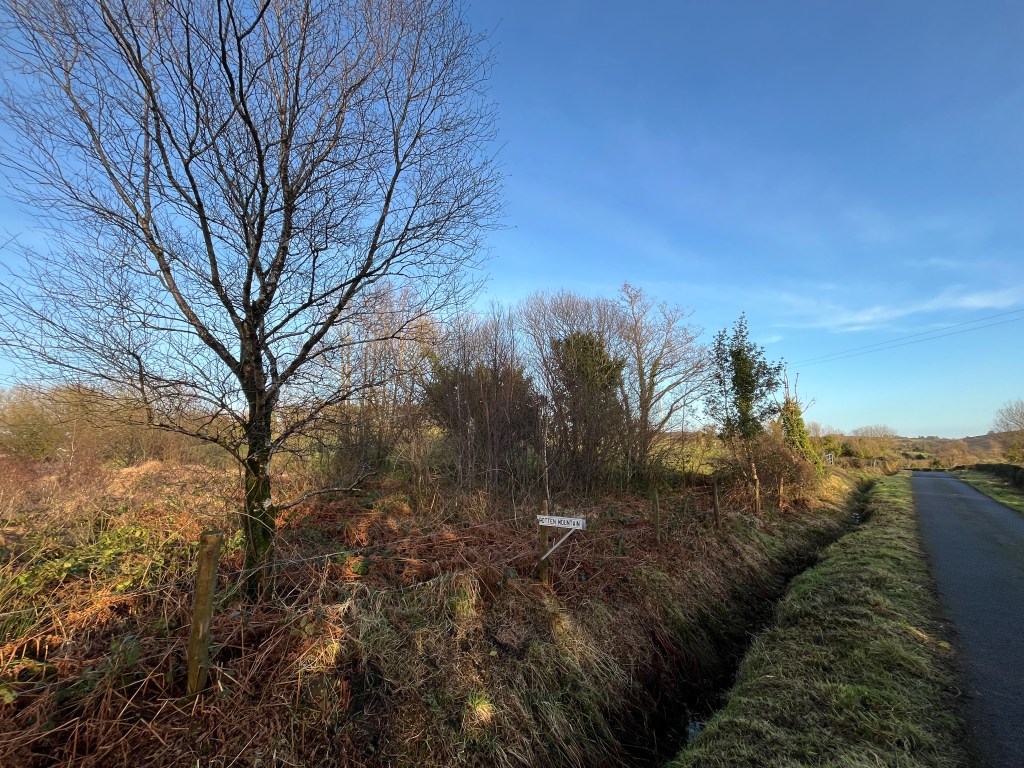
I was lucky enough to be able to céilí at Danny Gormley’s in the townland of Rotten Mountain (a transliteration from the Irish: the original name may have been rath tine (fort of fire) or raithneach muine (shrubbery of ferns), in Co Fermanagh, close to where I grew up. Rotten Mountain was always something of a legendary name to me when I was a child – I used to hear about it from my late father, Dr Seamus Montague, the local GP. The name always struck me. So it was great to get the chance to write about a really special event that took place there on January 31st, for my latest Country Diary. This céilí has taken place here for many years; and, on a wider scale locally, for many years before that.
Approaching Rotten Mountain from Tievenavornog
It was the eve of Imbolc, or St Brigid’s day, which is still celebrated here in the traditional way by making St Brigid’s crosses out of rushes.
James Hugh’s perfect symmetry
I have so many people to thank, those that made it to céilí that night; and all the other nights of the past. I want to thank Danny for opening his home to us all, and sharing so many stories with me; and I’d like to thank his family for their hospitality and kindness; Mena Hegarty who always makes me welcome in Drumskinny (another nearby townland); all the dancers and singers and story-tellers, young and old. It was a magical evening, and I’m so glad to have had the chance to be there.
And thanks, as ever, to Paul Fleckney, editor of the Country Diary, for the opportunity to write about such a special event.
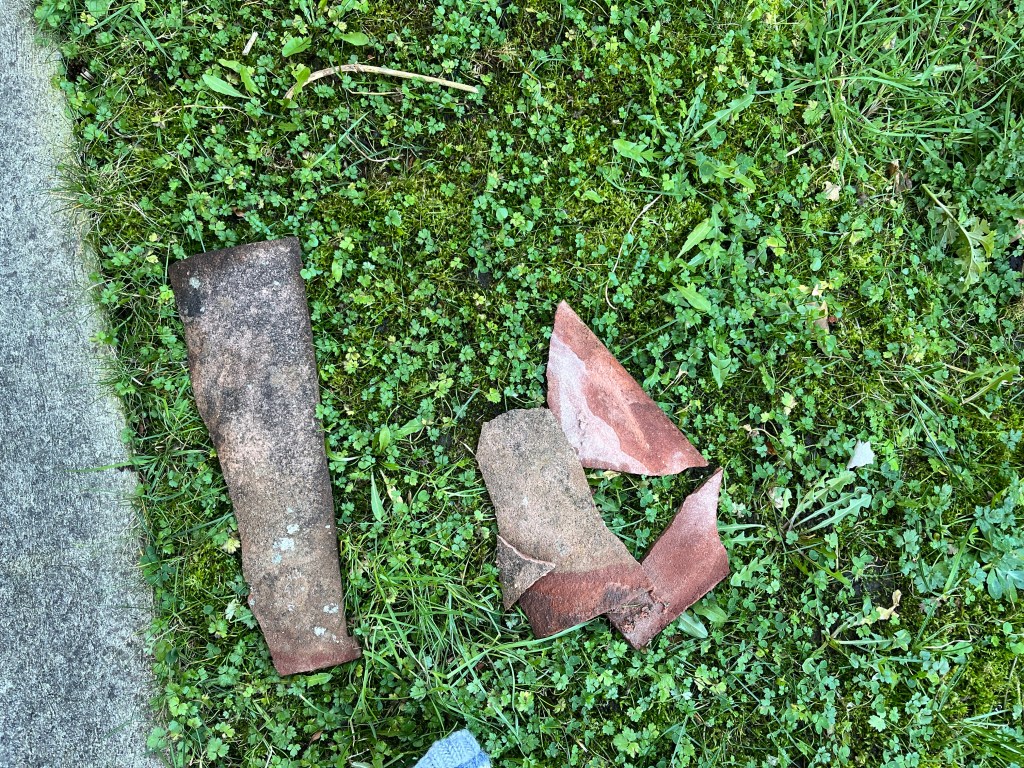
Yesterday there was a brief respite between Storm Éowyn on Friday and today’s pretty standard wind and rain. Thankfully we got through Éowyn fairly unscathed, losing only a couple of tiles from the “rooflet” over our downstairs bay window. Mind you, that was probably because Storm Darragh took off a swathe of our roof’s tiles before Christmas, which meant we had our roof already mended and reinforced. Our immediate neighbours lost a fair few tiles.
Minor losses
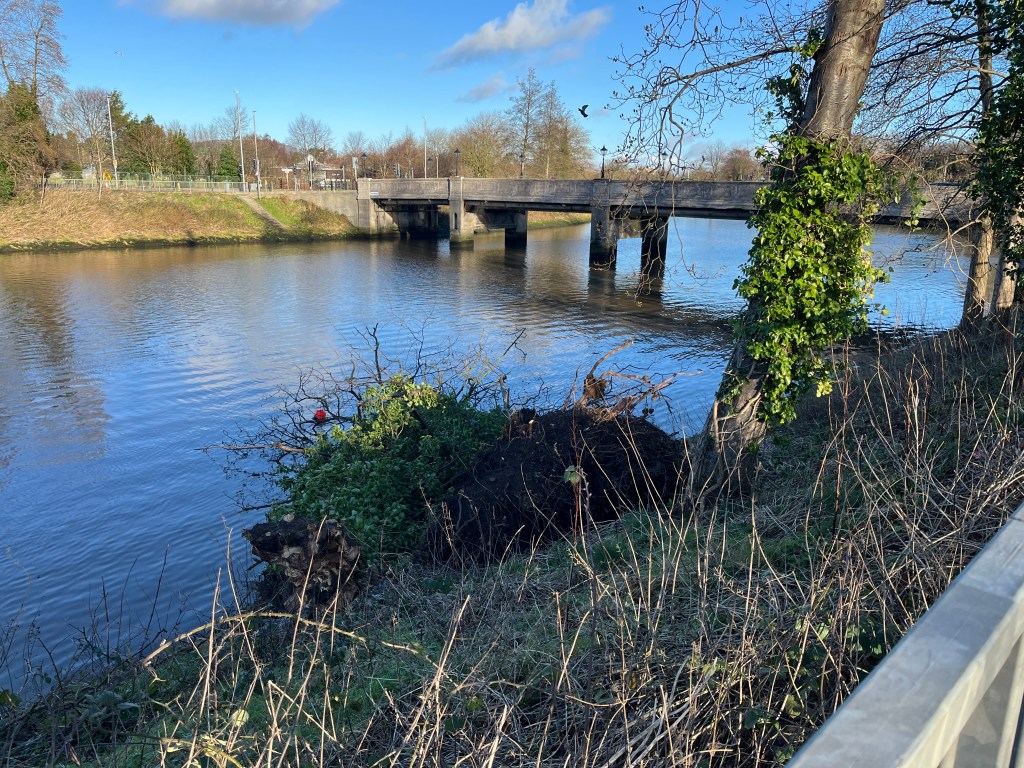
Anyway, a day confined to quarters meant I was desperate to get out yesterday morning’s bright sunshine and crisp frost. On the way to the river, there were already several trees down, and the air was full of the smell of sap and the dust of cut wood. At the main junction just before the river, the clean-up was in full swing – the racket of chain-saws sliced through the traffic noise, and wood was piled at the side of the road.
A fallen tree in the river, just above King’s Bridge
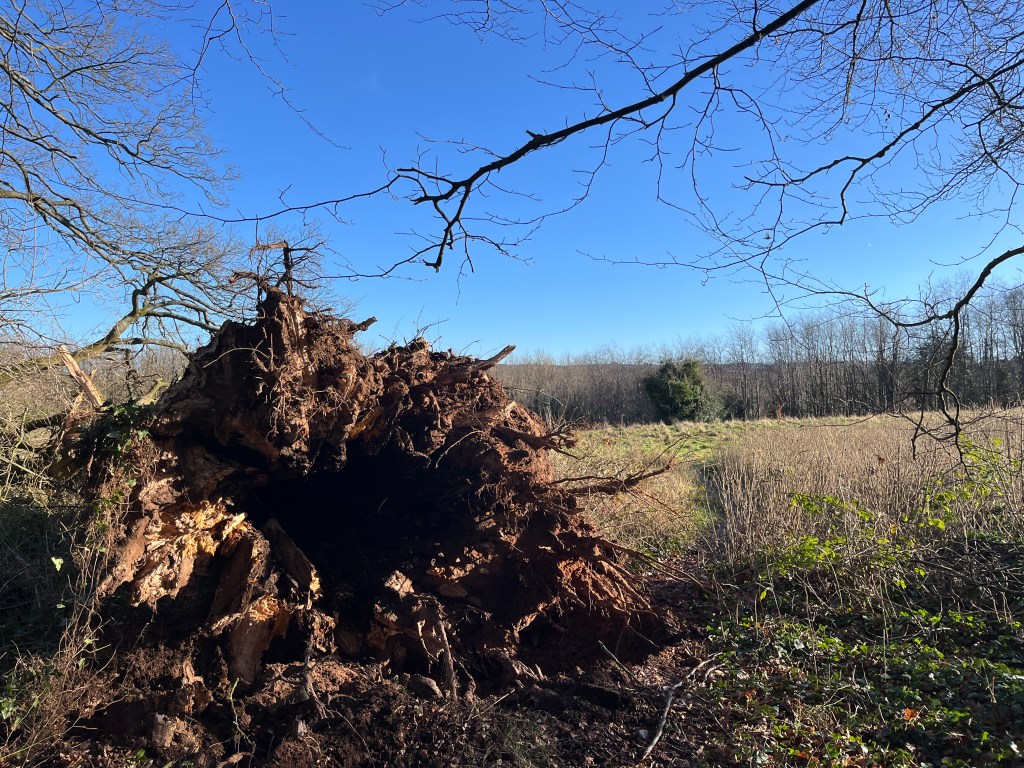
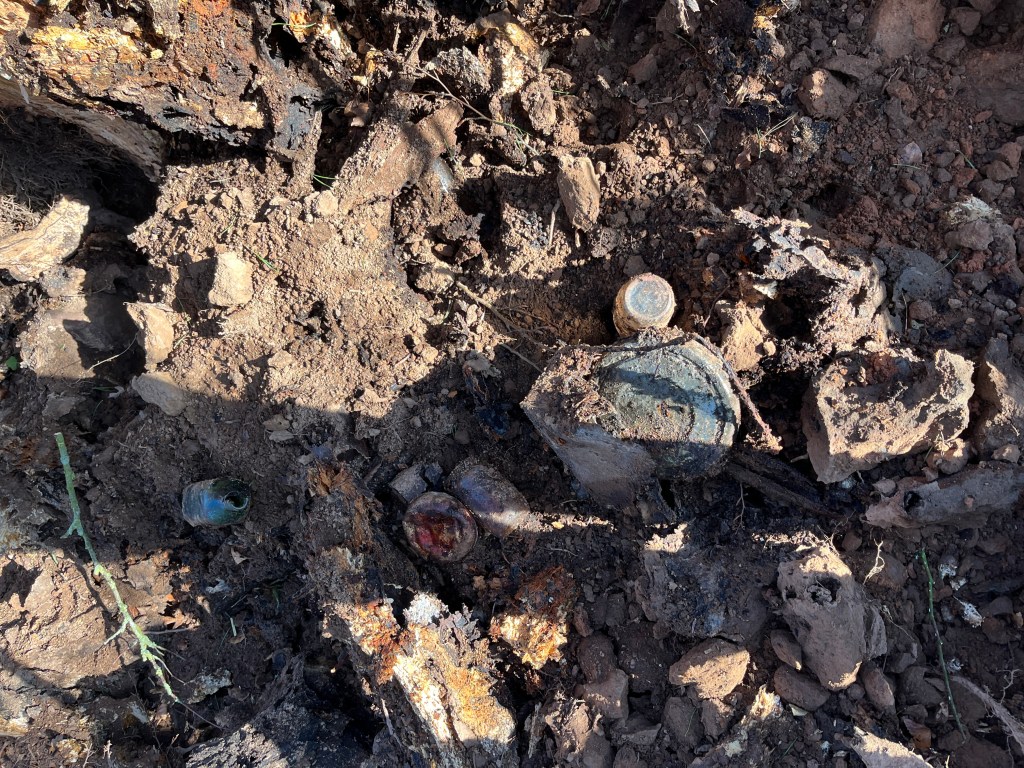
The black-headed gulls were reassuringly arrayed as usual on the railings at the pontoon just past Governor’s Bridge. When I got to Lagan Valley Park itself, I got off the towpath fairly quickly and headed for the woods. It was great to see the bright yellow breasts of blue tits in the sun; watch the coal tits needling away at the buds on the trees; and hear the assertive call of a great tit nearby. Groups of magpies swooped about; and I got a great view of a jay. At upper Lagan Meadows, however, I was a bit taken aback not only at the number of mature oak tree that had fallen, but the stuff that was showing in the torn earth: bottles and strange discs of metal that had me wondering if they were hubcaps; or unlikely leftovers from the second world war.
A fallen sentry at Lagan MeadowsThis was some of the stuff previously UNDER the tree. The mind boggles
As I walked around the meadow itself, I was treated to a posse of long-tailed tits dancing through the trees. Like the coal tits, these were busily interrogating any buds for whatever morsel they might winkle out. It was brilliant to see them. Such tiny birds, the epitome of cuteness. How they survived Friday’s hurricane is a mystery. Where did they hunker down? Being so loyal to their family group, I wonder did they all snuggle together in some crevice somewhere? And there they were, blithely flitting through the twigs as if nothing untoward had happened. I watched them for ages.
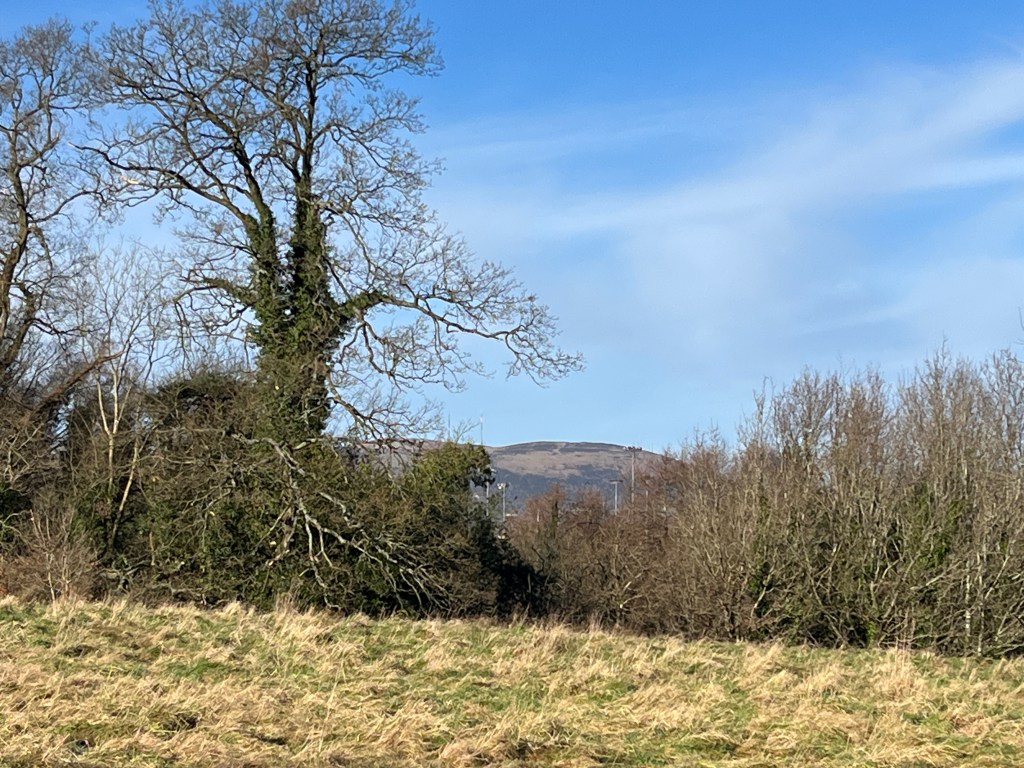
On the other side of the meadow, I was struck by the view I now had of the Belfast Hills, thanks to those fallen trees.
A new view
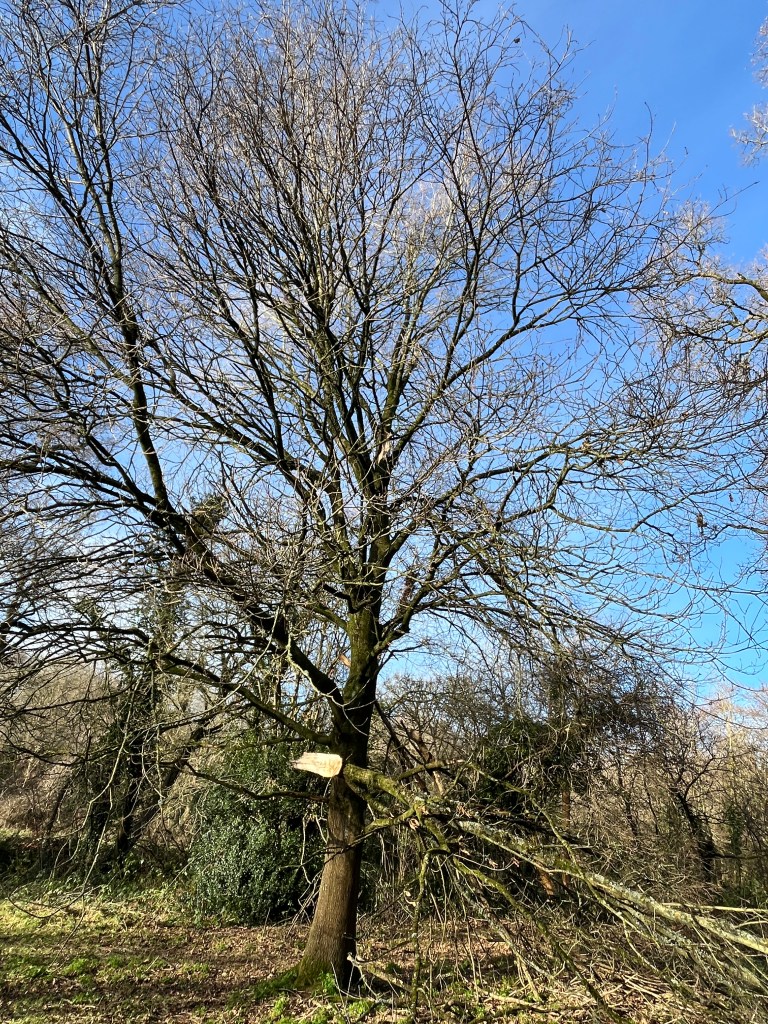
As I approached Moreland’s Meadow, I found myself getting tense. I realised, I was worried about the stand of very mature oaks and the single massive chestnut just beyond the stile. Thankfully most were still standing. But a number of the oaks at the edge or further out in field had either fallen, or were badly injured, their torn limbs and exposed heartwood searingly visible from a distance. All I could do was walk among them, touch their bark and whisper “sorry”. It felt like the loss of old friends. Another woman walking her dog stopped to commiserate with me. “I knew you were upset by your face,” she said to me, “it’s really sad.”
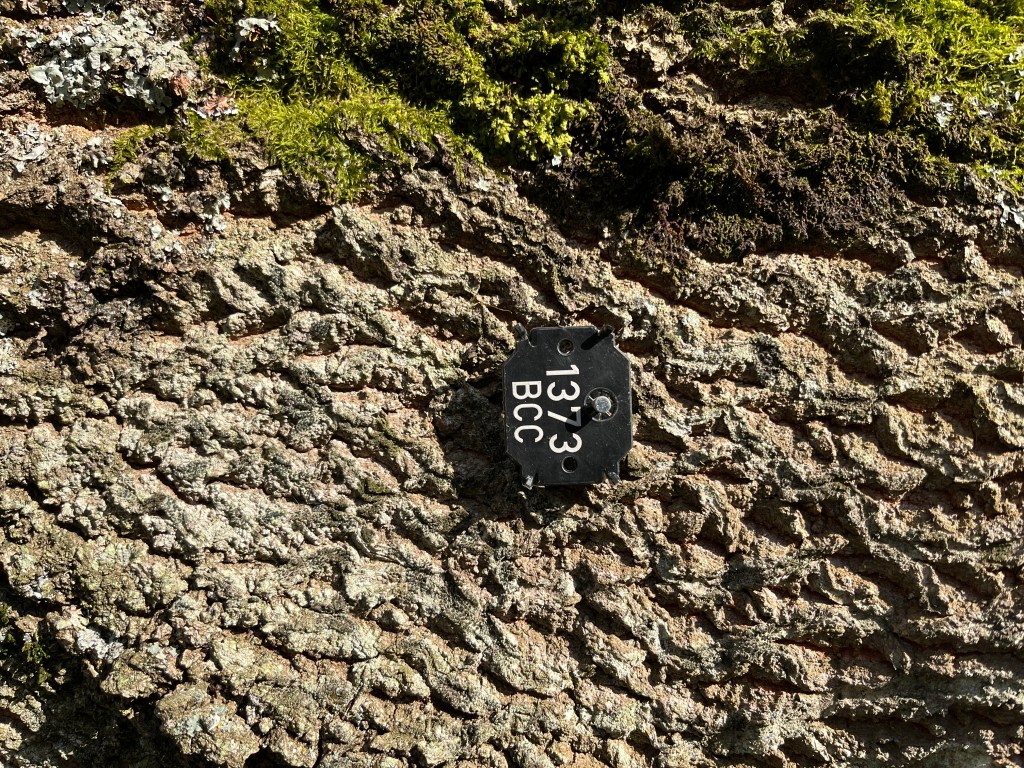
Moreland’s Meadow oak, its former crown lopped offTorn in two1373: felledMore gaps in the trees
It was a strange feeling to be mourning the trees. Recently, someone I know through blogging, Debra, who lives in California, wrote movingly about the devastation of the fires so close to where she lives. She has also written about its aftermath, the overwhelm and the grief. I know that the loss of ‘my’ trees, while a real loss, at some level doesn’t compare to the obliteration of entire communities that Debra, and many others have experienced. But the fires and storms and the floods are all connected.Nevertheless, perhaps the trees also offer hope. More will grow. Life is endlessly resourceful and there are always survivors, even of climate change.
But I didn’t know how much I loved these particular trees, these stands of them, till I saw how brutally hurt they were by this havoc. However, climate scientists have been predicting more extreme weather events for decades, so storms like this will accompany all of us into the future.














 mary-montague.com