Here’s my latest offering for The Guardian’s Country Diary. It was a wonderful subject to write about and I have come to appreciate and delight in our native hare even more than I did before.
I would like to thank Eugene Cooney of the Irish Coursing Club and Dr Neil Reid of Queen’s University for confirming the species ID and the absence of any record of the brown hare from that part of Donegal.
Many thanks to Paul Fleckney, editor of the Country Diary, for directing my initial ideas toward this subject, and his guidance in writing it.
I’d also like to thank Teresa and Cahir Doherty for yet another wonderful stay in John Ons cottage in Malin Head; and for their wealth of local knowledge.
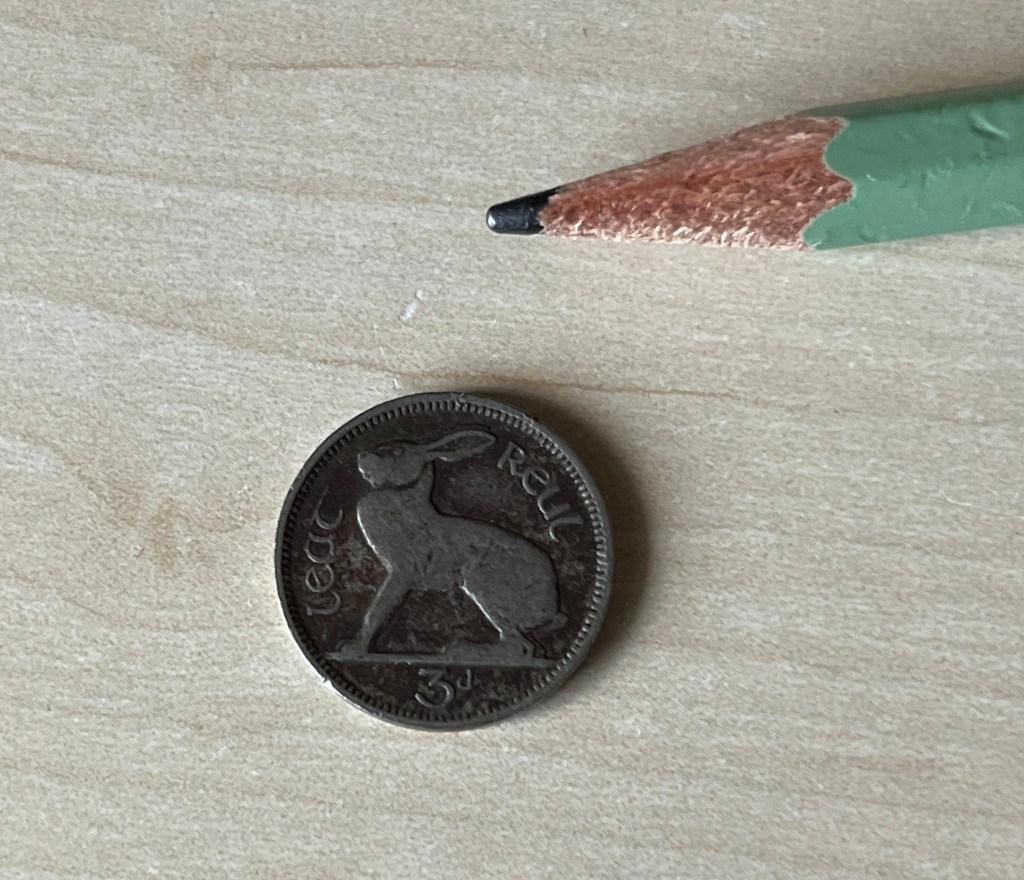
Finally, I didn’t get a photo of “my” hare but I found this little coin instead. And while reading around the subject, I came across this fascinating article about the minting of the Irish coins not long after the Free State was founded. I still remember the mixture of coinage that could find their way into a hand in my border county childhood. But it’s lovely to see the Irish hare commemorated and to be reminded that it has always been treasured.
I was away for a while in Malin Head, Co Donegal (see souvenir photo), so I’m late posting this. However, I want to thank John Maguire for inspiring and facilitating this particular Country Diary; and Paul Fleckney, editor, for accepting and shepherding the idea.
I’ve had a busy few weeks. Amongst other things, I was in the north west and one of the things that came out of that trip was my latest Country Diary, which was published last Friday in The Guardian. Many thanks to Jim Gregg for helping me identify the focus of all the excitement, and of course to the Country Diary editor Paul Fleckney, especially for the stunning photograph of a gar/needlefish.
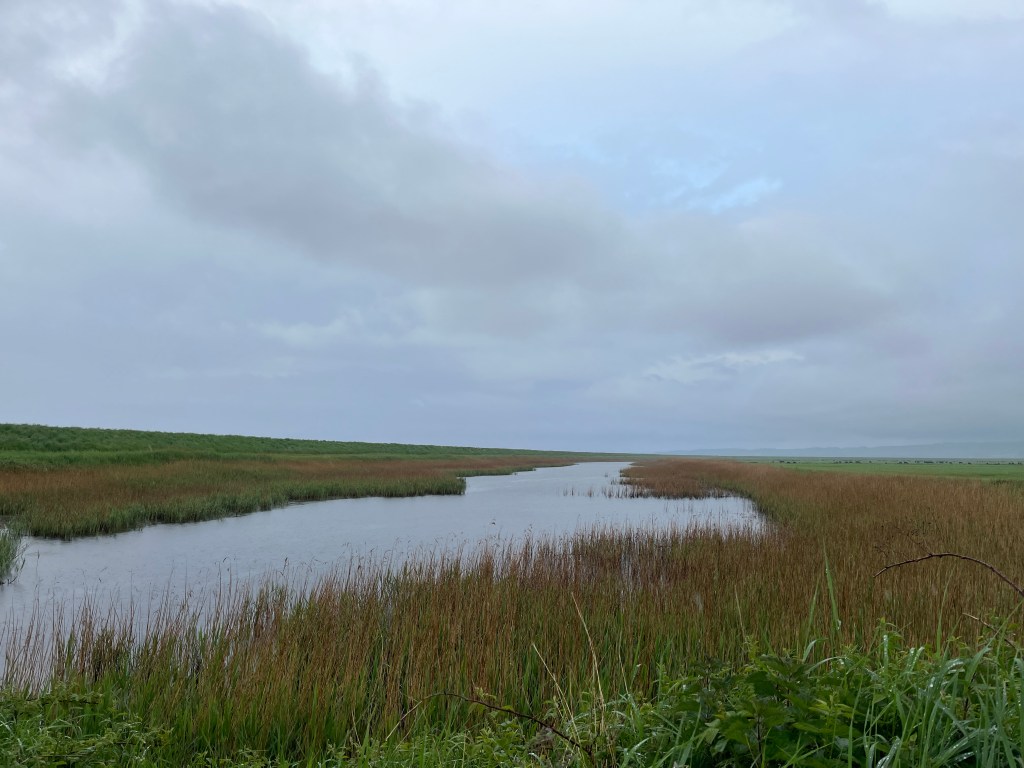
I always love a visit to the reed beds at Donnybrewer and the views over Lough Foyle aren’t bad either.
Reedbeds at Donnybrewer, Co Derry. Sunrise over Lough Foyle
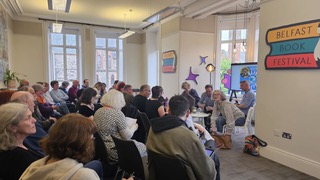
Another recent event, as part of the Belfast Book Festival, was the conversation on Nature Writing & Creativity, with ecologist Conor McKinney of, amongst many other things, Wild Belfast; fellow Guardian Country Diarist, as well as award winning nature and science writer, Lev Parikian; and the brilliant poet, Moya Cannon. It was an honour and a joy to chair this conversation among three very different but equally passionate advocates for nature, and to listen to them discuss how we create and respond to “nature” in the current times. I certainly hope there are more of these “hybrid” science and arts events. Thank you all at the Belfast Book Festival, especially Sophie Hayles and Laoise McWilliams, and the Crescent Arts Centre.
That’s Conor, Lev & Moya, keeping everyone enthralled. I’m the one footering in my bag!
Finally, my last creative writing workshop for the time being was delivered on Saturday. It was at a favourite venue of mine, the MarketPlace Theatre and Arts Centre, Armagh. The workshop was on memoir writing, and I was delighted with the attendance, and the great feedback from the participants. It’s always very gratifying when people feel that they have had a useful and rewarding experience. So thanks everyone for your engaging participation and your kind feedback. Hoping to get it up on the relevant page of this site asap.
My friend Micheal McCann, a brilliant young poet from Derry, has just launched his first full collection, Devotion, with Gallery Press. Here he reads the poem “How We Got Here, Where We’re Going”, from the collection. As he says, this is a found poem taken from this book, Biological Exuberance, which I first came across in the university library, while I was doing my PhD here in Belfast.
Rather disarmingly, the poem is dedicated to me. Thank you, Mícheál!
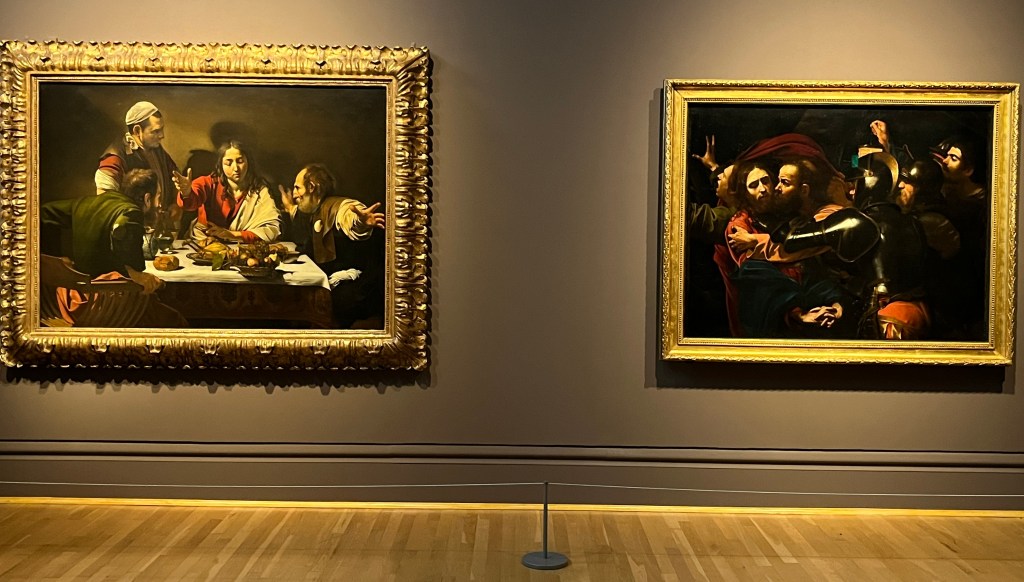
I was there this morning to see these. The two Caravaggios, We were first viewers to arrive at 10am, and for about five glorious minutes had the room to ourselves.
The attendant filled us in on the details that brought these two paintings together into the same physical space almost for the first time since they were painted in 1601 (for The Supper at Emmaus) and 1602 (for The Taking of Christ). I’ve seen both of them before in the National Galleries of Dublin & London, and of course I spent a huge amount of time studying The Taking of Christ when I wrote my poem inspired by that painting; but there was something magical about seeing the two together in the natural light with just a single line of lamps at ceiling level to softly highlight them. Over four hundred years and they still look so fresh and raw and muscular.
With the western cultural reflex of reading left to right, initially I wondered about the placing of the paintings from L-R in non-chronological order in terms of the Biblical scenes they represent. Of course, the resurrected Christ in Emmaus has been restored to the visage of a very young man. Nevertheless, in narrative terms, Christ’s seizing in Gethsemane precedes that of his resurrection. Perhaps it because we entered the room on the right? So one’s gaze would, arguably, first meet Taking. And then the gaze would follow on across the unseen crucifixion to the relief of recognising the risen Christ. The order couldn’t be that of chronology of their creation, because that’s reversed with respect to the Biblical scenes they represent. Furthermore, Caravaggio’s use of chiaroscuro is, to me, even more developed in Taking compared with his admittedly superb use of it in Emmaus.
The beauty of seeing these painting now however, compared with when I first saw each of them is that today I have an iPhone. And you’re allowed to take photos. As I kept taking various parts of each painting, my eye was drawn more and more to the characters. Obviously Caravaggio used the models that were available to him at the time, including, famously, himself as the young man lifting the lamp at the rear of the mob in Taking. I stared at the captain of the guard with the crest on his helmet in Taking. Was he Cleopas of the outspread arms in Emmaus? And is the guy serving the table in Emmaus an older version of Caravaggio? They aren’t exactly alike, but an artist who can portray a 15-year (at least) age difference in his main character (Jesus) could surely do it for himself: a receding hairline; the gaunter face. And there’s the bemused nonplussedness of this servant in Emmaus, his hands thumbed into his belt. He doesn’t have a clue, or is certainly not overly impressed, at the astonishing moment that Caravaggio has just captured: the recognition of Christ by Luke and Cleopas in the breaking of the bread.
What I love about Caravaggio’s take on that moment is the millisecond of a difference in that recognition by the two pilgrims (I also love the shell representing the Camino de Santiago; and the continuity from Jesus’ own day through Caravaggio’s right to the present, that that little symbol gathers to itself). Jesus’ right hand is raised suggesting the conventional blessing. However, it can also be interpreted as having just lifted from the piece of bread broken for Luke on Christ’s right, because Luke’s astonishment seems to be slightly behind that of Cleopas’ – Luke has had only time to grip the arms of his chair in reaction. Cleopas, however, having had the bread broken first for him, has had a millisecond longer to fling both his arms wide, thus embracing the whole of the moment. Yet again, using this gesture of Christ’s, what Caravaggio has done is embody the sacred in the ordinary and the quotidian. Literally in time. I found myself close to tears at the sight of it.
Because I was paying such close attention to the hands (oh, I could say more about Jesus’ tightly gripped and braced hands in Taking versus his relaxed and open hands moving gracefully through the air in Emmaus), I then noticed the trompe d’oeil of John’s stretched arms in the Taking and of Cleopas’ in Emmaus. I’ve always thought the portrayal of John’s terror magnificent, if a little ungainly – his left arm disappears out of the frame into the darkness, the flounce of his cloak forms a canopy for the treachery of Judas’ kiss as the pallid fists of the second soldier grip on the tail end of it – but it’s that upraised right arm with its splayed fingers that make a megaphone for John’s scream that has always gripped me. But now I wonder, is this the reason for the L-R order of the display? Is John’s left arm reaching not into but through the darkness where it has the possibility of gripping Cleopas’? The splayed hands of each of them seem to suggest the possibility. Those fingers look as if they could lock, not defensively and protectively as Jesus’s do in Taking, but to hold each other steady for the horror of the interval between. Or more precisely, for Cleopas’ to reach back for John’s to hold him steady.
Did the curator display these two works of art like this so that that Cleopas can reach back to help John across the chasm of death and darkness into the light of the resurrection?
Given that Caravaggio painted these two works for the same family in a relatively short space of time, could that have been, consciously or unconsciously, his own intention?
Whatever the reason for the order of the display, the fact that paintings from another age can speak so viscerally, both individually and together, is surely a sign of Caravaggio’s continued hold on the imagination. What an artist. These two works, and the possibilities of the conversation between them, are not to be missed. I will be back for more.
I had the good fortune to be invited to give a workshop on poetry and birds at Jubilee Farm. It was a wonderful day in an inspiring place. It was great to have the opportunity to highlight the good work that is being done there.
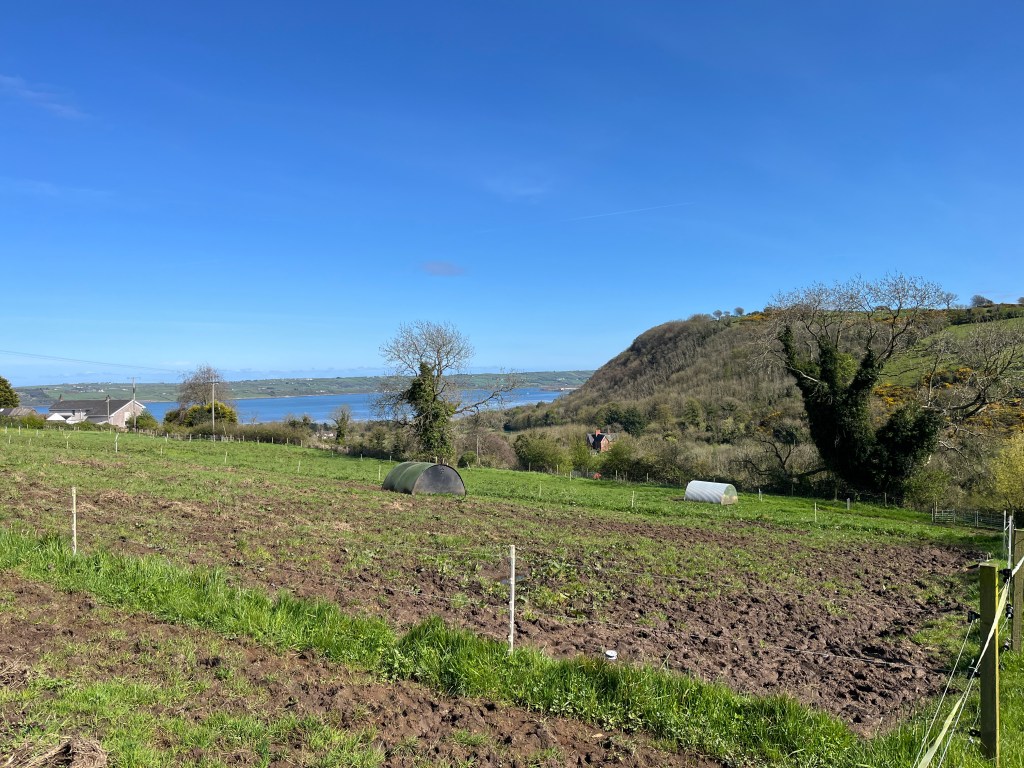
A view over Jubilee Farm
Thanks to Geoff Newall, now of the Belfast Hills Partnership, for the original invitation to give the workshop; and to Matt Williams and Portia Woods of Jubilee for getting the logistics sorted, and for their hospitality. Also to Martin and Nuala and other attendees for their warm participation in the workshop and everybody’s contribution to the delights of the day.
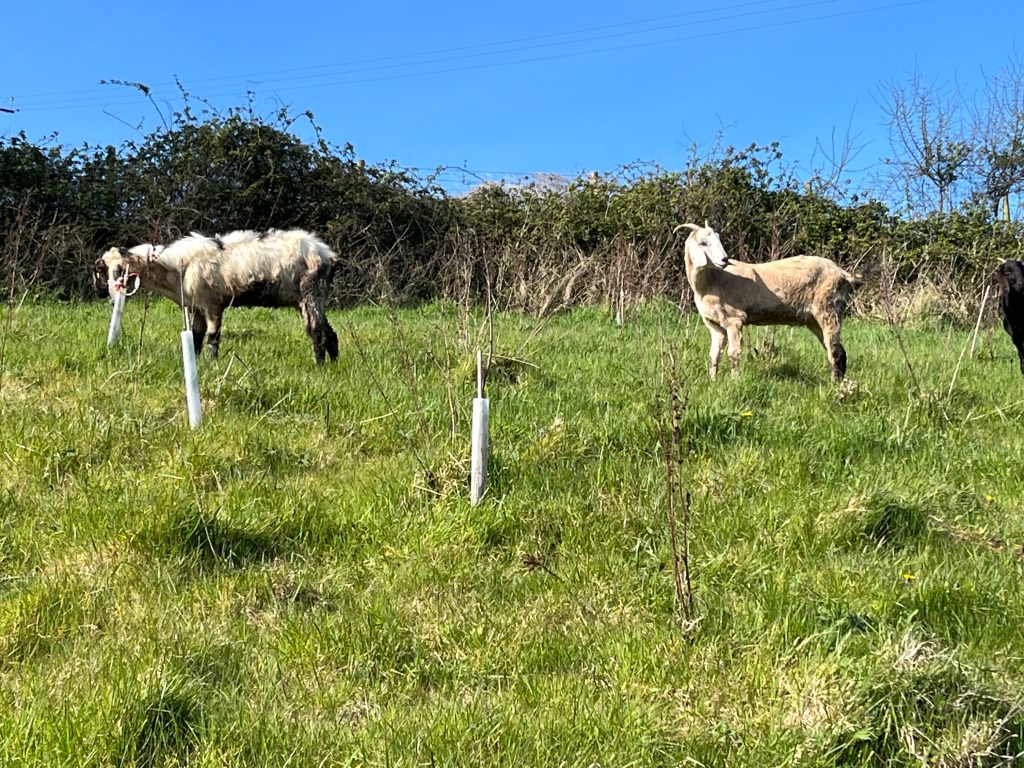
Anglo-Nubian goats at Jubilee Farm
And as always thanks to Paul Fleckney, editor of the The Guardian’s Country Diary.
As an addendum to yesterday’s post, I want to give a shout-out for this event this coming Friday. Unfortunately, other commitments mean I won’t get to attend myself, more’s the pity. However, having been in his company on Saturday at Jubilee Farm, I can attest to Geoff’s expertise and delightful ability to tell a story. I have been scouring details on the Bombus clan ever since.
I’d a lovely day on Saturday, delivering a workshop on poetry and birds at Jubilee Community Farm, which is Northern Ireland’s first community-owned farm. We looked at a range of poems about birds, and then spent a couple of happy hours rambling the fields, looking at and listening to the variety of species that are making their home in and around the farm. More of that anon. Many thanks to Matt Williams and Portia, and to all the participants. Special thanks also to Geoff Newall, formerly of Jubilee Farm, now (or again!) of the Belfast Hills Partnership, who originally engaged me to give the workshop, and who also did me the honour of returning to attend it!
The same workshop is taking flight later on this month, and migrating to Portadown! While there, it will mutate a little. I will be giving this version of my Learning the Songs of Birds workshop over 2 two-hour sessions on Saturday 11th & 18th May at the fabulous Millennium Court.
For further details on these birdsong workshops, check out my Birds page.
So now for that magical encounter that I first wrote about a couple of weeks ago, here. Today’s Country Diary is the big reveal.
Chaffinches have always been one of my favourite species. Indeed, I previously wrote here, they were among the first species I learned to identify under my own steam from a bird guide as a child. And it seems I’m not alone. Coincidentally, Stephen Moss also wrote about the male chaffinch in The Guardian this week, and and confirmed that this was his experience also. No wonder the chaffinch has such a grip on our hearts.
It’s a grief, as the commentator FinrodFelagund said below the line of both pieces, that the chaffinch has declined to such a degree that they are absent from gardens in some areas. I can’t imagine a world without chaffinches. Those same finches’ wings of Hopkins’ Pied Beauty, might also be those of the Holy Ghost with which the poet ends his wonderful poem, God’s Grandeur. There lives the dearest freshness in chaffinch wings; and in their voices.
I’d like to thank to Paul Fleckney for his editorial guidance, which, as always, improved my writing.




 mary-montague.com