My latest Country Diary come out in today’s Saturday Guardian. Which is lovely because Saturday is the day we always get the paper copy …
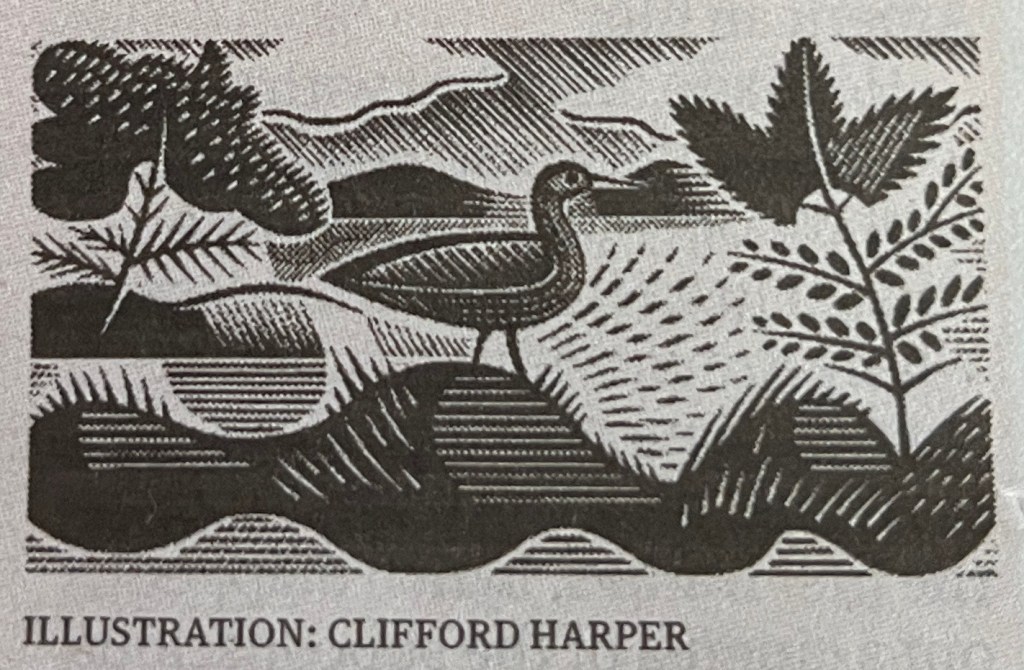
Which also means I can upload this lovely image of a stylised redshank that accompanied the print version …
Thank you, Clifford Harper for that delicate picture. And as ever, but especially so this time, to the Country Diary’s editor, Paul Fleckney who helped me narrow my focus on this fascinating topic. For more on info the bits I had to leave out of the piece itself, you can read my replies to my ever-attentive readership. Thanks to all of you also.
In the Christmas madness I’m only finding a moment to post my latest Guardian Country Diary today – a nice reminder, even to myself, of how the pause can be the moment of change.
Thanks, as ever, to Paul Fleckney, editor, both for accepting the proposal of writing about the winter solstice at Newgrange ahead of time, and for his stewardship to the day itself.
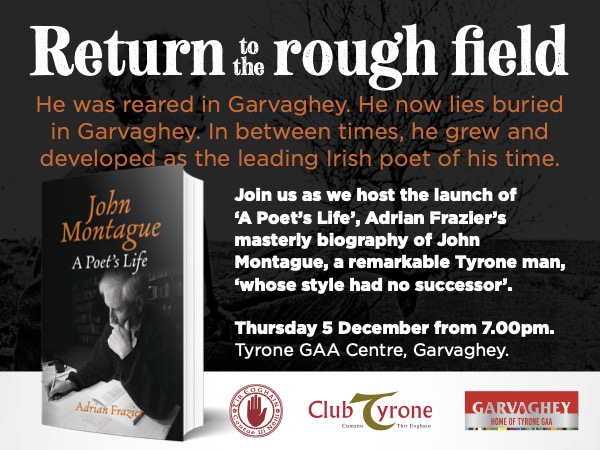
Well, hopefully not quite. I may well have more to say after the event but for now this is my last posting ahead of the launch of A Poet’s Life, Adrian Frazier’s biography of John Montague. Scroll through the programme below to see the shape of the evening.
Thanks to everybody, but especially my cousin Andrew Montague, for all the hard work and determination to make this event a success. All we can do now is relax and wait for the people to come. And raise a wee toast to John. So here’s to tomorrow night in Garvaghey!
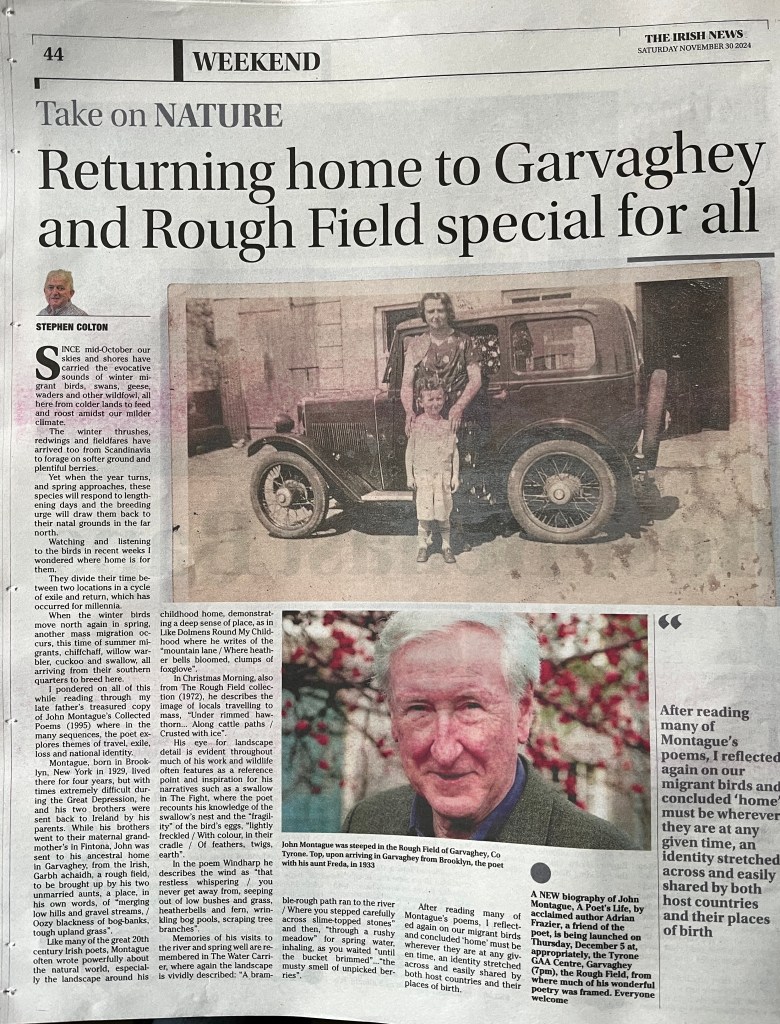
As we approach both John Montague’s 8th anniversary and the launch of his biography this Thursday in Garvaghey, it was lovely to see this perceptive reflection on migration and poetry by Stephen Colton, in Saturday’s Irish News.
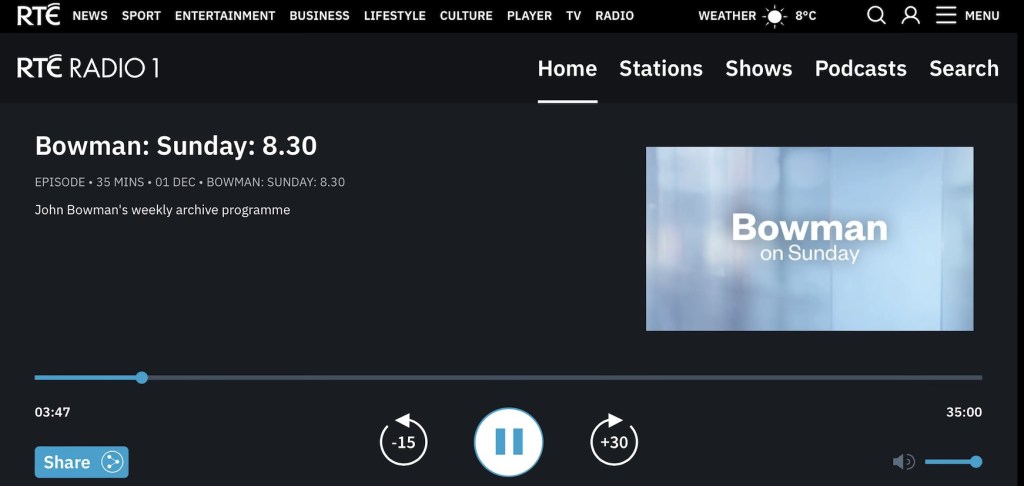
On the heels of Adrian Frazier’s newly published biography of John, this weekend also saw John’s work and life featured in John Bowman’s Sunday programme on RTÉ1.
Another reminder to anyone who might have missed the news, the launch of A Poet’s Life is this Thursday at 7pm, in Tyrone GAA Centre, Garvaghey, Co Tyrone, just a field away from where John Montague grew up.
If I’d been able to add my tuppence worth as a comment to this article, I wouldn’t be writing this blog. But a couple of weeks ago, I read it and was dying to add this book to the list that article celebrates. I’ve read a fair few on that list, I was pleased to note, but was even more pleased to see that I haven’t read the majority – which means MORE JOY awaits me. Because, in these dark times, as Francesca Segal puts it, we need, not escapism, but solace.
However. That barrier to me adding my contribution got me thinking about the books I’ve read on repeat. Not the books I’ve read several times. Because, when I like a book, I am a several-times reader. But those re-readings can take place over years or decades. And that’s different. I’m talking about the books that, the minute I’ve come to the final page, I literally go back to the start. I’m talking about reading on a loop. Of those, I think there’s only been these two:
Nothing in common – except for, decades apart, being read by me on a loop.
I’m on my third time for Romantic Comedy, and I’m not done with it yet. It is pure joy. It’s funny and contemporary, the dialogue zings, and the story is both realistic and reassuring. I love the way, Sally, our unreliable narrator is so insecure and only through the arc of the novel do we come to realise how highly competent and talented she is. It’s a tale that captures the exhilaration of work, and the pleasures of belonging to a small group of people similarly engaged. I saw an interview with Curtis Sittenfeld where she compared it to being a post-grad student, and that is spot-on; but I’m sure it also applies to any specialist high-status but semi-reclusive workplace, where those that are part of it are envied by outsiders, and create their own utterly self-involved world. And it is also, fundamentally, a book about writing, and the perils and rewards of creativity.
I’ve a way to go until Romantic Comedy achieves the repeats of read that Black Beauty was thought worthy of by my seven-year old self. I read BB at least twenty times as a child (21 is the figure in my head and, while I can’t be sure, I think it’s probably a conservative estimate). I read it on repeat, and I also read it, as best I could at that young age, in a single go. Which meant starting it on a Friday afternoon when I came home from school, reading it until I fell asleep that night, and finishing it when I woke up on Saturday morning. Week after week after week. I used to know passages of it off by heart, which sadly (take that qualifier as you wish) is no longer the case. But actually (!), it has some other things in common with Romantic Comedy, other than being repeatedly read by me. It’s a quest story, and the quest of both books is for love; and for the connection that provides a haven against a harsh world.
So these are both solace stories.
Before I leave the subject, I just want to add a mention of the two other books I have that came along with Black Beauty, as a box set gift from my father when I was seven. There were four, and one is gone the way of the lost and left behind – My Family and Other Animals by Gerald Durrell. It’s probably not a coincidence that that one did not survive in my long-term care, because while I read it, somewhat later, and enjoyed it, it’s the only one that does not have an animal protagonist.
So here’s the other two:
The Custer Wolf – apparently confronted by some candle-lit deer in winter.
The Custer Wolf is the story of what we would now call ecocide – exemplified by the slaughter of apex predators in the American West that focussed on “trophy wolves” – of which the (historical) Custer Wolf was one. It was this book – which I read often rather than on repeat because it was so upsetting – that it’s probably no exaggeration to say set the course of my life.
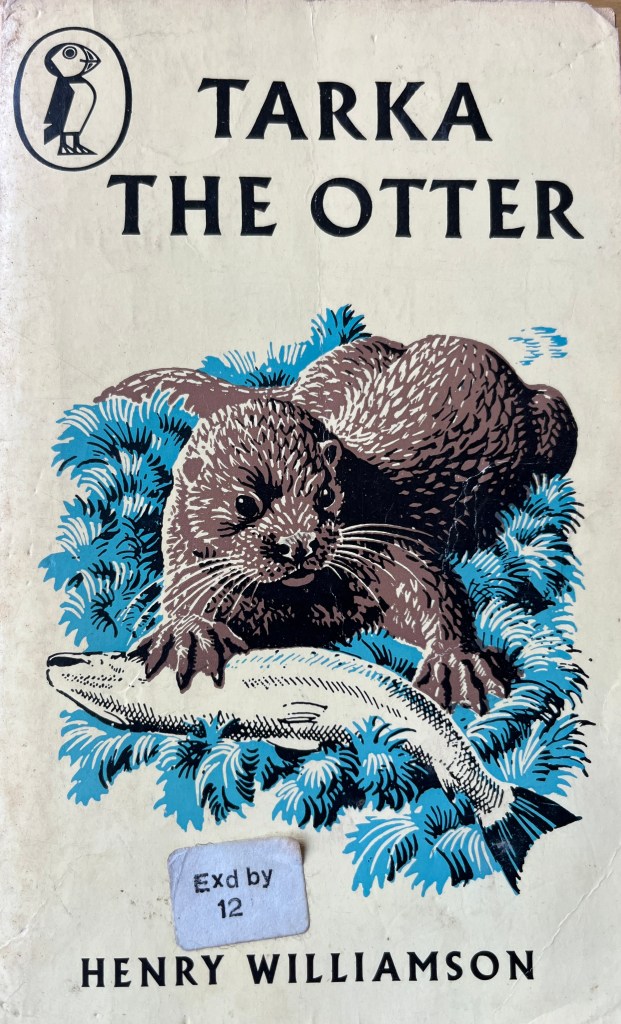
The other book is Tarka the Otter, by Henry Williamson. I’m not sure how it ended up “backed”, as we used to say when we were strengthening the covers of our school books, in 1970s Christmas paper. And until today, I’d never unwrapped. But here is the slow reveal:
The unveiling of Tarka
Against the advice of the above blurb, I definitely read Tarka too young, which is probably why it hasn’t nestled in my heart in quite the same way as BB & CW. But it could be time to give it another go, especially given this striking cover, hidden for decades:
Tarka on full show: the label was attached & I’m letting it stay. I should have waited till I was 12
I do remember enough of Tarka to know it is another ecocide story, albeit on a smaller scale than that of the Custer Wolf. So that brings me back to Francesca Segal’s premise. We need solace stories to strengthen the muscle of our heart to confront the terrible ones. Read all of them. On repeat, or often, or only the once to grasp their truth. But read them.
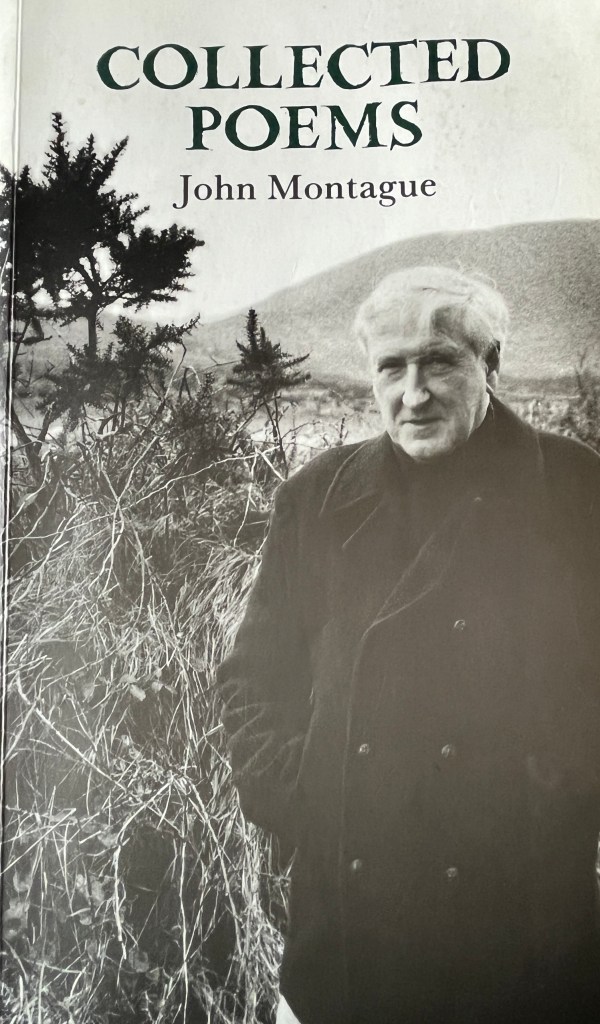
My late uncle, John Montague, is acknowledged as one of the greatest poets 20th century Ireland produced. While his work is loved and admired by many, I think it’s also fair to say that he’s also something of a well-kept secret, especially in his native Ulster. He was on the school curriculum in the Republic for many years. He was also Ireland’s first Professor of Poetry, a role set up following Seamus Heaney’s Nobel Prize in 1995. John was 10 years older than Heaney, and his Collected Poems came out also in 1995, which John regarded as execrable timing. It seemed to confirm his experience as the eternal outsider, always on the margins, never quite belonging.
His mid-Ulster family was profoundly affected by the partition of Ireland. His parents emigrated to New York, where John was born in 1929. The children were sent back home in 1933, ahead of their mother’s return. John was separated from his elder brothers, who stayed with their maternal grandmother. However, John was parcelled off to be brought up in Garvaghey, Co Tyrone, by two of his father’s unmarried sisters.
His double separation from both his parents and then his brothers had a profound effect on John. His mother’s return a few years later to her mother’s house (his father stayed on in the US for many years), reinforced his sense of isolation from the rest of his birth family. While his aunts loved him deeply, his mother’s reluctance to retrieve him, no doubt with the best of intentions, wounded him. It was a wound he never fully recovered from; but he did, at some cost, channel and transform it into poetry. His work draws parallels between the fracture in his birth family and the partition of Ireland (and of Ulster). He’s also recognised as a major love poet and is a wonderful nature poet. He drew on his multiple identities – Irish and American, and Francophile. He lived in France for much of his adulthood, and he died there. He received a Chevalier de la Legion d’honneur, France’s highest civil award.
But it was to Garvaghey that he came home to rest. And it is in Garvaghey, that John Montague 1929-2016: A Poet’s Life, by acclaimed biographer Adrian Frazier will be launched next month. Professor Frazier offers an intimate and authoritative portrait of John, drawing on over 40 years of personal friendship and exclusive access to the poet’s private papers.
The Irish/UK edition is published by Lilliput Press (Dublin). A US edition will be published by Wake Forest University Press in Spring 2025.
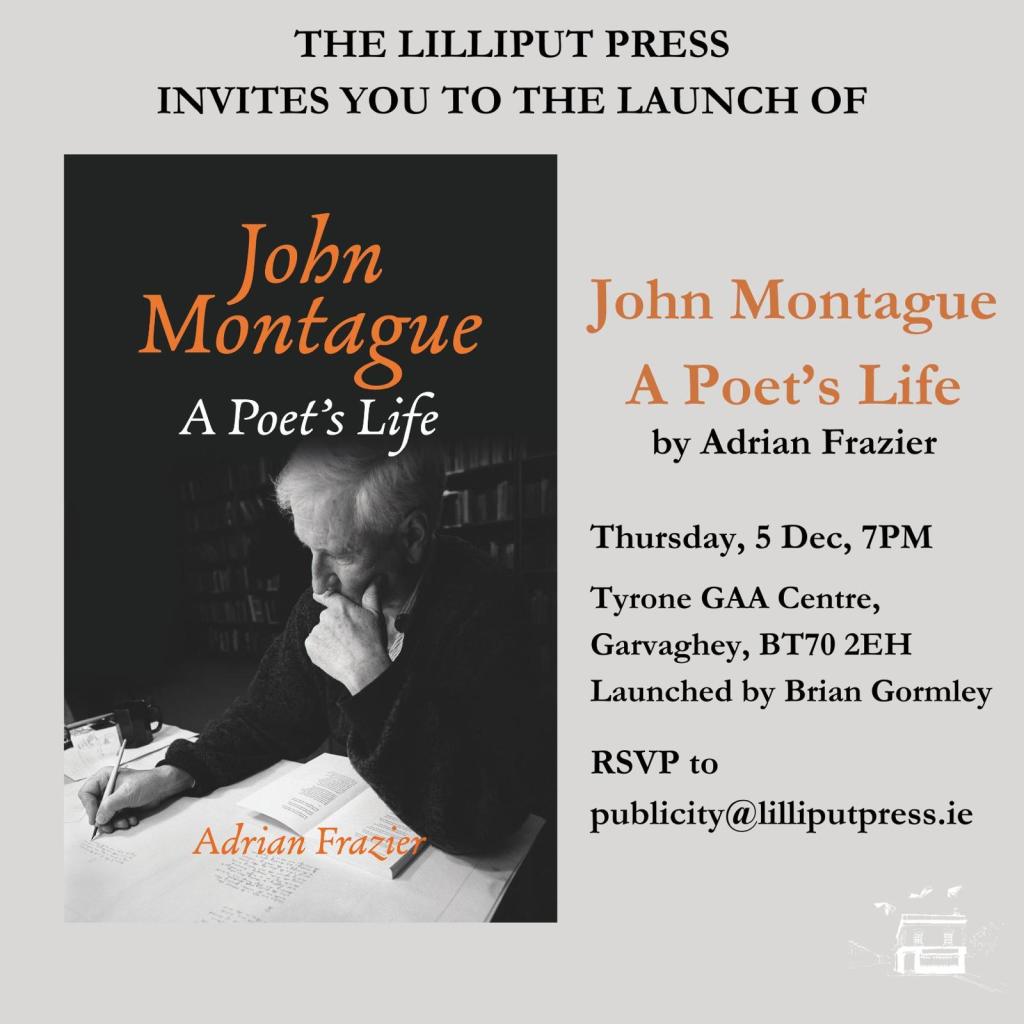
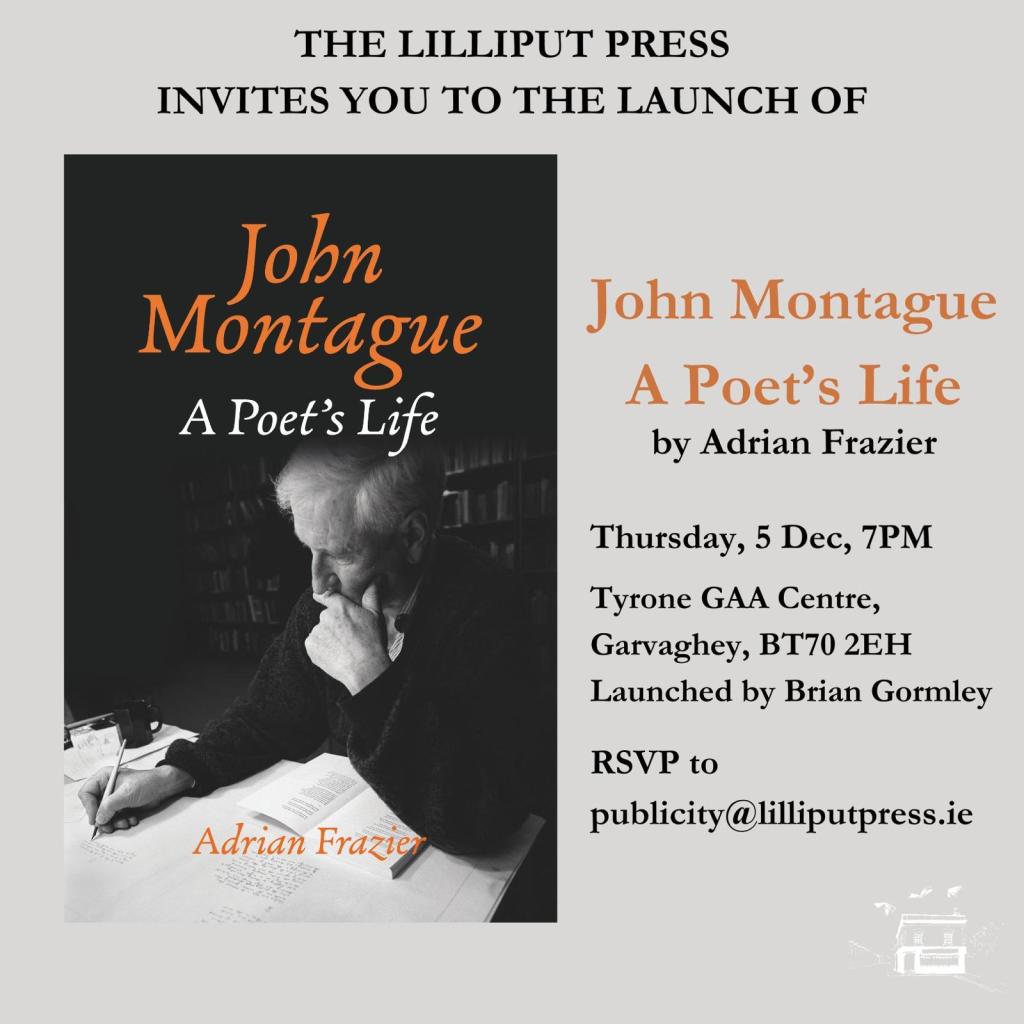
A Poet’s Life will be launched in the GAA centre, Garvaghey, Co Tyrone at 7pm on Thursday 5 December 2024 – and all are welcome.
Lilliput Press’ INVITATION: everyone welcome
There are also launches in: Dublin, Dec 4th, 6pm Irish Writers Centre, Parnell Sq, Dublin, and in Galway, Dec 6th, 6pm, Charlie Byrne’s bookstore, Galway.
Born out of pain and conflict, and despite all the difficulties of his life, transforming his experience into beautiful and often profoundly moving poetry, it’s good to have this telling of John Montague’s story being celebrated in the place that shaped him.
Oak sapling, possibly seeded during the mast year of 2022
My latest Guardian Country Diary came out yesterday. Some lovely comments on it, for which, many thanks! And thanks as always to the editor, Paul Fleckney.
On the back of the publication of Under the Changing Skies, I was interviewed by Nicola Weir for Radio Ulster’s Countryside. The programme will be broadcast tomorrow at 2pm, but it’s already available on BBC Sounds if you want to sneak a preview.
As the blurb puts it: And it’s BBC Northern Ireland’s Book Week and Nicola speaks to poet, writer and Queen’s University Lecturer, Mary Montague, about her contribution to a new anthology called ‘Under The Changing Skies’ – a collection of the columns written for the Guardian’s Country Diary – and she exposes the hidden world of the mallard!
You’ve only 29 days left to listen! So if you want to cut to the chase or listen on repeat, tune your ears into Nicola’s “50 Shades of Grey” intro in the first couple of mins. And then to solve that little mystery go to 46:28 and listen till after 54:00.
Thanks a million to Nicola for the opportunity to talk about the book and the joy (mallard sexual habits notwithstanding) it is to write for the Country Diary.
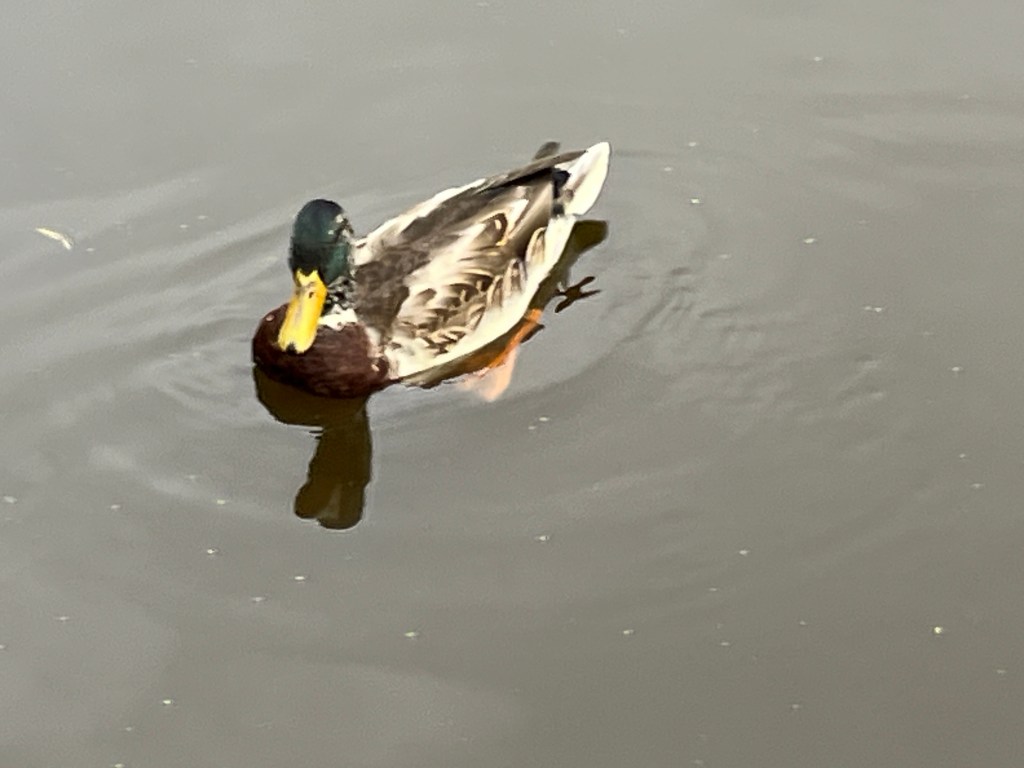
A young male mallard looking slightly the worse for wear …
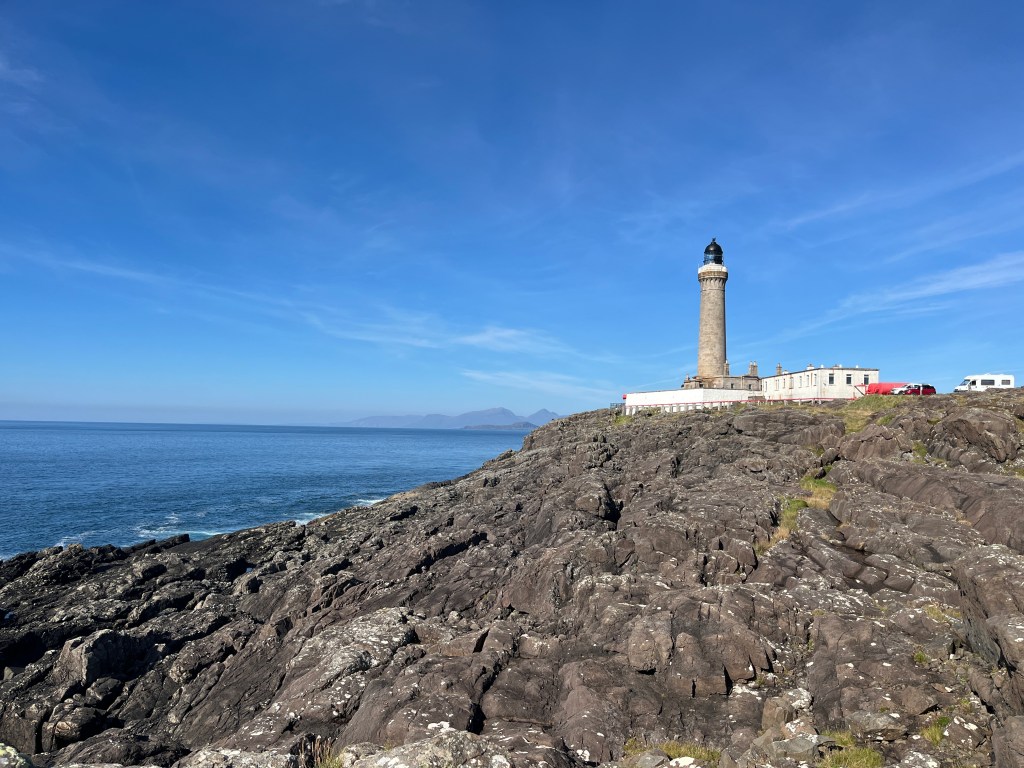
I was on holidays in Scotland recently (with a brief sojourn in England’s Peak District of which more anon). I came home to this:
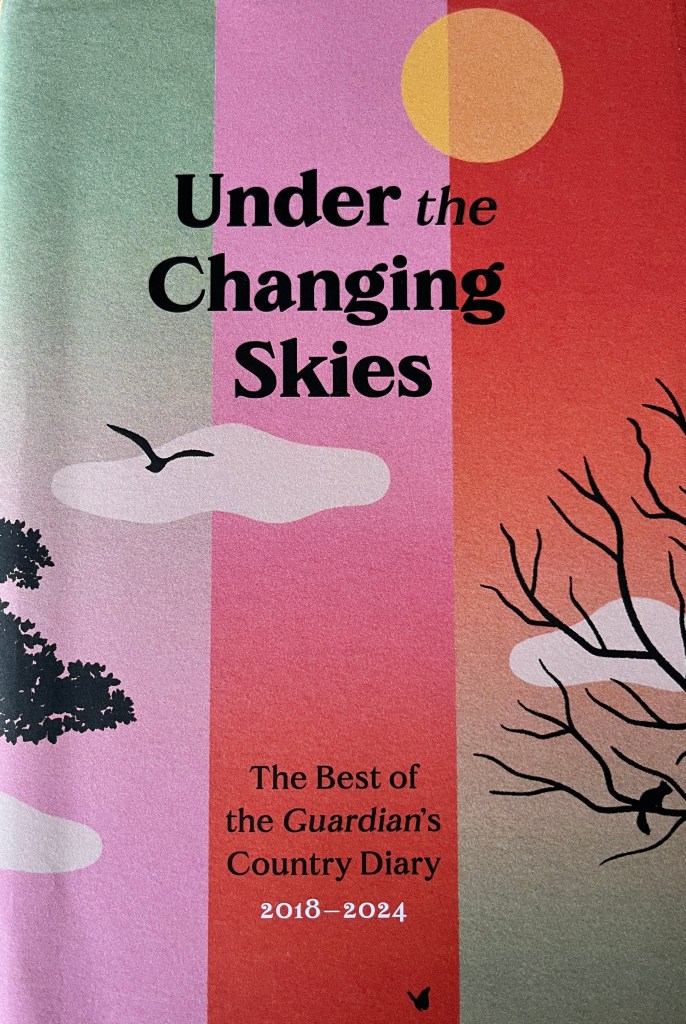
Published by Faber & Faber; edited by Paul Fleckney (Guardian), with Mo Hafeez (Faber & Faber)
My contributor’s copy! What a pleasure and honour it is to be part of this collection published by Faber & Faber (under the Guardian Faber partnership). The book is a delight. It is organised month by month, and my intention is to read it in that way – although I’ve already dipped in and out and rushed through September into October. It is marvellous to read all the different voices and perspectives and subjects, and (pinching myself) to find myself in such august company. I’m not just saying it because I’m in it, but this is an important publication. I’d like to thank the Country Diary’s editor, Paul Fleckney, and Mo Hafeez. Commissioning Editor at Faber & Faber.
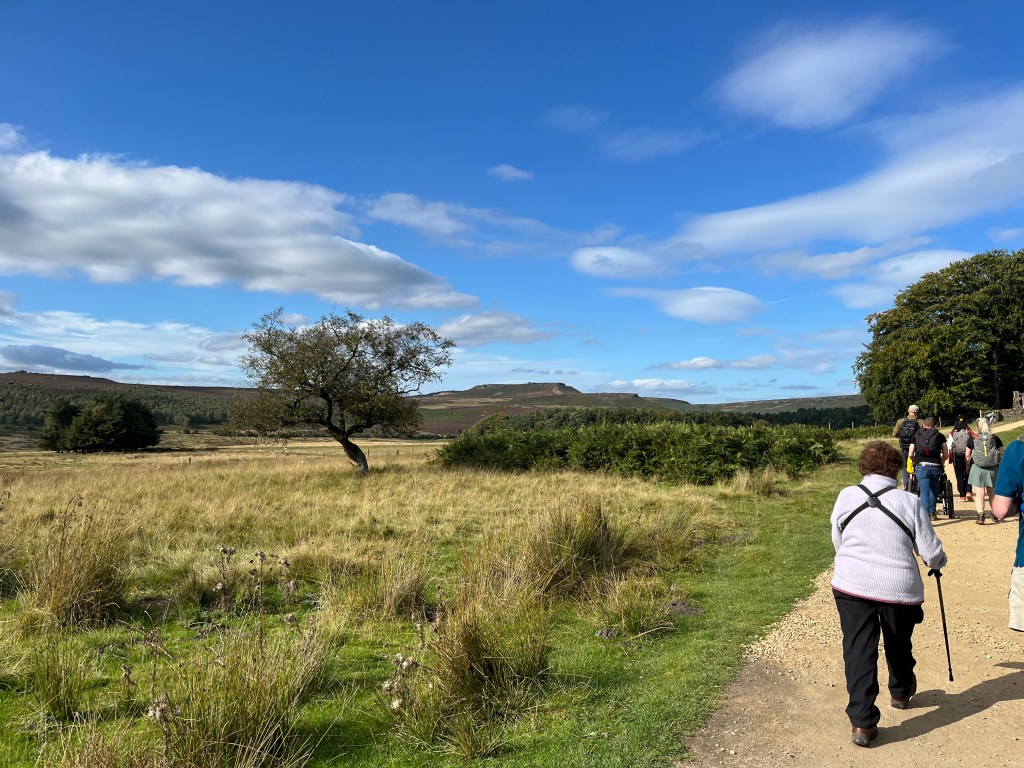
Pre its launch into the world (which is formally tomorrow, although you can still pre-order up to the end of today, as far as I’m aware), there was a meet-up to celebrate. Paul chose the Peak District as a reasonably central place (and convenient to almost nobody, as far as I could make out). As it happened, I was in Scotland over that period of time. This had advantage of allowing me to travel down by train (and do a little work on said trains), thus avoiding flying, which I am very happy about. (I’m doing my best to fly as little as possible for the rest of my life. So far, it’s been about five years without). About 20 of us showed up for a desultory ramble and get-together, and I really enjoyed putting faces to names and establishing more personal connections to my Country Diary colleagues.
Country Diarists out and about in the Peak District
Finally, because the regular contributions are the source of the book, here, somewhat late as I was away when this came out, is my latest. I’d like to thank Graham Day for all his help with sources and material, and the lovely group of botanists who introduced me to the tall sea lavender, Limonium procerum procerum, of the Lecale coast.







 mary-montague.com