Now then. I wasn’t expecting my latest Country Diary to be out till Monday, so when Beloved shouted from the living room “You’re in it today!”, it was a very pleasant surprise. We get the hard copy every Saturday, so it was lovely to see my recent take on the waders/shorebirds of Tyrella in Saturday’s sepia column next on the letters page.
Then I checked my Guardian app and that’s when I realised that the paper version and the online version are a little differently finessed themselves. The paper one has my original opening. The online version is a little compressed. But hey, great to have both.
Hence, the uploads of the photos of the paper version. Just because.
Clearly this must be a plot to ensure that I buy the hard copy every time I have a piece published.
Thanks as always to Paul Fleckney, the Country Diary’s editor. It’s great to get a Saturday slot, no matter what the Bauplan.
I was invited to MC this gorgeous event on Friday evening at the Crescent Arts Centre, by its instigator and mediator, Natasha Cuddington. It was a lovely event, and a pure pleasure to introduce it.
Art emerges out of the background of a life, in a way that is similar to how a signal emerges from noise. All of us are shaped by chance encounters that mediate and channel our voices into different expressions of sound and meaning. The full title of the event Correspondences: Collaboration, Noise & Innovative Poetries gives a flavour of the mix and its integration. The performances evolved from the background noise of the artists’ lives through the chiming of correspondences that transformed the original soundings into signal works of art that shimmered with new valence.
Matt Kirkham read from his latest collection Thirty-Seven Theorems of Incompleteness (Templar, 2019), as well as new work. He was followed a collaborative poetry performance by Zara Meadows and Alanna Offield. Their work referenced pop cultural moments, particularly those associated with social media, in a perceptive and irreverent fashion. That was followed by the performance of a recent collaboration by Eilish Martin and Natasha Cuddington, entitled “Didn’t get round to Nick Cave’s Carnage”. As well as being inspired by Nick Cave’s album, this collaboration was also suggested to Natasha by book “Hearing”, a listening-in between Lyn Hejinian and Leslie Scalapino, that explores “ongoing existence in a phenomenal world”. Finally, we had the pleasure of “Correspondences”, which is a soundscape and piano composition by Shannon Kuta Kelly, that performs Eilish’s and Natasha’s collaboration both vocally and musically.
The work and its performance had evolved beautifully out of the background noise of the artists’ lives through the chiming of correspondences between them. As audience, we had the pleasure of absorbing how the original soundings had been transformed into signal works of art that shimmered with new valence.
Many thanks to Natasha, Eilish, Shannon, Alanna, Zara & Matt. Also to the Crescent, and particularly the technical staff who ensured everything ran smoothly; and of course to the audience whose attention and appreciation helped bring the performance of the work into its full expression.
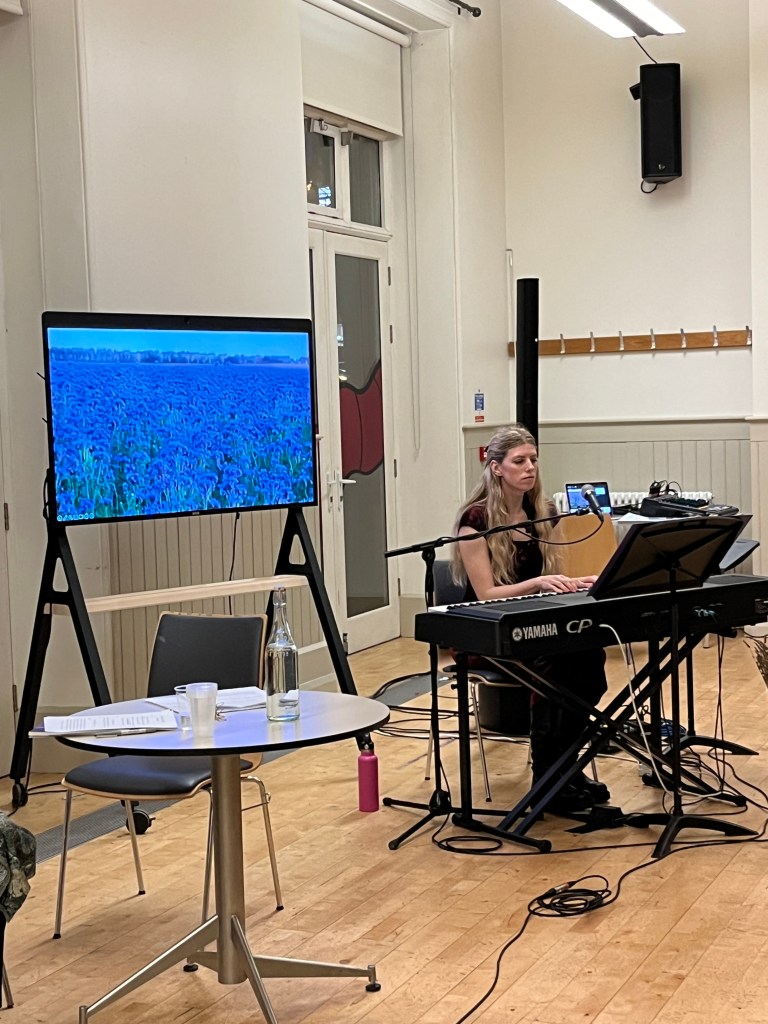
Shannon Kuta Kelly rehearsing “Correspondences”, which is a soundscape and piano composition (with accompanying visual).
I have a number of people to thank. First and foremost is John Maguire of Clonee, who went above and beyond in terms of helping me get access to sites, and pointing me in the right direction for the larger context. Particular thanks also to Owen Rush for the chance to visit Drumkeen’s fairy fort, as well as to Jim Muldoon, and Ann Marie McVeigh, for visits to the fairy forts of Letterboy and Monavreece/Moneyvriece.
I’d also like to thank John B. Cunningham for a wonderful and stimulating conversation about the history of Fermanagh in general, as well as the Ederney area in particular. John was also kind enough to send me a number of documents which filled me in on a lot of background that, ultimately could not be fitted into a piece of such brevity. However, I am looking forward to the getting the chance to use that information in the future. At the very least I am delighted that I now know a lot more about the history of the area I grew up in.
As always, many thanks to Paul Fleckney, editor of The Guardian’s Country Diary.
And, finally, because of all those long-ago walks that he insisted on, without which this piece would never have been written, I also have to acknowledge the dog who was my constant companion when I was young. Thank you, Frisky. You were a good boy.
I was in Fermanagh yesterday evening, in the townland of Rotten Mountain. I went there for the eve of St Brigid’s Day (Imbolc), to céilí with some old friends, neighbours and acquaintances at Danny and Fidelma’s house. I’ve been there before, when Danny was kind enough to fill me in on a lot of local history and some significant local places that I’m hoping to write about in the future. Himself and Fidelma have a wonderful room set aside as a little museum of local history, but which is also used for céilí-ing (traditional socialising). Anyway, I got word that I’d be welcome to come along and join in for the gathering to make Brigid’s crosses. I couldn’t resist the opportunity.
Making Bridget’s Crosses in Rotten Mountain
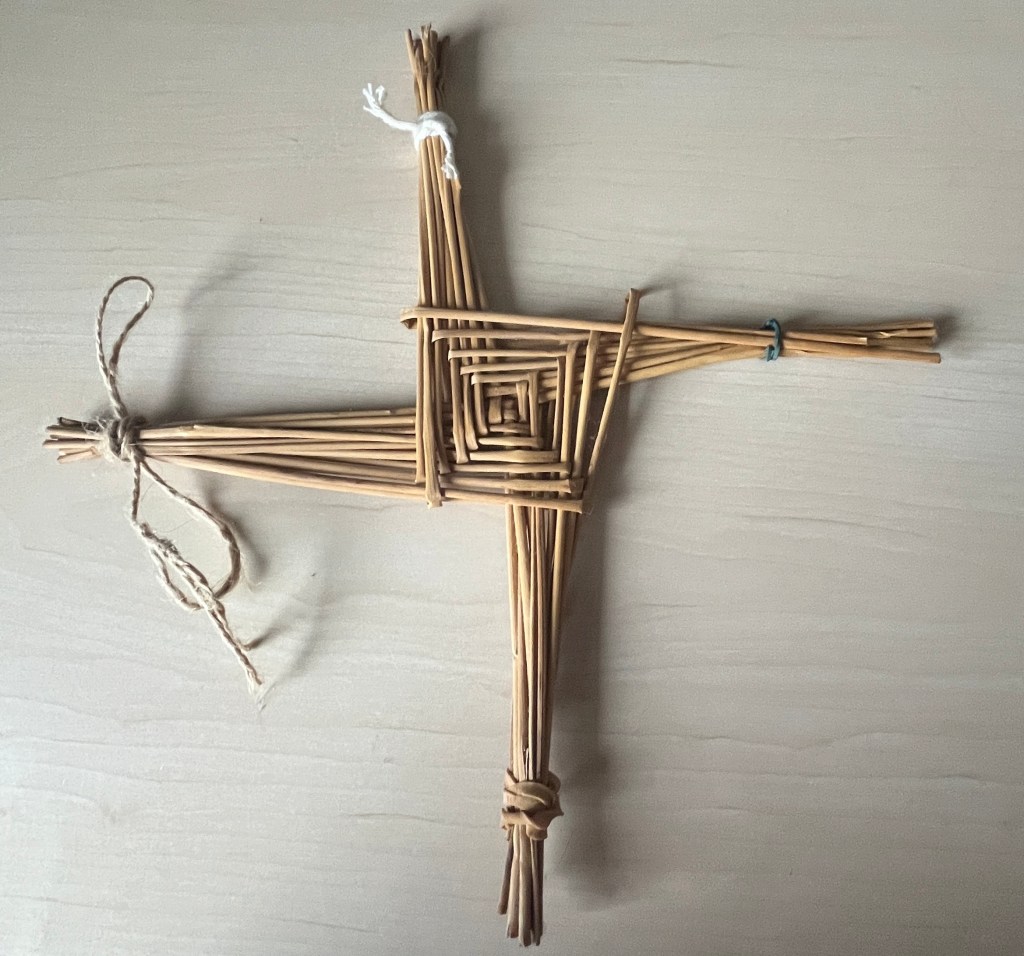
It’s been a long time since I last made a Brigid’s cross – I have one that I made about 30 years ago in Derry. I can’t exactly remember what the circumstances of its making were, but I have carried that long-faded little cross about with me through various abodes and incarnations of my life.
My first Brigid’s Cross c. 1994
I’m not about to de-throne that little cross any time soon, but thanks to last night and all the people that were there, I now have several successors lined up. When I arrived in Rotten Mountain, I was immediately made welcome – you’d think I’d only been away for a week or two, instead of, essentially, decades. I was regaled with tales about my father, who was the local GP in that area for years and years, but everyone was focussed on the business of the evening. The central table was piled with rushes. There were fertiliser bags of them stacked about. But if I’d had any notion that I could sit back and enjoy the spectacle and skill of the makers – not a chance. I was there to make my own cross. So I did.
JH’s mastery …
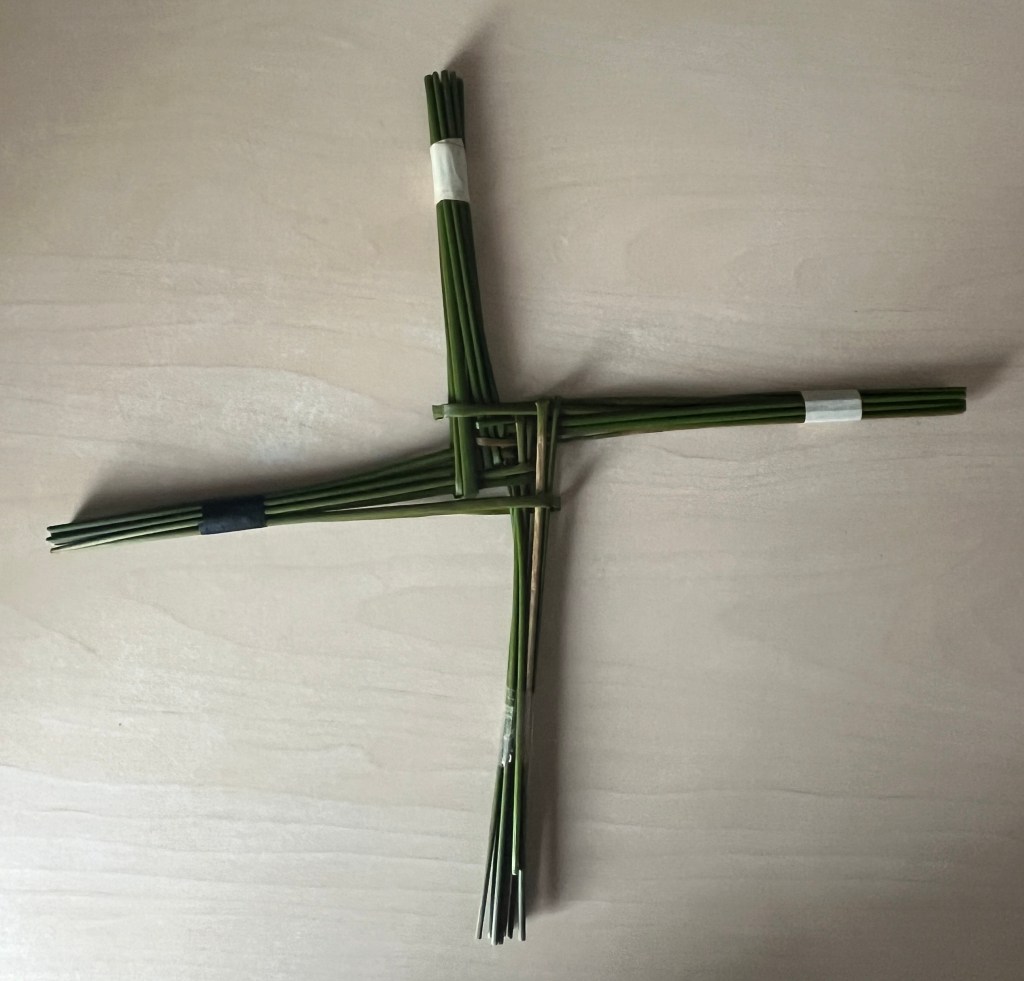
After a couple of, shall we say, sloppy attempts, JH took me under his wing and gave me the benefit of his expertise. I learned to line up the rush horizontally, and in front of the intersect that I held in my left hand, while reaching round with my right to fold the horizontal over. Then rotate – while avoiding putting your neighbour’s eye out with the waving end of a rush – and repeat. I was hampered by the lack of strength of my left hand grip – I overheard Danny instructing a grandson - a primary school child – to hold it tight to stop everything falling apart. I had the same problem. The central quadrangle – mine was far too mobile to be called a square – kept sliding and angling out of my grip. JH’s were as regular and symmetrical as if they had been machine-made. The layered lines of their centre piece were works of art. Mine – not so much. But as everyone kept making them, and the completed crosses were stacked on a surface, or sequestered into a bag – for distribution to friends and family – I began to realise that perfection wasn’t the point. Continuing the tradition was, the weaving and interweaving of time and generation. To make something that had grown out of the past but was shaped by one’s own self.
Exhibit A: a study in miniature (M.Montague)
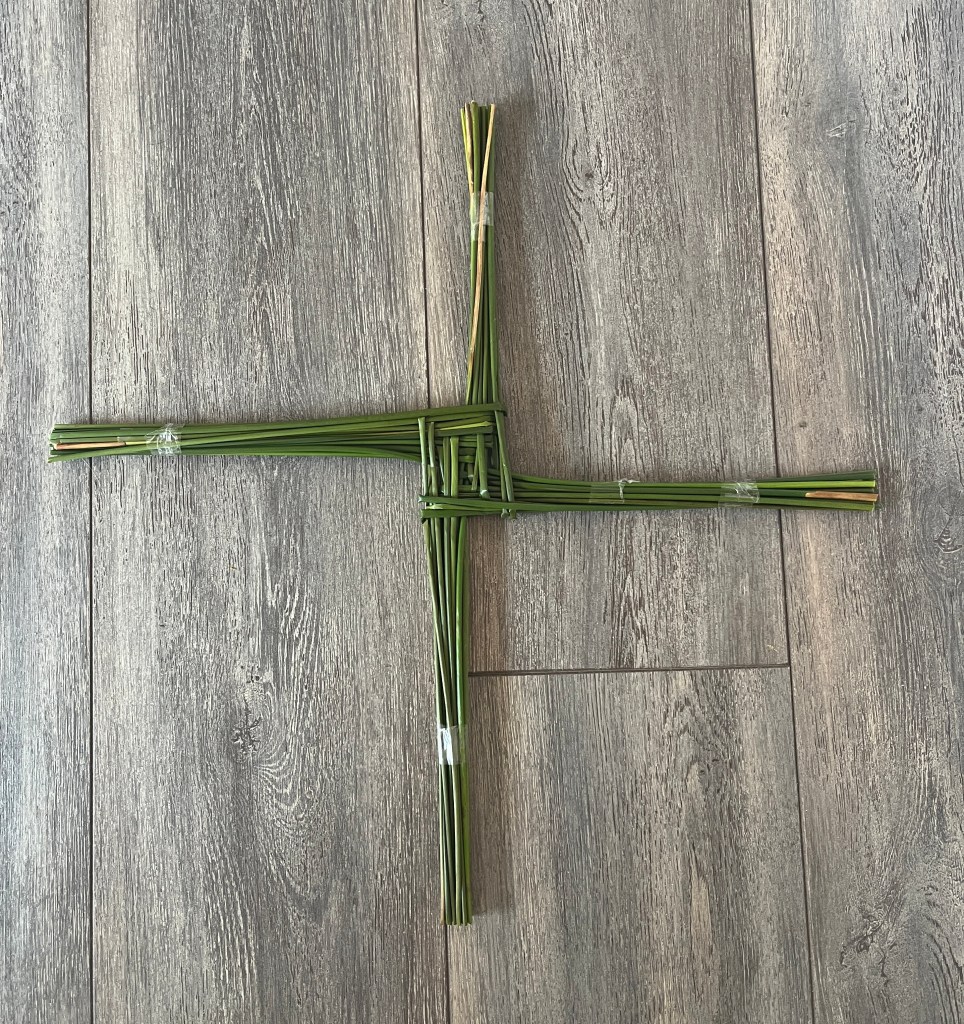
The evening was rounded off in the traditional way with tea and sandwiches, cakes and buns, and a lot of poetry and song. I had such a good time. I headed home under a huge waning gibbous moon with four fresh Brigid’s crosses. Thanks a million to Mena, and to Danny & Fidelma, and everyone there.
Exhibit B: later work, on a larger scale (M. Montague).
My poem Requiem had the honour of being selected for publication by the late Eavan Boland during her editorship of Poetry Ireland Review. It was published in the last volume of Poetry Ireland Review (129) of 2019. It was subsequently chosen for publication in the groundbreaking collection Queering the Green (Lifeboat Press 2021) by editor Paul Maddern.
Now Requiem has been published in German! It has been translated by Gabriele Kreuzner and is given prominence in Demenz das Magazin, a publication for people with dementia, and their carers and advocates. The hard copy of the magazine arrived on my mat over the weekend (accompanied, it has to be said, by much, presumably post-Brexit, paperwork).
This translation and publication has a special place in my heart. My late father, who is the subject of Requiem, suffered from vascular dementia. My late mother also had dementia, most likely Alzheimer’s disease (there was no post mortem, so any plaques were unidentified, but she fitted the profile). So it is particularly affirming that my poem has spoken across geography and language. Dementia is such a horrible condition that robs us of our loved ones before they die, and robs them of their former selves. But there is a little comfort in the thought that my parents may be resonating in the minds of others and not just in my own. And that my Dad continues to walk Rosnowlagh Strand as stubbornly as he did that long ago September afternoon
Many thanks to Cherry Smyth for suggesting the translation to Oliver Schulz, to Oliver himself for steering it, and to Gabriele for her faithful rendition. I am truly moved by this honour.
I was so busy before Christmas that I didn’t get the chance to announce some happy news. I was successful in my application for a “Support for the Individual Artist” award from the Arts Council of Northern Ireland. I’m going to use this grant to support my reflections on the natural world in the form of series of essays. I am so grateful to the ACNI for this award and am buoyed up at the thought of exploring the natural world in a new form.
My latest Country Diary for The Guardian is about stories embodied by three churches, in one of my favourite parts of the world. And about birds, of course.
The dollaghan is a variety of brown trout, unique to Lough Neagh, and “islanded” there since the last Ice Age. This is my latest Country Diary, in which they are the key that unlocks a mysterious world, constantly under threat, and even more so given the current crisis at Lough Neagh.
The Six Mile Water River
Many thanks to: David Kennedy, Development Officer of Crumlin & District Angling Association (and addressing some of the issues that anglers are contesting in the second letter here); Jim Gregg of the Six Mile Water Trust, who took me under his wing, allowing me to experience a magical evening; as well as Micheal Martin, with Andy and Ethan. The dollaghan are such a beautiful fish. Here’s the one that was caught that evening in all its freckled gunmetal and gold.
A dollaghan, weighing about one and three quarters pounds
Many thanks also to the Country Diary editor, Paul Fleckney